Folkstrings.com is reader-supported. When you buy through links on our site, we may earn a small commission.
Choosing between a lyre harp, lever harp, and Celtic harp can feel overwhelming for anyone new to these beautiful instruments.
Each type offers different features, price points, and playing experiences that suit various skill levels and musical goals.
The Celtic harp and lever harp are actually the same instrument with different names, while the lyre harp is a distinct, smaller, and more affordable option that functions differently.
Understanding these differences helps players make informed decisions based on their budget, portability needs, and musical ambitions.
This guide breaks down what makes each harp unique and compares their sound quality and design.
Whether someone wants an affordable entry point for learning or plans to pursue serious harp study, knowing the distinctions between these instruments makes the selection process much simpler.
Table of Contents
- Lyre Harp Explained
- Lever Harp Explained
- Celtic Harp Explained
- Key Differences at a Glance
- Which Harp Should YOU Buy?
- Frequently Asked Questions
- Final Recommendations
Lyre Harp Explained
A lyre harp is a small stringed instrument with an ancient harp design that dates back thousands of years to Greek and Mesopotamian cultures.
Modern versions have become popular among musicians seeking a portable harp option that’s easy to carry and play anywhere.
Most lyre harps feature between 7 and 19 strings, with the 16 string lyre harp being a common choice for players who want more melodic range.
The instrument typically measures 12-18 inches tall and weighs just 1-3 pounds, making it incredibly portable compared to traditional harps.
The strings attach to tuning pegs at the top and pass through the soundboard to metal ball ends, similar to guitar construction.
Players can hold the instrument in their lap, rest it on a table, or use a hand strap for standing positions.
Plucking can be done with fingers or a plectrum.
Pros of lyre harps:
- Budget-friendly pricing from $60-150 makes them an accessible budget harp option
- Lightweight and easy to transport
- Simple learning curve for absolute beginners
- No formal training required to start playing
Cons to consider:
- Limited note range compared to full-sized harps
- Basic sound quality that lacks depth
- Cannot quickly change keys during playing
- Smaller string count restricts complex pieces
A beginner lyre harp comes tuned to pentatonic or diatonic scales, with chromatic versions available for advanced players.
The instrument requires a tuning wrench for any pitch adjustments.
Lever Harp Explained
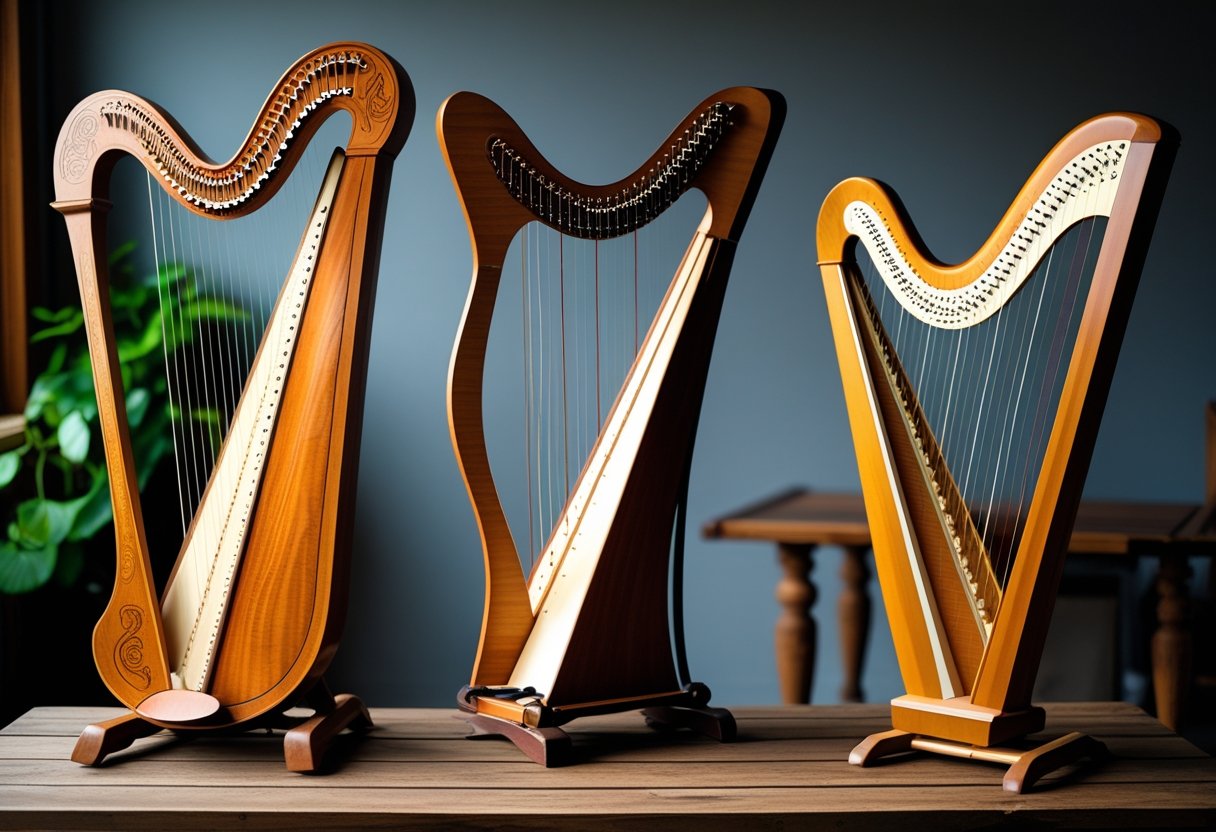
The lever harp, often called a folk harp, is a medium-sized stringed instrument that sits between entry-level harps and professional pedal harps.
It typically features between 22 and 36 strings, offering players a substantial musical range without the bulk of concert instruments.
What sets this instrument apart is its sharping levers mounted on each string near the tuning pins.
These mechanical levers allow players to raise the pitch of individual strings by a semitone, enabling key changes and chromatic notes.
This feature makes the instrument significantly more versatile than simpler harps without requiring the complex pedal mechanisms found on orchestral models.
A celtic lever harp generally ranges from $500 to $2,500, positioning it as a semi-professional harp suitable for serious students and performing musicians.
The 36 string harp represents the larger end of this category, providing nearly the same range as smaller pedal harps.
Key advantages include:
- Full diatonic range with chromatic capabilities
- Excellent for Celtic and folk music traditions
- More portable than pedal harps
- Professional sound quality for performances
Considerations for buyers:
- Higher price point than beginner instruments
- Weighs more than smaller lap harps
- Requires more skill to master lever changes while playing
- Regular maintenance needed for lever mechanisms
Celtic Harp Explained
The Celtic harp is a stringed instrument deeply rooted in Irish, Scottish, and Welsh musical traditions.
Known as the Irish harp in Ireland and the clarsach in Scotland, this instrument has been central to folk music for centuries.
Celtic harp and lever harp are terms often used interchangeably, though Celtic typically refers to the musical style and cultural tradition rather than a distinct instrument type.
A traditional Celtic harp can be either a lever harp or a pedal harp, depending on the mechanism used for changing keys.
The instrument features strings that players pluck with their fingers to create resonant, melodic tones.
Most Celtic harps sit on the floor while the musician sits on a chair or stool, though smaller models can rest on the lap.
They typically range from 22 to 38 strings, with 29-30 strings being common for intermediate to advanced players.
Key characteristics:
- Wire or nylon strings producing warm, rich tones
- Lever mechanisms for semi-tone adjustments
- Smaller and more portable than concert pedal harps
- Designed specifically for folk and traditional music
Advantages:
- Beautiful, authentic sound for traditional music
- Professional harp quality suitable for performances
- Available in various sizes for different skill levels
Disadvantages:
- Price range typically spans $1,000 to $5,000 or more
- Requires dedicated lessons and practice time
- Can be large and heavy, making transport challenging
Key Differences at a Glance
The Celtic harp, lever harp, and lyre harp each offer distinct characteristics that appeal to different musicians.
Understanding these differences helps players choose the right instrument for their needs.
Size and Portability
Lyre harps are the most compact option, easily fitting in a lap or small bag.
Lever harps sit at a medium size, manageable but requiring more space.
Celtic harps (pedal harps) are the largest, often standing five to six feet tall and weighing up to 80 pounds, making them stationary instruments best suited for home or studio use.
String Count and Range
- Lyre harps: 6-30 strings, limited range
- Lever harps: 22-36 strings, full diatonic scale
- Celtic harps: 40-47 strings, extensive range
The string count directly impacts the variety of music each instrument can play.
Types of Small Harp offer more limited ranges compared to their larger counterparts.
Price Comparison
Lyre harps are the most affordable at $60-$150, making them accessible entry points.
Lever harps range from $500-$2,500, while Celtic pedal harps start at $1,000 and can exceed $5,000 for professional models.
Skill Level Considerations
Lyre harps suit beginners with their simpler design and fewer strings.
Lever harps work well for intermediate players developing their technique.
Celtic harps require advanced skills due to their size, complexity, and pedal mechanisms for key changes.
Which Harp Should YOU Buy?
The best harp for beginners depends on budget, musical goals, and commitment level.
A clear understanding of these factors makes the decision straightforward.
If working with a tight budget (under $100), a lyre harp is the practical choice.
These compact instruments let absolute beginners explore harp music without a major financial commitment.
Buying a harp for beginners requires balancing affordability with quality.
For serious learners with $500-1500 to invest, a lever harp offers the right balance.
These instruments provide enough range for both folk and classical pieces.
A 34-string lever harp works well for those planning to take graded exams or perform regularly.
Children and casual learners benefit most from starting with a lyre harp.
The smaller size and lighter weight make practice sessions less physically demanding.
String configurations of 21 or 27 strings give enough range to play recognizable songs without overwhelming new players.
Players with professional aspirations and larger budgets should consider 36 to 38-string Celtic harps.
These instruments start around $6,995 new but offer the tonal quality and range needed for advanced repertoire.
Used options provide cost savings, with 34-string models starting around $4,150.
| Budget | Experience Level | Recommended Harp |
|---|---|---|
| Under $100 | Absolute beginner | Lyre harp |
| $500-1500 | Serious learner | 34-string lever harp |
| $1500+ | Intermediate/Advanced | Celtic lever harp |
| Any | Children/Casual | Lyre harp |
Portability matters too.
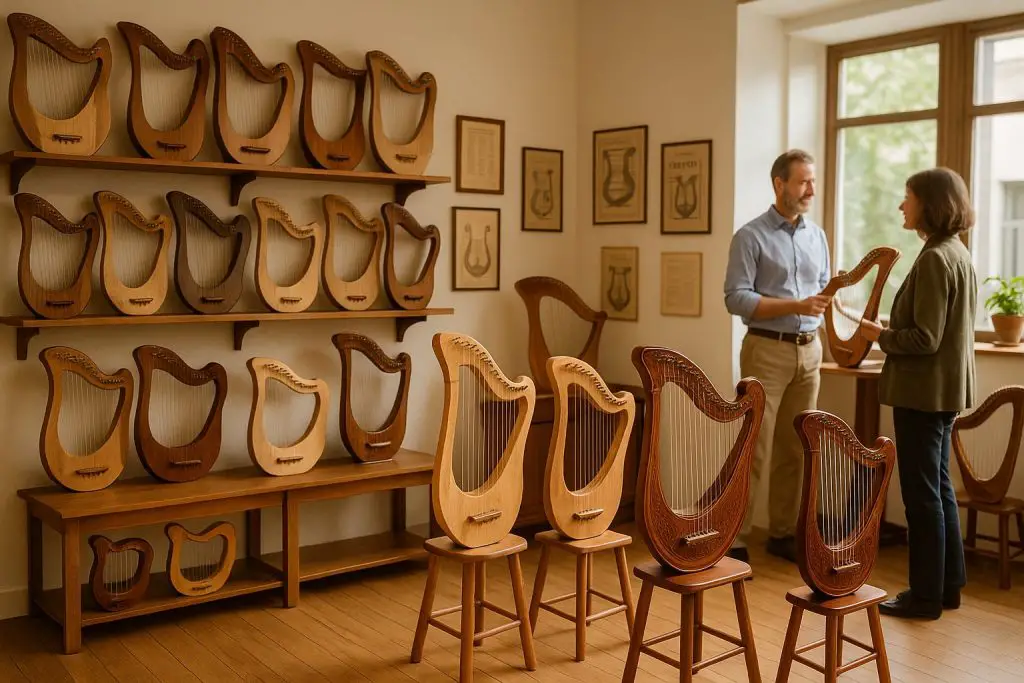
Knee harps transport easily to lessons and performances, while floor harps deliver fuller sound but require dedicated space.
Testing different models before purchasing helps identify which size and string tension feels most comfortable.
Frequently Asked Questions
Is a Celtic harp the same as a lever harp?
These terms are often used interchangeably, and for good reason.
A Celtic harp is a type of lever harp, named for its historical association with Celtic music and culture.
The defining feature is the use of sharpening levers that allow players to change pitch on individual strings.
Both terms describe smaller, portable harps that differ from large pedal harps used in orchestras.
Some people prefer “folk harp” as another alternative name for the same instrument.
Can you play Celtic music on a lyre harp?
Celtic music can be adapted for lyre harp, though with some limitations.
The lyre’s smaller string count and different tuning systems mean players need to simplify arrangements or transpose pieces.
Many traditional Celtic tunes work well on pentatonic or diatonic lyre harps, especially slower airs and melodies.
However, complex Celtic pieces that require quick key changes or a wide range of notes prove challenging.
The lyre harp’s portability makes it appealing for casual playing of Celtic-inspired music.
What’s easier to learn: lyre or lever harp?
Lyre harp difficulty is generally lower for complete beginners due to fewer strings and simpler playing positions.
Most lyre harps have 16-22 strings compared to 22-38 strings on lever harps.
The lyre’s lap-friendly size makes it less physically demanding to hold and play.
Lever harps require more finger independence and coordination but offer greater musical range.
Both instruments sound pleasant even during early learning stages, which helps maintain motivation.
Which type of harp has better resale value?
Lever harps typically maintain better resale value than lyre harps.
Quality lever harps from established makers hold 50-70% of their original value when well-maintained.
Lyre harps, being newer to the market and often produced at lower price points, depreciate more quickly.
Premium handcrafted lyre harps from reputable builders retain value better than mass-produced models.
The lever harp market is more established with recognized brands, making pricing more stable and predictable for resale.
Do I need lessons to learn the harp?
Many people successfully learn harp at home using online resources, books, and video tutorials.
However, lessons provide valuable feedback on hand position and technique that prevents bad habits.
Both in-person and online instruction options exist for all harp types.
Self-teaching works well for casual players focusing on simple melodies.
Those pursuing advanced repertoire benefit significantly from professional guidance.
The choice depends on musical goals, learning style, and budget constraints.
Final Recommendations
Choosing between these three harp types depends on individual goals and commitment level.
Lyre harps serve as an excellent entry point for those uncertain about pursuing the harp long-term.
They’re affordable, portable, and require minimal space.
Quick Selection Guide:
- Lyre Harp: Best for curious beginners, hobbyists, and those wanting to explore harp music without significant investment
- Lever Harp: Ideal for serious students ready to develop proper technique and expand their repertoire
- Celtic Harp: Suited for dedicated musicians pursuing traditional Irish and Scottish music styles
Many accomplished musicians began their journey with affordable starter instruments.
The progression from lyre to lever to Celtic harp represents a natural path as skills and commitment grow.
Some players skip directly to lever harps if they’re certain about their musical direction.
Budget considerations play a significant role in harp buying recommendations.
Lyre harps under $100 make excellent testing grounds.
Lever harps require more investment but offer greater versatility and longevity.
Players focused on Celtic music traditions should eventually transition to a Celtic harp for authentic sound and playing technique.
Those interested in broader musical styles might prefer a lever harp’s flexibility.
Understanding key features before purchasing helps avoid costly mistakes.
The beginner to professional harp journey doesn’t demand starting with the most expensive instrument.
Exploring various options helps new players find their perfect match.
Author Profile