
Irish String Instruments: A Guide to Traditional Music-Making in Ireland
Folkstrings.com is reader-supported. When you buy through links on our site, we may earn a small commission.
Last Updated on July 3, 2026 by folkstrings
Irish traditional music has one of the most distinctive instrumental voices in folk music — and a lot of that distinctiveness comes from how string instruments are used in it. The Irish approach to fiddle, bouzouki, and even banjo has evolved into something genuinely its own, shaped by the specific demands of the session tradition and the ornamentation patterns that define the style. Having played folk instruments for over twenty years, including autoharp, mandolin and harp, I find the Irish string tradition endlessly interesting — particularly how instruments borrowed from other traditions (bouzouki from Greece, banjo from America) have been completely reimagined in an Irish context.
History of Irish String Instruments
The Celtic harp is the oldest of the Irish string instruments and has been documented in Ireland since at least the 10th century. The wire-strung harp — using metal rather than gut or nylon strings — was the primary Irish form until the 18th century, producing a bright, bell-like tone that was quite different from the gut-strung harps of mainland Europe. The suppression of Gaelic culture under English rule, particularly after the Cromwellian period, led to a significant decline in professional harp playing. By the time Edward Bunting began collecting Irish harp music at the Belfast Harp Festival of 1792, the tradition was nearly extinct.
The fiddle became the dominant melody instrument in Irish traditional music from the 18th century onward, largely because violins were more affordable and portable than harps. The banjo arrived in Ireland in the early 20th century via returning emigrants who had encountered it in America, and the bouzouki arrived in the 1960s when Irish musicians discovered the Greek instrument and adapted it for accompanying traditional tunes. This pattern of absorbing instruments from outside and reshaping them in an Irish context is one of the most distinctive features of the tradition.
Types of Irish String Instruments
Harp
The harp is Ireland’s national symbol and its oldest documented string instrument. Modern Irish folk musicians generally play the lever harp (also called the Celtic harp) rather than the historical wire-strung version, though there has been a revival of interest in wire-strung playing since the 1970s. The lever harp uses nylon or gut strings and is capable of playing in multiple keys by engaging small levers on individual strings. Players like Gráinne Hambly and Laoise Kelly have developed the harp as a serious session instrument rather than just a solo or concert one. If you’re interested in the harp specifically, the small lever harp is a good starting point — we cover the best options in our small harps buying guide.
Fiddle
The fiddle is the dominant melody instrument in Irish traditional music and is physically identical to a classical violin — the difference is entirely in how it’s played. Irish fiddling uses a distinctive bowing style, more continuous and driven than classical playing, with specific ornamentation techniques like cuts, rolls, and trebles that aren’t part of the classical vocabulary. Regional styles also vary significantly: the Sligo style (associated with Michael Coleman) is fast and highly ornamented; the Clare style (associated with Martin Hayes) is more lyrical and spacious; the Donegal style shows Scottish influences in its bowing.
Banjo
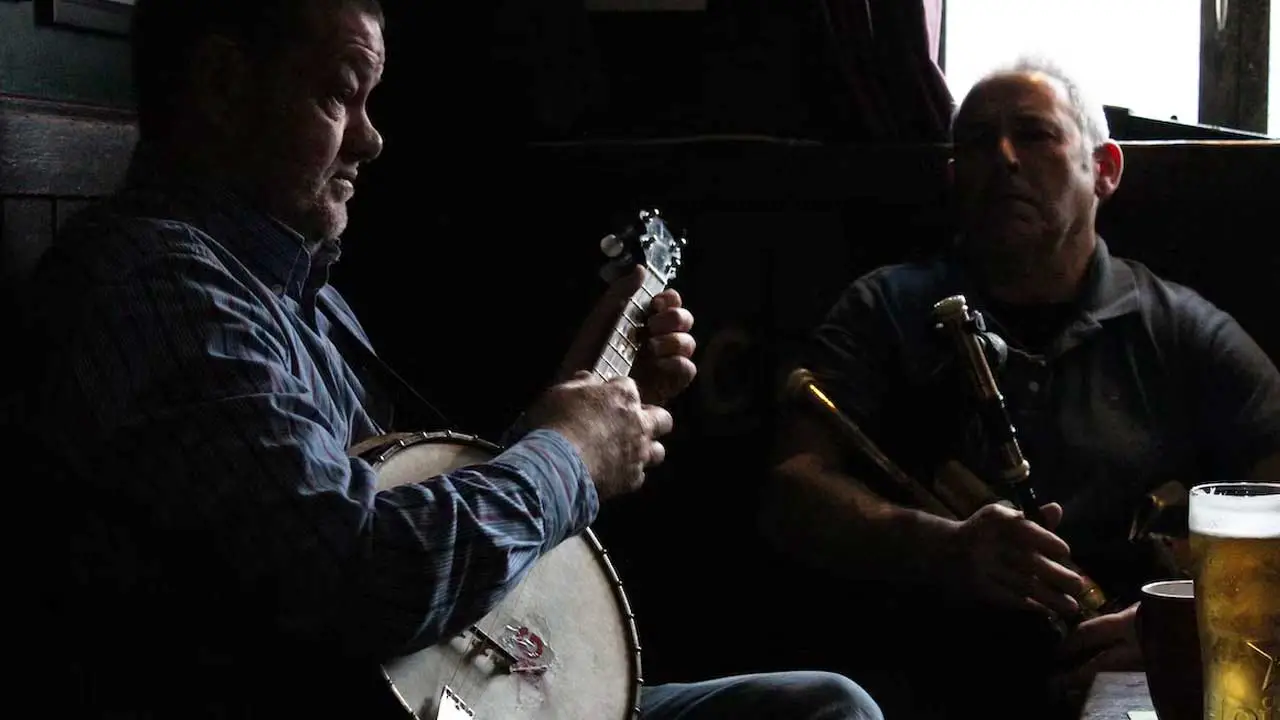
The Irish tenor banjo is a four-string instrument tuned in fifths (GDAE, same as the fiddle and mandola), which means fiddle players can transfer their knowledge directly. This is one reason it was adopted so quickly into Irish sessions — musicians who already knew the tunes could play them immediately without learning a new note layout. The Irish tenor banjo style is quite different from American bluegrass banjo; it’s played with a plectrum rather than fingerpicks, and the focus is on single-string melody playing rather than the roll patterns of bluegrass. Gerry O’Connor and Mick Moloney are the key players to listen to for classic Irish tenor banjo style.
Bouzouki
The Irish bouzouki is arguably the most interesting story in Irish folk music — a Greek instrument, completely reimagined. Johnny Moynihan of Sweeney’s Men was the first to bring the Greek bouzouki into Irish folk in the mid-1960s, followed quickly by Andy Irvine, who adapted it more fully to an Irish accompaniment role. Dónal Lunny and Alec Finn (of De Dannan) developed it further into the instrument it is today. The Irish bouzouki typically has eight strings arranged in four pairs, tuned differently from the Greek version, and is used primarily as a rhythmic and harmonic accompaniment instrument rather than a melody instrument. Its distinctive chopped chord patterns are one of the defining sounds of contemporary Irish folk.
Mandolin
The mandolin shares the same GDAE tuning as the fiddle and tenor banjo, which again made it an easy addition to Irish sessions. It’s used primarily as a melody instrument, and the best Irish mandolin players bring the same ornamentation and bowing-equivalent techniques from fiddle playing into their picking style. Donogh Hennessy and Declan Folan are worth listening to for contemporary Irish mandolin. The instrument works particularly well for reels, where its bright, fast attack suits the style.
Dulcimer
It’s worth being precise here: the dulcimer is not a primary Irish instrument in the way the fiddle or bouzouki is. The hammered dulcimer has some presence in Irish folk — primarily through players who have imported it from other traditions — but it’s not traditional in the same sense. The mountain dulcimer (Appalachian dulcimer) is even less associated with Ireland. That said, it’s used by some contemporary Irish folk players and fits well with the modal nature of many Irish tunes. If you’re interested in the dulcimer specifically, we cover it in detail in our dulcimer guides.
Other Instruments in Traditional Irish Music
The uilleann pipes are the most distinctively Irish of all traditional instruments — a bellows-blown bagpipe with a softer, more expressive tone than Scottish Highland pipes. The Irish flute (a simple-system wooden flute) and tin whistle are the most common melody instruments in sessions alongside the fiddle. The bodhrán (a frame drum played with a tipper) provides rhythm. The concertina — particularly the Anglo concertina — is strongly associated with traditional Irish music, especially in County Clare. These aren’t string instruments but they’re the ensemble context in which Irish string players operate.
Key Figures in Irish String Music
Alec Finn
Alec Finn (1944–2022) was the bouzouki player in De Dannan, one of the most influential Irish traditional bands of the 1970s and 1980s. He was largely responsible for establishing the bouzouki as a serious accompaniment instrument in Irish music and developed a sophisticated harmonic approach that went well beyond simple chord strumming. His playing on De Dannan’s early recordings remains some of the finest Irish bouzouki work on record.
Dónal Lunny
Dónal Lunny is arguably the single most influential figure in the development of modern Irish folk accompaniment. A founding member of Planxty and The Bothy Band, and later MOVING HEARTS, he pioneered the use of bouzouki, guitar, and bodhrán in Irish folk contexts and almost single-handedly defined how those instruments sound in a traditional session. His approach to rhythmic accompaniment — driving, percussive, harmonically sophisticated — became the template that most Irish folk accompanists have worked from since the 1970s.
Martin Hayes
Martin Hayes is the defining figure of the Clare fiddle style and one of the most recorded Irish fiddlers of his generation. His approach — slower tempos, long sustained notes, minimal ornamentation — creates a meditative quality that’s quite different from the flashier Sligo or Donegal styles. His long-running partnership with guitarist Dennis Cahill, and more recently with the Gloaming, brought Irish fiddle playing to a wider international audience.
Frequently Asked Questions
What is the main string instrument in Irish traditional music?
The fiddle is the primary melody instrument in Irish traditional music and the most commonly heard string instrument in sessions. The bouzouki has become the dominant accompaniment string instrument since the 1970s, replacing or supplementing guitar in many contexts.
What is the 8-string Irish instrument?
This is almost certainly the Irish bouzouki, which typically has eight strings arranged in four pairs (courses). It’s sometimes confused with the mandola or cittern, which can also have eight strings, but the bouzouki’s longer scale length and specific Irish tunings make it distinct.
Are Irish fiddles different from regular violins?
Physically, no — an Irish fiddle is a standard violin. The difference is in technique, style and ornamentation. Irish fiddlers typically use a slightly looser bow hold, specific bowing patterns suited to jigs and reels, and ornamental techniques (cuts, rolls, trebles) that aren’t used in classical playing. Some fiddlers prefer a slightly flatter bridge to make double stopping easier, but this is a personal preference rather than a standard modification.
What is the easiest Irish string instrument to learn?
The tenor banjo or mandolin are probably the most accessible entry points if you already play guitar or any GDAE-tuned instrument, since the note layout transfers directly. The fiddle is technically demanding but has the most teaching resources available. The bouzouki is relatively straightforward to begin with as an accompaniment instrument if you understand chord theory, but developing a genuinely idiomatic Irish bouzouki style takes years.
Author Profile

- Daniel Johnstone — Dániel to his friends back in Miskolc — is a Hungarian folk musician and writer who has been playing stringed instruments for over twenty years. Growing up in northeastern Hungary with a family steeped in folk music, he developed an early obsession with Celtic and Appalachian styles that eventually brought him to the UK. He worked his way through tenor banjo, 5-string banjo, autoharp, mountain dulcimer, mandolin, ukulele, harp and kalimba — most of them acquired through trial, error and more money than he'd like to admit. He founded Folkstrings.com to cut through the noise: practical, experience-based guides to instruments, strings, gear and accessories for folk players at every level.
Latest entries
 BanjoJuly 14, 2026Is Banjo Hard to Learn? Here’s What Nobody Tells You
 MandolinJuly 14, 2026Online Mandolin Lessons — What YouTube Can’t Teach You (And What Can)
 Useful ToolsJuly 13, 2026Recorder Fingering Chart — Complete Guide for Soprano Recorder (Baroque and German)
 UkuleleJuly 12, 2026Gifts For Ukulele Players: 10 Best Picks