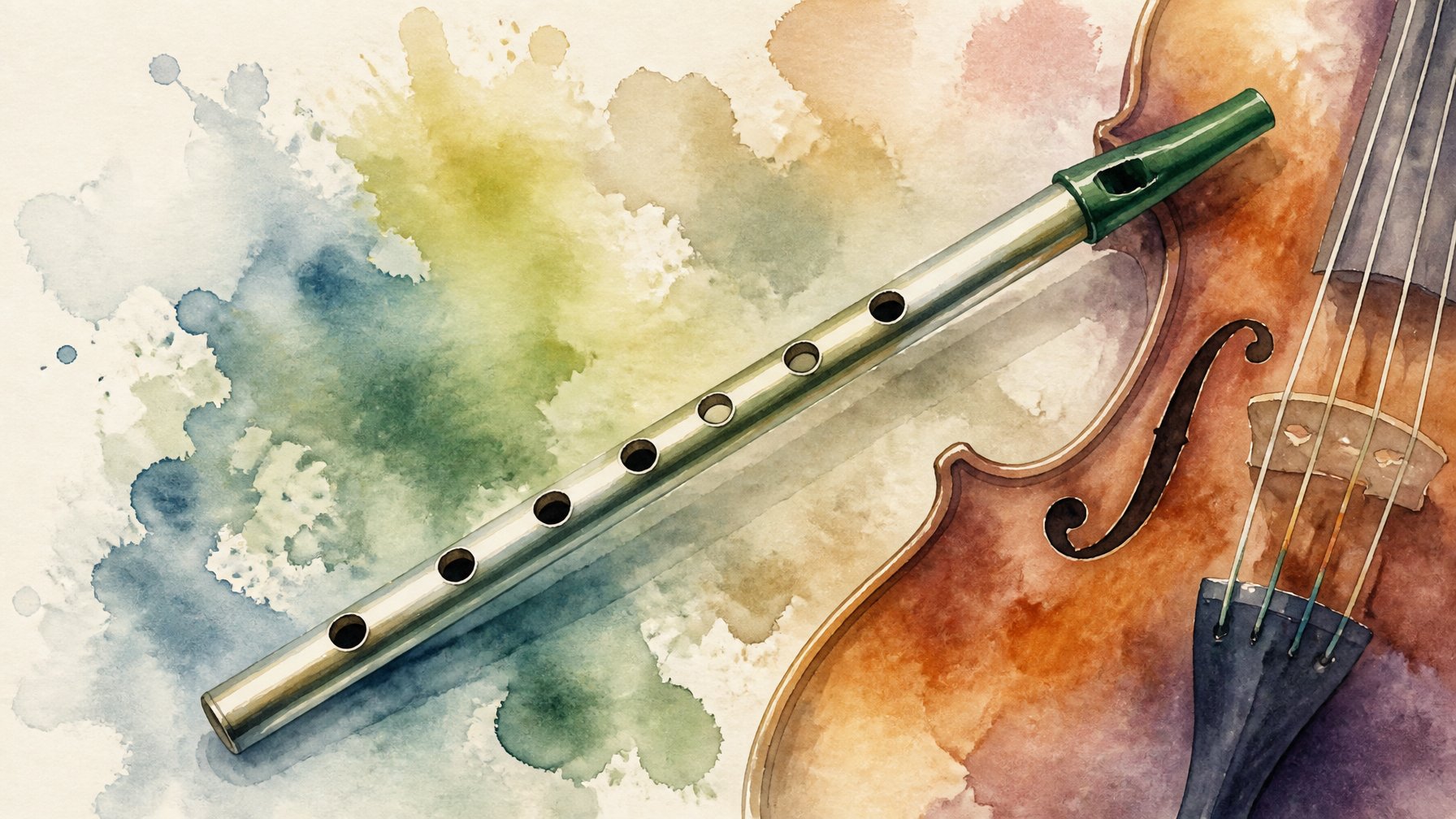
Tin Whistle Fingering Chart — All Notes in Both Octaves (D and C Whistle)
Folkstrings.com is reader-supported. When you buy through links on our site, we may earn a small commission.
Last Updated on July 11, 2026 by folkstrings
Tin Whistle Fingering Chart
Standard D whistle — all notes in both octaves
Tin Whistle Notes — What You Are Actually Playing
A standard D tin whistle plays the D major scale in its natural range, plus a C natural (flat seventh) that gives access to the G major scale as well. With both octaves available, the full range runs from D4 up to D6 — two complete octaves. Most traditional Irish, folk and session music sits comfortably within this range.
How the Two Octaves Work
The tin whistle is one of the simplest wind instruments to understand. The fingering positions are identical in both octaves — the only difference is air speed. Blow gently for the lower octave, blow faster and harder for the upper octave. The whistle naturally jumps to the second octave when you increase air pressure. Learning to control this transition cleanly is the main technical challenge for beginners.
If your upper octave notes sound squeaky or shrill, you are blowing too hard. If they sound flat and dull, you are not blowing hard enough. The sweet spot is a firm, steady stream of air — not a blast.
C Natural — The Crossing Note
C natural does not appear in the D major scale, but it is available on a D whistle through a cross-fingering: open the top three holes and close the bottom three. This note is called the flat seventh or crossing note and it allows you to play in the key of G major on a D whistle. It is essential for many Irish trad tunes. An alternative approach is to half-cover the top hole while keeping a C#-like position — exact execution varies between instruments and players.
For more on folk instruments: our folk instrument quiz helps beginners choose where to start, and our tenor banjo capo chart covers key transposition for players moving between instruments.
Author Profile

- Daniel Johnstone is an English writer and folk musician who has been playing stringed instruments for over twenty years. He started on guitar as a teenager before working his way through cavaco, tenor guitar, autoharp, mountain dulcimer, and harp. He founded Folkstrings.com to provide practical, experience-based buying advice for folk instrument players at every level — the kind of guidance he always wished had existed when he was finding his feet.
Latest entries
 Useful ToolsJuly 11, 2026Tin Whistle Fingering Chart — All Notes in Both Octaves (D and C Whistle)
 Useful ToolsJuly 11, 2026Banjo String Gauges — Complete Guide for 5-String, Tenor and Irish Tenor
 Useful ToolsJuly 11, 2026Harp String Chart — How to Identify and Replace Any Harp String
 Useful ToolsJuly 11, 2026Mountain Dulcimer Chord Chart — Key of D in DAD Tuning