Tenor Banjo Capo Chart — Key Transposition for GDAE and CGDA Tuning
Folkstrings.com is reader-supported. When you buy through links on our site, we may earn a small commission.
Last Updated on July 11, 2026 by folkstrings
Tenor Banjo Capo & Key Transposition Chart
Shows which key you play in at each capo position — for both GDAE (Irish) and CGDA (standard) tuning
| Capo | Open Strings Sound Like | G shape → | D shape → | A shape → | Notes |
|---|
How Tenor Banjo Players Use a Capo
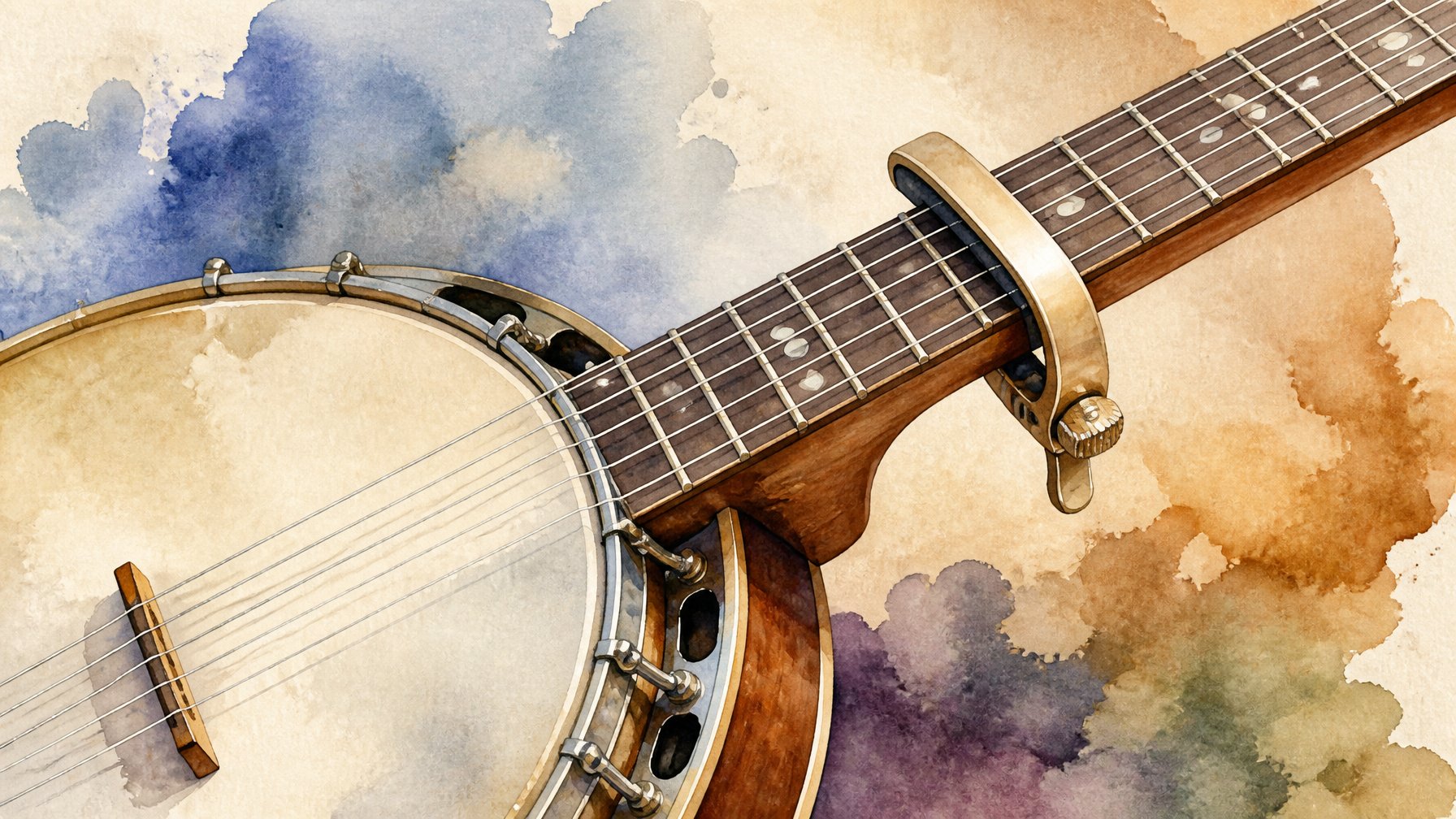
A capo on a tenor banjo works the same way as on a guitar — it clamps across all strings at a given fret, raising the pitch of every string by the same amount. Your chord shapes stay identical; the capo simply moves everything up in pitch. An open G shape gives you G. Capo on fret 2 and that same G shape sounds like A.
In Irish traditional sessions, the most frequently used keys are G, D, A and E. In GDAE tuning, G and D are fully accessible open. Capo 2 gives you A and E — the other two most common session keys. This is why capo 2 is the single most used capo position for Irish tenor banjo players.
GDAE vs CGDA — Which Tuning?
GDAE (Irish tuning) is used almost universally in Irish traditional sessions. It is tuned identically to the violin, viola and mandolin — G, D, A, E from lowest to highest — meaning players transferring from those instruments use the same fingering positions immediately.
CGDA (standard tuning) is used in jazz, Dixieland, and older vaudeville contexts. Method books from the early twentieth century are typically written in CGDA. It is a fourth lower than GDAE throughout.
For more on the tenor banjo in folk and traditional music, see our guide to Irish string instruments.
Author Profile

- Daniel Johnstone is an English writer and folk musician who has been playing stringed instruments for over twenty years. He started on guitar as a teenager before working his way through cavaco, tenor guitar, autoharp, mountain dulcimer, and harp. He founded Folkstrings.com to provide practical, experience-based buying advice for folk instrument players at every level — the kind of guidance he always wished had existed when he was finding his feet.
Latest entries
 Useful ToolsJuly 11, 2026Tin Whistle Fingering Chart — All Notes in Both Octaves (D and C Whistle)
 Useful ToolsJuly 11, 2026Banjo String Gauges — Complete Guide for 5-String, Tenor and Irish Tenor
 Useful ToolsJuly 11, 2026Harp String Chart — How to Identify and Replace Any Harp String
 Useful ToolsJuly 11, 2026Mountain Dulcimer Chord Chart — Key of D in DAD Tuning