The Ultimate Guide to Autoharp Accessories: What You Need to Get Started
Folkstrings.com is reader-supported. When you buy through links on our site, we may earn a small commission.
Last Updated on July 16, 2023 by folkstrings
So you’ve chosen the autoharp, that’s awesome.
More and more people are picking up the autoharp as a hobby, and it can be a fun way to spend your free time not to mention the beautiful sound it gives out. However, even though the autoharp is relatively easy to play, it may be worth considering some autoharp accessories to take care of it and get going.
In this short article, I will give a quick guide on what autoharp accessories you should think about getting for the best possible experience with your instrument.
Table of Contents
- The Best Autoharp Accessories for Novice Players
- Caring for Your Autoharp
- Accessories for Cleaning Your Autoharp
- Summary – Autoharp Accessories
If you haven’t yet read our Top 10 Best Autoharps for Beginners, do have a look.
The Best Autoharp Accessories for Novice Players
If you’re a hobbyist, then these are the accessories that will help you get started.
1. Instructional materials
The autoharp is a versatile instrument with many different uses and styles of music – from folk to jazz to classical. In order to play the autoharp well, you’ll need to have some instruction on how it should be played and what kind of tunes should be played on it.
Luckily, there are some books out there with lots of information about the autoharp.
Probably one of the most well-known and recommended books among beginners would be this one.
2. Tuning tools
The strings stretch over time and need to be tuned periodically for optimal sound quality. If you’re a novice player, then you will need a tuning wrench or an electronic tuner that can be used without a jack input or amplifier input.
If you’re a more advanced player, then these two types of tuning tools may not work for you and instead what’s needed is a capo or pitch pipe.
3. Picks
An essential autoharp accessory for any stringed instrument picks come in both metal and plastic varieties and offer different playing surfaces depending on your preference.
Picks can either be finger-style or thumb-style depending on how close your hand is to the strings when picking them.
4. Case
It goes without saying that an autoharp needs a case to keep it protected from the elements and from getting damaged. Case sizes can vary, but It’s best to get a case that fits all of the extra little bits you will need to play and maintain your instrument so as they don’t get lost or misplaced between sessions.
Think about this Oscar Shmidt case which is padded and has ample pocket space for books and small accessories.
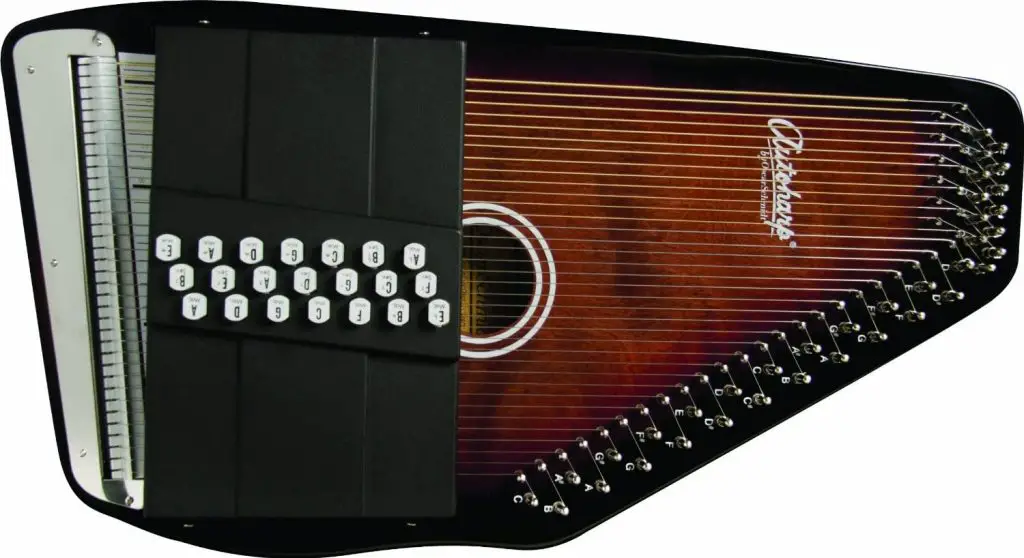
Caring for Your Autoharp
Accessories for Cleaning Your Autoharp
Your autoharp is going to get dirty every now and then. It’s important to keep it clean and in good shape free from dust.
I would advise you to stay away from using any harsh chemicals to clean your autoharp as it’s likely the chemicals can damage the French polish finish on the instrument. For instance, products containing alcohol or acetone will dissolve the finish.
In most cases, a quick wipe with a simple cheap microfiber cloth can do the trick.
Put one of these in your autoharp case.
If you do go for a polish, go for one that Is recommended by the manufacturer. Do not apply the solution directly to the instrument, apply it to the cloth, and then use it to wipe whatever it is you are trying to clear up.
A soft-bristled brush like a soft toothbrush can be a useful tool to have handy to remove dust and any debris you may have on your autoharp.
Summary – Autoharp Accessories
Hopefully, this article goes some way to help you get an idea of some useful autoharp accessories to make your learning experience a little easier.
Comment below and let us know what’s in your autoharp bag!
Author Profile

- Daniel Johnstone — Dániel to his friends back in Miskolc — is a Hungarian folk musician and writer who has been playing stringed instruments for over twenty years. Growing up in northeastern Hungary with a family steeped in folk music, he developed an early obsession with Celtic and Appalachian styles that eventually brought him to the UK. He worked his way through tenor banjo, 5-string banjo, autoharp, mountain dulcimer, mandolin, ukulele, harp and kalimba — most of them acquired through trial, error and more money than he'd like to admit. He founded Folkstrings.com to cut through the noise: practical, experience-based guides to instruments, strings, gear and accessories for folk players at every level.
Latest entries
 MandolinJuly 14, 2026Online Mandolin Lessons — What YouTube Can’t Teach You (And What Can)
 Useful ToolsJuly 13, 2026Recorder Fingering Chart — Complete Guide for Soprano Recorder (Baroque and German)
 UkuleleJuly 12, 2026Gifts For Ukulele Players: 10 Best Picks
 MandolinJuly 12, 2026Gifts For Mandolin Players: 10 Best Picks