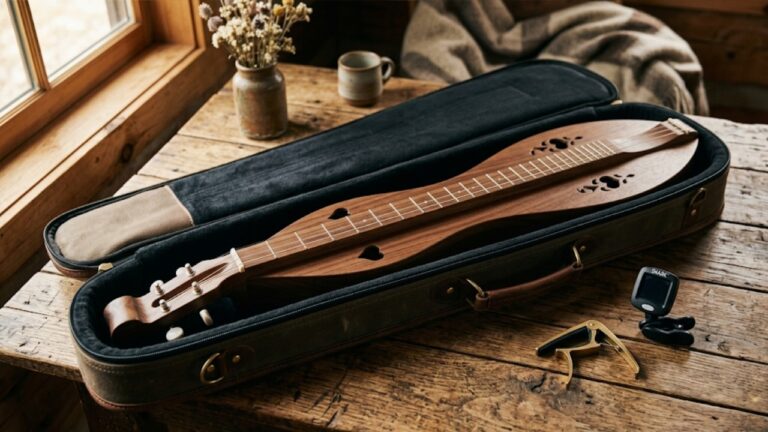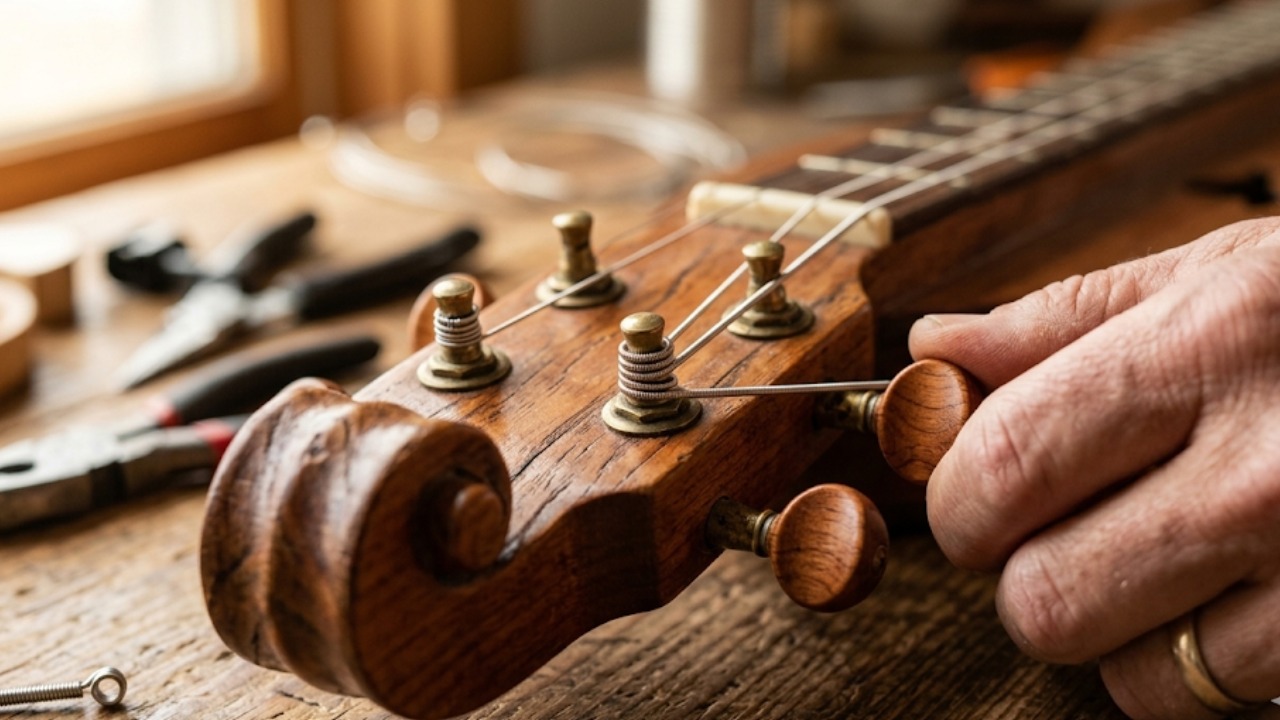
Mountain Dulcimer Strings: What to Buy and Why It Matters
Folkstrings.com is reader-supported. When you buy through links on our site, we may earn a small commission.
Last Updated on June 9, 2026 by folkstrings
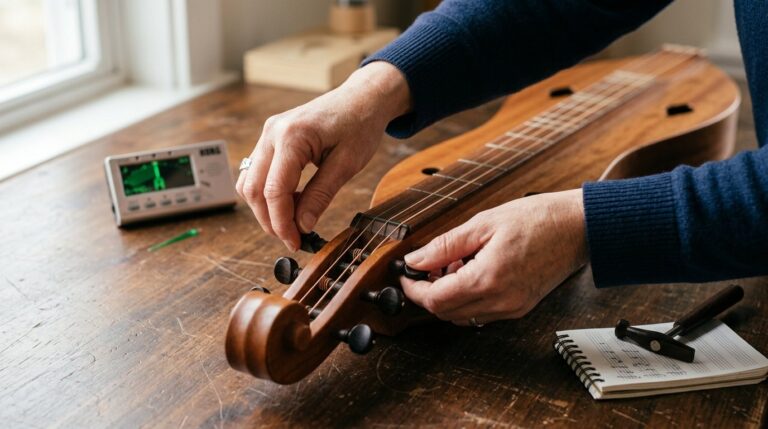
Strings are one of those things that most dulcimer players don’t think about until they break one — and then suddenly it becomes urgent. But choosing the right mountain dulcimer strings matters beyond just replacing what snapped. The gauge, the winding, and even the end type all affect how your instrument feels to play and how it sounds. Getting this right is worth a few minutes of attention.
I’ve restrung enough folk instruments over the years to have opinions on this. What follows is what I’d actually buy, and why.
Quick Comparison
| D’Addario EJ64 ★ Best Overall |
Folkcraft Ball End | Folkcraft Loop End | |
|---|---|---|---|
| Best for | Most players | Ball end instruments | Loop end instruments |
| End type | Ball | Ball | Loop |
| String count | 4 | 4 | 4 |
| Material | Nickel-wound / plain steel | Plain steel / bronze-wound | Plain steel / bronze-wound |
| Reviews | 1,571 (4.7★) | 70 (4.9★) | 27 (4.9★) |
| Check Price | Check Price | Check Price |
Ball End vs Loop End: Get This Right First
Before anything else, you need to know whether your dulcimer takes ball end or loop end strings. This is the single most important compatibility question, and it trips up a lot of beginners.
Loop end strings have a small metal loop at the tail end that hooks onto a pin or post on the tailpiece. Ball end strings have a solid metal ball — the same as a standard guitar string — and require a tailpiece with slots or holes that can anchor the ball. Many modern dulcimers accept both, but older instruments and some traditional designs are specific. Check your tailpiece before ordering: if the pins are small and upright, you need loop ends. If there are slots or holes in the tailpiece plate, ball ends will work.
If you are not sure, loop end strings are the safer default — they fit more dulcimer configurations than ball ends do.
D’Addario EJ64 4-String Dulcimer Strings — Best Overall
D’Addario make strings for virtually every stringed instrument on the planet, and their dulcimer set is no exception — it’s the best-selling mountain dulcimer string on Amazon by a significant margin, with over 1,500 reviews and Amazon’s Choice status. That kind of sustained popularity in a niche market means something.
The EJ64 is a loop end set with nickel-plated steel strings — three plain steel and one wound bass string. Nickel plating gives a bright, clear tone with good projection, and the medium gauge sits in the right place for most players: responsive enough for light strumming, with enough tension for clear note definition when fretting. The wound bass string has a warm, round character that balances well against the plain treble strings.
One practical note: D’Addario package their strings in individual sealed envelopes within the set, which keeps each string fresh and makes it easy to replace a single string without disturbing the others. A small thing, but it matters if you are the type to snap a melody string mid-session.
Check price — D’Addario EJ64 Dulcimer Strings on Amazon
Folkcraft Mountain Dulcimer String Set, Ball Ends — Best for Ball End Instruments
Folkcraft Instruments have been making dulcimers in the USA since 1968, which gives them a particular authority when it comes to what strings work on their instruments — and mountain dulcimers generally. Their ball end string set is what they sell alongside their own instruments, which is about as strong an endorsement as a string set can have.
The gauges (.011/.011/.013/.024BW) are slightly lighter than the D’Addario set, which means a slightly softer touch and a warmer tone. Nickel-plated winding on the bass string. At 4.9 stars across 70 reviews, the ratings are exceptional — small review count, but an unusually clean signal. These suit players who want a slightly more mellow, folk-oriented sound rather than the brighter projection of the D’Addario set.
The ball end configuration means these are the right choice if your dulcimer has a slotted tailpiece rather than pin-style anchors.
Check price — Folkcraft Mountain Dulcimer Strings, Ball Ends on Amazon
Folkcraft Mountain Dulcimer String Set, Loop Ends — Same Quality, Different Fit
The same Folkcraft string set in loop end configuration. Identical gauges, identical materials, identical tone — the only difference is the tail end fitting. If your dulcimer uses pin-style anchors on the tailpiece, these are the ones to buy rather than the ball end version above.
Worth keeping a spare set of whichever type your instrument takes. Dulcimer strings are not expensive, and having a set in your case means a broken string doesn’t end a session or delay a performance.
Check price — Folkcraft Mountain Dulcimer Strings, Loop Ends on Amazon
Choosing the Right Strings for Your Dulcimer
Gauge and tone
Lighter gauge strings (.009–.011 on the melody strings) are easier to press and produce a softer, warmer tone. Heavier gauges (.012–.014) require more finger pressure but give more volume and note clarity. Both Folkcraft sets use .011 melody strings, which sit toward the lighter end. The D’Addario medium gauge is slightly heavier and brighter. Neither is objectively better — it depends on your playing style and what tone you are after.
Plain vs wound strings
The bass string on a 4-string dulcimer is almost always wound — a plain steel string at that pitch would be impractically thick and hard to play. The melody strings are plain steel. If you are replacing individual strings rather than a full set, make sure you match the wound bass correctly — the gauge needs to match your current setup or you will change the instrument’s balance and intonation.
How often should you change dulcimer strings?
More often than most players do. Strings lose brightness and intonation accuracy as they age — oxidation and playing wear degrade the metal surface gradually. For regular players, every three to six months is a reasonable target. If you play infrequently, once a year. The signs that strings need changing are: dull, lifeless tone; difficulty staying in tune; visible discolouration or corrosion on the windings.
3-string vs 4-string sets
Traditional mountain dulcimers have three strings — one bass and two melody strings tuned in unison. Modern instruments often add a fourth string, giving a bass string plus three melody strings (or sometimes a doubled bass). Check how many strings your dulcimer has before ordering — both D’Addario and Folkcraft make sets for 4-string instruments. If you have a 3-string, you will need to check the specific listing.
Frequently Asked Questions
Can I use guitar strings on a mountain dulcimer?
In principle, individual guitar strings of the right gauge can substitute for dulcimer strings in an emergency. The main issue is the end type — most guitar strings are ball end, which may not fit a loop end tailpiece. You would also need to select gauges that match your dulcimer’s requirements individually rather than buying a matched set. It works as a temporary fix, but I would not recommend it as a regular approach.
Why do my dulcimer strings keep going out of tune?
New strings stretch for the first few days after fitting and will go out of tune frequently until they settle. This is normal — tune up before every session for the first week and they will stabilise. If an instrument that previously held tune is suddenly drifting, the cause is usually worn strings, a loose tuning peg, or a nut slot that is cut too wide. Replacing the strings is always the first thing to try.
Do dulcimer strings come in different materials?
Most mountain dulcimer strings are steel or nickel-plated steel, which suits the instrument’s bright, penetrating tone. Phosphor bronze wound bass strings are available and give a warmer, rounder low end. Pure gut strings exist for players who want a very traditional, mellow sound, but they are harder to find and more sensitive to humidity and temperature changes. For most players, nickel-plated steel is the right starting point.
Author Profile

- Daniel Johnstone is an English writer and folk musician who has been playing stringed instruments for over twenty years. He started on guitar as a teenager before working his way through cavaco, tenor guitar, autoharp, mountain dulcimer, and harp. He founded Folkstrings.com to provide practical, experience-based buying advice for folk instrument players at every level — the kind of guidance he always wished had existed when he was finding his feet.
Latest entries
 Useful ToolsJuly 11, 2026Tin Whistle Fingering Chart — All Notes in Both Octaves (D and C Whistle)
 Useful ToolsJuly 11, 2026Banjo String Gauges — Complete Guide for 5-String, Tenor and Irish Tenor
 Useful ToolsJuly 11, 2026Harp String Chart — How to Identify and Replace Any Harp String
 Useful ToolsJuly 11, 2026Mountain Dulcimer Chord Chart — Key of D in DAD Tuning