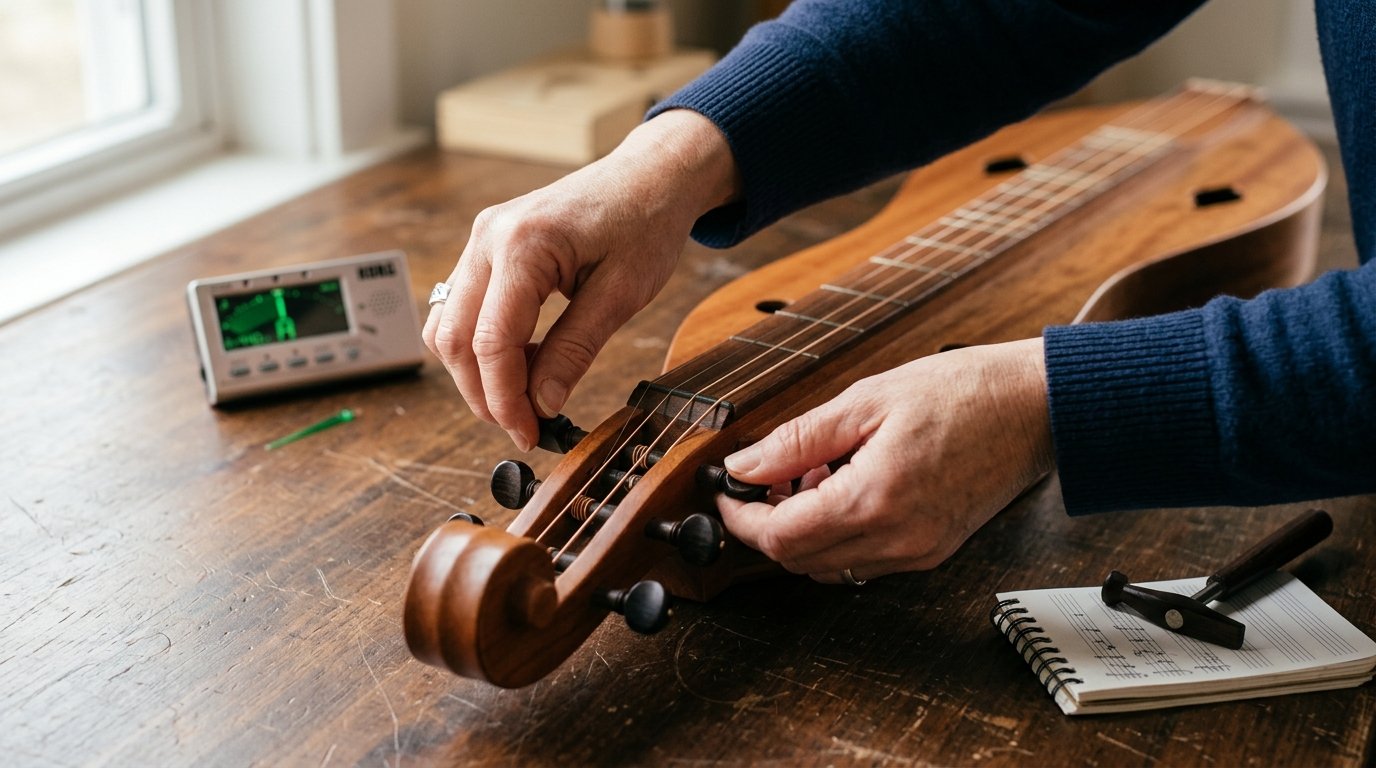
Dulcimer Tuning Guide for Beginners
Folkstrings.com is reader-supported. When you buy through links on our site, we may earn a small commission.
Last Updated on July 15, 2026 by folkstrings
Getting your dulcimer in tune is the single most important thing you can do before you play a single note. I remember sitting down with my mountain dulcimer for the first time and realising I had no idea which string was which, let alone what pitch each one needed. If that sounds familiar, you are in the right place.
This guide walks you through exactly how to tune your dulcimer, string by string, covering the two most common tunings — DAD and DAA — plus how to tune by ear once you are comfortable with a tuner. I also cover the mistakes I made early on, including the one that nearly cost me a string.
Understanding Your Strings
Before you touch a tuning peg, it helps to know which string you are adjusting. Mountain dulcimers have three courses of strings, though the total number of physical strings varies by setup.
Bass, Middle and Melody
The bass string is the thickest and sits closest to you when the instrument is in your lap. It produces the lowest note. The middle string sits in the centre and is tuned to A in standard tuning. The melody string is the thinnest and farthest from you, producing the highest note — this is the string you play your tunes on.
3, 4 and 5-String Setups
On a 3-string dulcimer you have one string per course. On a 4-string dulcimer (the most common), the melody course is doubled — two strings tuned to the same pitch side by side. On a 5-string dulcimer, both the bass and melody courses are doubled. The doubled strings give a richer, fuller tone and are a feature, not a problem.
If you have a 4-string dulcimer, tune both melody strings to the same note. If they are slightly out with each other you will hear a chorus or wavering effect — keep adjusting until both ring clean together.
Standard DAD Tuning
DAD is the most common mountain dulcimer tuning and the one you should start with. The letters refer to the pitch of each course from bass to melody: D — A — D.
Exact notes: Bass string = D3 • Middle string = A3 • Melody string(s) = D4. The bass D and melody D are an octave apart — the melody sits one octave higher than the bass.
A quick note on music theory: DAD gives you D Mixolydian, which is like a major scale with a flattened seventh (C natural instead of C sharp). You will hear this in a lot of traditional Appalachian and Irish tunes. You do not need to understand the theory to play — just know that DAD gives you a bright, open, traditional sound.
Using a Tuner App Safely
A tuner app works well as a reference but can get you in trouble if you are not careful. The biggest risk is tuning to the wrong octave. If your app shows “D” but you are already at the correct pitch and keep tightening, you will head toward D5 — a full octave too high. That is how strings break.
- Pluck the string and check what note the app reads before you start turning
- If the note is close to your target, make small turns — a quarter turn at a time
- If the app shows a note far from your target, loosen the string first, then tune up slowly
- Always tune up to the note rather than down — tuning up keeps tension more stable
- If your tuner shows octave numbers, for DAD you want D3 on the bass and D4 on the melody
DAA Tuning
DAA is the other main mountain dulcimer tuning. The melody string drops from D to A, giving you D — A — A.
Exact notes: Bass string = D3 • Middle string = A3 • Melody string(s) = A4. All three courses now share a D or A relationship, making chord shapes across the fretboard very consistent.
The theory behind it: DAA gives you D Ionian — a standard major scale. Every major scale chord is available without cross-fingering, which makes DAA easier for beginners who want to focus on melody rather than drone-string management.
When to Use DAA Instead of DAD
DAA works well when you are learning to play a melody cleanly without worrying about incorporating the drone string. Some players find it easier to pick out tunes by ear in DAA. Others prefer DAD for its fuller, more traditional drone sound. There is no right answer — try both and see which suits how you want to play.
Tuning by Ear
Once you are familiar with the pitches, you can tune by ear using the instrument itself as a reference rather than relying on an app every time. This is slower at first but builds your ear significantly faster.
Finding A From the Bass String
If you have a reference pitch for D — from a piano, another instrument, or a single tuner note — you can find A by ear. Pluck the bass string at the 4th fret. The note you hear is A. That gives you the pitch for your middle string. Match the open middle string to that note.
Matching the Melody String
In DAD tuning, the melody string should match the bass string exactly but one octave higher — a cleaner, brighter version of the same D. Play them together and listen for beating (a wavering sound) which tells you they are not quite in unison. Adjust the melody string until the beating disappears.
Why Daily Tuning Builds Your Ear
Tuning by ear every session is one of the fastest ways to develop musical hearing. Even if you use a tuner app to verify, try to get the string close by ear first. Each time you do this you are reinforcing your internal sense of pitch. Within a few weeks you will find you need the app less and less.
Common Mistakes and How to Fix Them
Tuning to the Wrong Octave
This is the mistake I see most often, and I made it myself early on. Your tuner shows “D” and you assume you are done — but there is a D in every octave. Tuning a thin melody string up to D5 instead of D4 puts dangerous tension on it. Always check the octave number on your tuner if it displays one. If it does not, use your ears: the melody D should sound clearly higher than the bass D, but not screamingly tight.
What String Tension Should Feel Like
A correctly tuned dulcimer string should feel like gentle but definite resistance when you pluck it — not floppy, not hard as a wire. If a string vibrates loosely against the frets it is probably too low. If it feels very stiff or sounds tight and thin it may be too high. A properly tuned string has a gentle firmness and rings clearly without fret buzz.
When Your Dulcimer Won’t Stay in Tune
New strings stretch for the first few days and will go out of tune quickly. This is normal — tune it, play it, retune it. After a few sessions new strings bed in and hold pitch much better. If an older dulcimer still will not stay in tune, worn strings are the most likely cause. Replacing the strings is the first thing to try before adjusting pegs or the bridge.
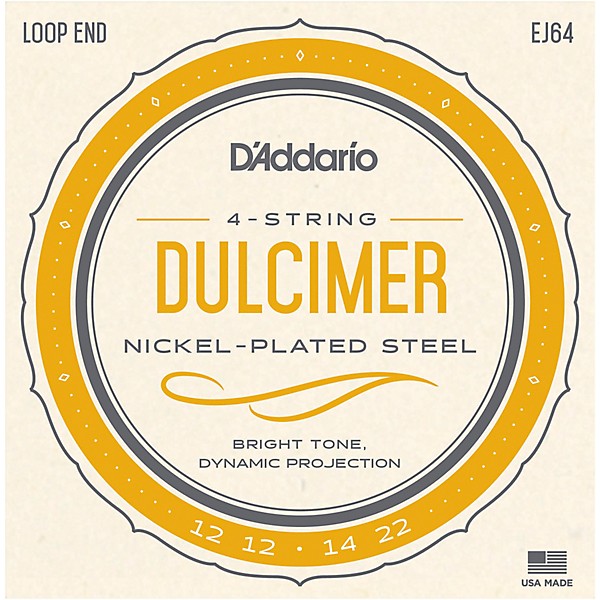
D’Addario EJ64 Mountain Dulcimer Strings
- Nickel-plated steel loop-end strings — the standard set for mountain dulcimer in DAD tuning
- Gauges .012/.012/.014/.022w — well-balanced tension across the string courses
- Fresh strings hold tuning significantly better than worn ones — if your dulcimer is drifting, this is the first thing to check
- Affordable enough to change regularly without thinking twice about it
If your dulcimer is going out of tune quickly between sessions, worn strings are the most common culprit. A fresh set of EJ64s is the first thing I reach for before adjusting anything else on the instrument.
Once your tuning is sorted, the next steps are learning chord shapes and finding the right instrument if you are still on a beginner dulcimer.
- Mountain Dulcimer Chord Chart — interactive chord diagrams for DAD tuning, all the main shapes in one place
- Best Mountain Dulcimer Guide — if you are thinking about upgrading your instrument
Frequently Asked Questions
What are the standard tunings for a mountain dulcimer?
DAD (D3-A3-D4) and DAA (D3-A3-A4) are the two main tunings. DAD is the most common and gives a traditional drone sound. DAA produces a standard major scale and is often easier for playing pure melody. Most beginner instruction starts with DAD.
How do I tune a mountain dulcimer using a phone tuner app?
Open a chromatic tuner app, pluck each string individually and watch the display. Match each string to its target note: D for the bass, A for the middle, D (or A for DAA) for the melody. Always check the octave number and tune upward to the pitch rather than downward.
What’s the easiest way for beginners to tune a dulcimer?
Use a clip-on chromatic tuner rather than a phone app if you can — it reads vibrations through the instrument and works even in noisy environments. Tune the bass string first, then the middle, then the melody. If you have a 4-string dulcimer with doubled melody strings, tune them both to the same note.
How should a 4-string dulcimer be tuned?
A 4-string dulcimer follows the same tuning as a 3-string (DAD or DAA) but with the melody course doubled. Tune both melody strings to the same pitch — D4 for DAD or A4 for DAA. If they are even slightly different from each other you will hear a wavering beat. Keep adjusting until both ring cleanly together.
Why won’t my dulcimer stay in tune?
New strings are the most common cause — they stretch over the first few sessions and need repeated retuning until they bed in. If your strings are older and the problem is persistent, replacing them is the first step. Also check that the pegs are not slipping; friction pegs on older instruments sometimes need chalk or peg compound applied to grip properly.
Author Profile

- Daniel Johnstone — Dániel to his friends back in Miskolc — is a Hungarian folk musician and writer who has been playing stringed instruments for over twenty years. Growing up in northeastern Hungary with a family steeped in folk music, he developed an early obsession with Celtic and Appalachian styles that eventually brought him to the UK. He worked his way through tenor banjo, 5-string banjo, autoharp, mountain dulcimer, mandolin, ukulele, harp and kalimba — most of them acquired through trial, error and more money than he'd like to admit. He founded Folkstrings.com to cut through the noise: practical, experience-based guides to instruments, strings, gear and accessories for folk players at every level.
Latest entries
 BanjoJuly 14, 2026Is Banjo Hard to Learn? Here’s What Nobody Tells You
 MandolinJuly 14, 2026Online Mandolin Lessons — What YouTube Can’t Teach You (And What Can)
 Useful ToolsJuly 13, 2026Recorder Fingering Chart — Complete Guide for Soprano Recorder (Baroque and German)
 UkuleleJuly 12, 2026Gifts For Ukulele Players: 10 Best Picks