Best Instruments for Small Hands: My Top Picks for Easy Playing
Folkstrings.com is reader-supported. When you buy through links on our site, we may earn a small commission.
Last Updated on June 30, 2026 by folkstrings
Hand size matters far less than most people assume, and for some instruments, smaller hands are genuinely an advantage. Here are the six I’d actually point a friend toward.
1. Ukulele

Kala Soprano Starter Kit
- From Kala, one of the most established ukulele makers
- 13-inch scale and nylon strings — chord shapes that defeat you on guitar land naturally here
- Includes online lessons, tuner app, and booklet

The soprano ukulele has a 13-inch scale length and four nylon strings. The fret spacing is close enough that chord positions which require uncomfortable stretching on a guitar come naturally to smaller hands, and the nylon strings are much softer on fingers that aren’t yet calloused.
What I notice when I play the ukulele after coming from guitar is how immediately forgiving it is. The first chord you try just works. No awkward stretch, no accidentally muting an adjacent string. That’s not something you get on guitar for weeks.
For small hands: The chord shapes that defeat you on guitar just land naturally here. You’ll feel the difference in your first session — not after weeks of practice.
For a child: Suitable from around age 5–6. The four nylon strings are soft enough that small fingers won’t hurt, and there are ukulele versions of virtually every song a child might already know.
2. Kalimba (Thumb Piano)

Newlam Kalimba (17 Keys)
- Played entirely with your thumbs — genuinely no hand span requirement at all
- Standard C major tuning, real melodies within minutes
- Around $26 — the lowest-commitment pick on this list
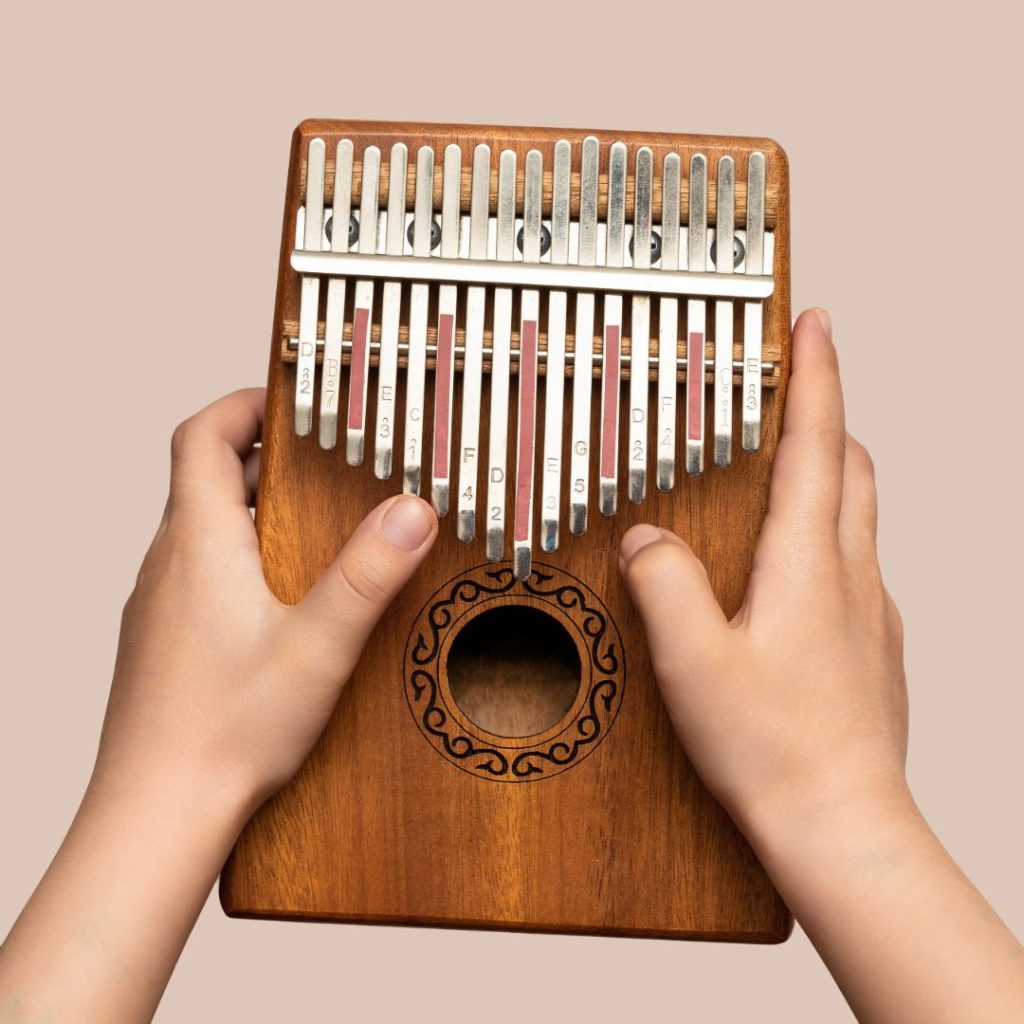
If you’ve never played an instrument before and want the easiest possible starting point, the kalimba is it. You hold the instrument in both hands and press the metal tines with your thumbs — no chord positions to form, no hand span required at all. The tines are arranged from the centre outward so your thumbs alternate naturally, and the standard C major tuning means you can play real melodies within minutes of picking it up.
The first 30 seconds feel completely counterintuitive — you’re playing with your thumbs, which your brain has never associated with an instrument. Then something clicks. After that it becomes the most natural motion, and hand size stops being a consideration entirely.
For small hands: There is genuinely no hand span requirement. You press individual tines with your thumbs — one at a time. It’s probably the only instrument on this list where large hands are more of a disadvantage than small ones.
For a child: One of the safest instruments for young children. No strings to press down, no sharp edges, and playable from around age 4 upwards. The sounds it makes are immediately pleasing rather than the screeching that comes from early violin or recorder attempts.
3. Lyre Harp

VixxNoxx 19-String Lyre Harp
- Plucking only, lap-held — no fretting or chord shapes at all
- Comes with tuning wrench, bag, instructions, and extra strings
- Around $69 — a genuinely complete starter kit

As a harp player myself, I’ll admit some bias here — but the lyre harp is genuinely one of the best instruments for small hands. You hold it on your lap and pluck individual strings with your fingertips. No chord shapes to form, no frets to press down, no wide stretches required.
People expect it to sound thin given the size. It doesn’t. And because the strings are already tuned to a scale, it’s almost impossible to play a note that sounds wrong. That’s a confidence builder that most instruments don’t give you at the start.
For small hands: You only ever touch one string at a time. No stretching, no chord shapes — just fingertips on individual strings. The lap-held position also means there’s no weight to manage, which makes long sessions comfortable.
For a child: Works well from around age 7–8 with some supervision. The metal strings are firmer than nylon but there’s nothing to hurt small fingers. The visual appeal tends to hook children immediately — it looks like something from a story.
4. Autoharp
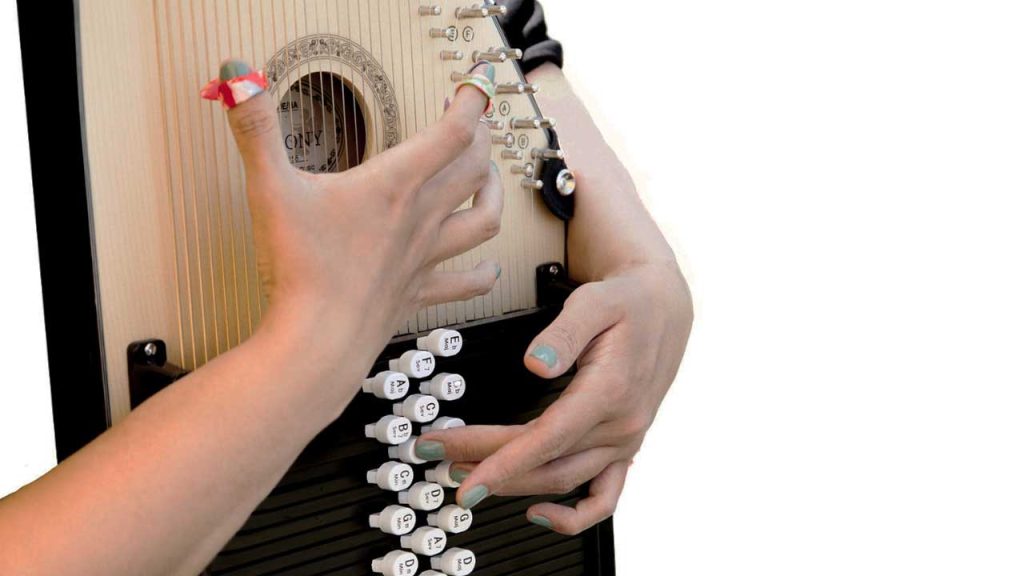
The autoharp may be the single best instrument for anyone who struggles with chord fingering. You press a chord bar with your palm or thumb — which damps all strings except those belonging to that chord — and strum with your other hand. No individual notes to fret, no chord shapes to hold, no hand span requirement whatsoever.
It has a particular party trick: within five minutes of picking it up, you sound like you can actually play. Not like a beginner stumbling through something — like someone who knows what they’re doing. That’s a rare quality in an instrument and it matters for keeping motivation up, especially with children.
For small hands: You press a chord bar with your whole hand and strum. There are no finger positions to hold at any point. If you’ve struggled with guitar chords specifically because of hand size, this removes that obstacle entirely.
For a child: Best suited to children from around age 8 and up. The chord bars need a reasonably firm press, so a little hand strength helps. But the fact that it sounds good immediately makes it unusually good for keeping a child engaged.
5. Mandolin

Vangoa Mandolin Kit
- Short, narrow neck — genuinely easier on small hands than a guitar neck
- Comes with case, tuner, picks, capo and strap included
- Around $114 — everything included to start playing same-day

The mandolin has a short scale length and a narrow nut width — the neck is noticeably shorter and narrower than any guitar, which makes a real difference for smaller hands. Eight strings arranged in four pairs tuned in unison means each fret position sounds two strings at once.
The surprise with the mandolin is the sound. Given the size you expect something quiet and thin. Instead it cuts right through a room — bright, punchy, and carrying in a way that feels disproportionate to how small the instrument is. That tends to be the moment people fall in love with it.
For small hands: The neck is short enough that positions requiring a stretch on guitar are simply reachable. If you’ve been put off string instruments by the reach required on a full guitar neck, the mandolin changes that calculation.
For a child: Better suited to children from around age 8–10. The steel strings require more finger strength than ukulele, so it’s not ideal for very young beginners. But for an older child who wants something a bit more challenging than ukulele, it’s a strong choice.
6. Harmonica

Hohner Special 20
- Fits any hand size — there’s no fretting or fingering involved at all
- A genuinely respected harmonica brand, not a toy-tier import
- Comes with case, manual, and polishing cloth

The harmonica is the most hand-size-agnostic instrument on this list — it fits in a shirt pocket and can be played regardless of hand size, finger length, or strength. The core mechanics of draw and blow can be understood in an afternoon, and the diatonic harmonica in C major covers an enormous sweep of folk, blues, and country material.
What’s worth knowing is that the expressive stuff — bends, vibrato, the techniques that make harmonica playing actually sound good — comes from breath control and diaphragm, not from the hands. Hand size is completely irrelevant to what makes a harmonica player sound like a harmonica player.
For small hands: You cup it loosely in both hands and control everything with breath. There is no physical technique that depends on hand size or finger length. It’s also the most portable instrument on this list by a significant margin.
For a child: Genuinely works from any age — children as young as 5 can produce notes. The diatonic C harmonica is the right starting point. One practical note: younger children tend to blow rather than draw, so expect the first few weeks to be one-directional until they work out the balance.
Why Hand Size Is Usually Overestimated as a Barrier
/wp:heading wp:paragraphGuitar and piano are the two instruments most people try first — and both do require a wider hand span to play comfortably. That’s created a widespread assumption that small hands limit your options across all instruments. They don’t. The acoustic folk world has always had a strong tradition of compact, accessible instruments that suit players of all sizes. Most of the instruments below were designed without any assumption about hand size, and several of them are actually easier for smaller hands than large ones.
/wp:paragraph wp:headingWhat to Look For When Choosing an Instrument for Small Hands
If you’re evaluating an instrument not on this list, these are the factors that actually matter:
- Scale length — shorter scale means frets are closer together and require less stretching
- Nut width — a narrower nut means a narrower neck, easier to reach across
- String material — nylon strings are softer and easier to press than steel, especially important for beginners
- Playing style — instruments that involve plucking or pressing chord bars naturally suit smaller hands over complex fretting
- Weight and size — lighter instruments are easier to hold in position for longer sessions
Frequently Asked Questions
What is the easiest instrument for small hands?
The kalimba is the easiest — it’s played entirely with the thumbs and requires no chord positions or finger placement. The ukulele and harmonica are close behind, both with low entry barriers and natural suitability to smaller hands.
Is the autoharp good for small hands?
Yes — the autoharp is one of the best instruments specifically for small hands because you press chord bars rather than finger individual strings. There’s no hand span requirement, which removes the main barrier that small-handed players face on guitar or piano.
What string instrument is best for small hands?
Among string instruments, the ukulele is the most forgiving because of its short scale and nylon strings. The lyre harp is an excellent option if you’re drawn to harp-family instruments — it only requires plucking. The mandolin suits smaller hands well because of its short, narrow neck.
Can children learn these instruments?
Yes. The ukulele, kalimba, and harmonica are the most accessible starting points for children. The soprano ukulele and kalimba are both playable from around age 6 with adult guidance. The mandolin and lyre harp are better suited to children from around age 8 to 10.
Author Profile

- Daniel Johnstone — Dániel to his friends back in Miskolc — is a Hungarian folk musician and writer who has been playing stringed instruments for over twenty years. Growing up in northeastern Hungary with a family steeped in folk music, he developed an early obsession with Celtic and Appalachian styles that eventually brought him to the UK. He worked his way through tenor banjo, 5-string banjo, autoharp, mountain dulcimer, mandolin, ukulele, harp and kalimba — most of them acquired through trial, error and more money than he'd like to admit. He founded Folkstrings.com to cut through the noise: practical, experience-based guides to instruments, strings, gear and accessories for folk players at every level.
Latest entries
 BanjoJuly 14, 2026Is Banjo Hard to Learn? Here’s What Nobody Tells You
 MandolinJuly 14, 2026Online Mandolin Lessons — What YouTube Can’t Teach You (And What Can)
 Useful ToolsJuly 13, 2026Recorder Fingering Chart — Complete Guide for Soprano Recorder (Baroque and German)
 UkuleleJuly 12, 2026Gifts For Ukulele Players: 10 Best Picks