Lever Harp Key Settings — Which Levers to Engage in Any Key
Folkstrings.com is reader-supported. When you buy through links on our site, we may earn a small commission.
Last Updated on July 11, 2026 by folkstrings
Lever Harp Key Settings
Select a key to see which levers to engage on a standard Celtic/lever harp
How Levers Work on a Celtic Harp
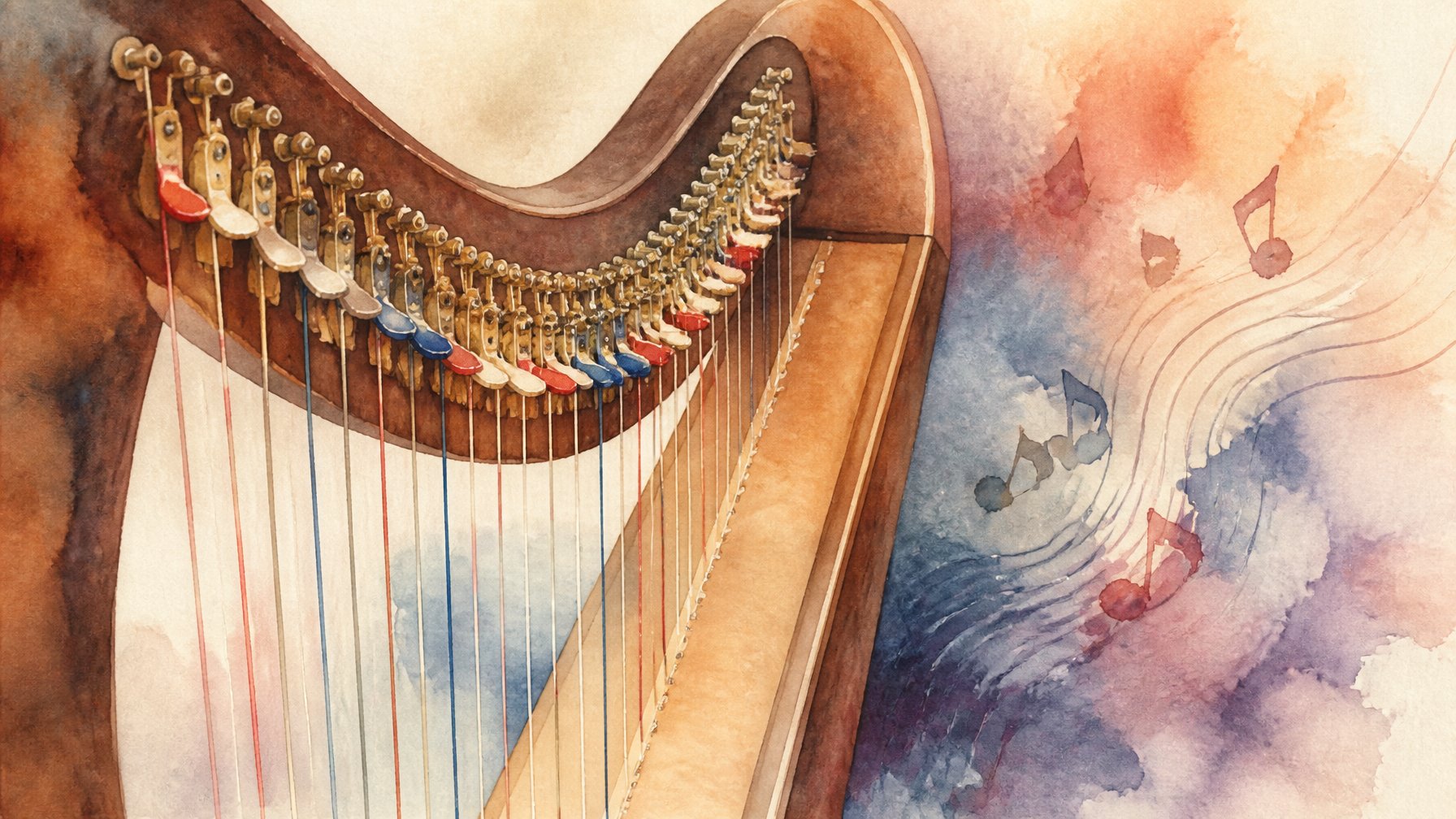
A lever harp has a small mechanical lever at the top of each string. When you flip a lever up, it shortens the vibrating length of the string by a precise amount — raising its pitch by exactly one semitone. So a C string with its lever engaged becomes C#. An F string with its lever up becomes F#.
This is how lever harps play in different keys. A standard lever harp is tuned to E♭ major (all levers down) — every string is at its flat pitch. To play in C major, you engage the levers on every B, E, and A string across all octaves, which raises them to their natural pitch. To play in G major, you also raise all F strings to F#. Each key has a specific combination of levers that need to be up.
The important rule: lever settings are per-key, not per-note. If you need F# in the key of G, you engage all F levers across every octave — not just the ones in the range you’re playing. This ensures every F string in any register will produce F# when played.
Changing key mid-piece requires flipping individual levers during the music — usually in a rest or between phrases. Most players learn to flip levers with the thumb or index finger of the left hand while the right hand keeps playing. It takes practice but becomes instinctive over time.
For more on getting started with the harp, see our guide to choosing a small harp — covering lever harps, lap harps and wire-strung options for every budget.
Author Profile

- Daniel Johnstone is an English writer and folk musician who has been playing stringed instruments for over twenty years. He started on guitar as a teenager before working his way through cavaco, tenor guitar, autoharp, mountain dulcimer, and harp. He founded Folkstrings.com to provide practical, experience-based buying advice for folk instrument players at every level — the kind of guidance he always wished had existed when he was finding his feet.
Latest entries
 Useful ToolsJuly 11, 2026Tin Whistle Fingering Chart — All Notes in Both Octaves (D and C Whistle)
 Useful ToolsJuly 11, 2026Banjo String Gauges — Complete Guide for 5-String, Tenor and Irish Tenor
 Useful ToolsJuly 11, 2026Harp String Chart — How to Identify and Replace Any Harp String
 Useful ToolsJuly 11, 2026Mountain Dulcimer Chord Chart — Key of D in DAD Tuning