Ukulele Capo Chart — Key Transposition for Standard GCEA Tuning
Folkstrings.com is reader-supported. When you buy through links on our site, we may earn a small commission.
Last Updated on July 11, 2026 by folkstrings
Ukulele Capo Transposition Chart
Standard GCEA tuning — what key each chord shape produces at every capo position
Why Use a Capo on Ukulele?
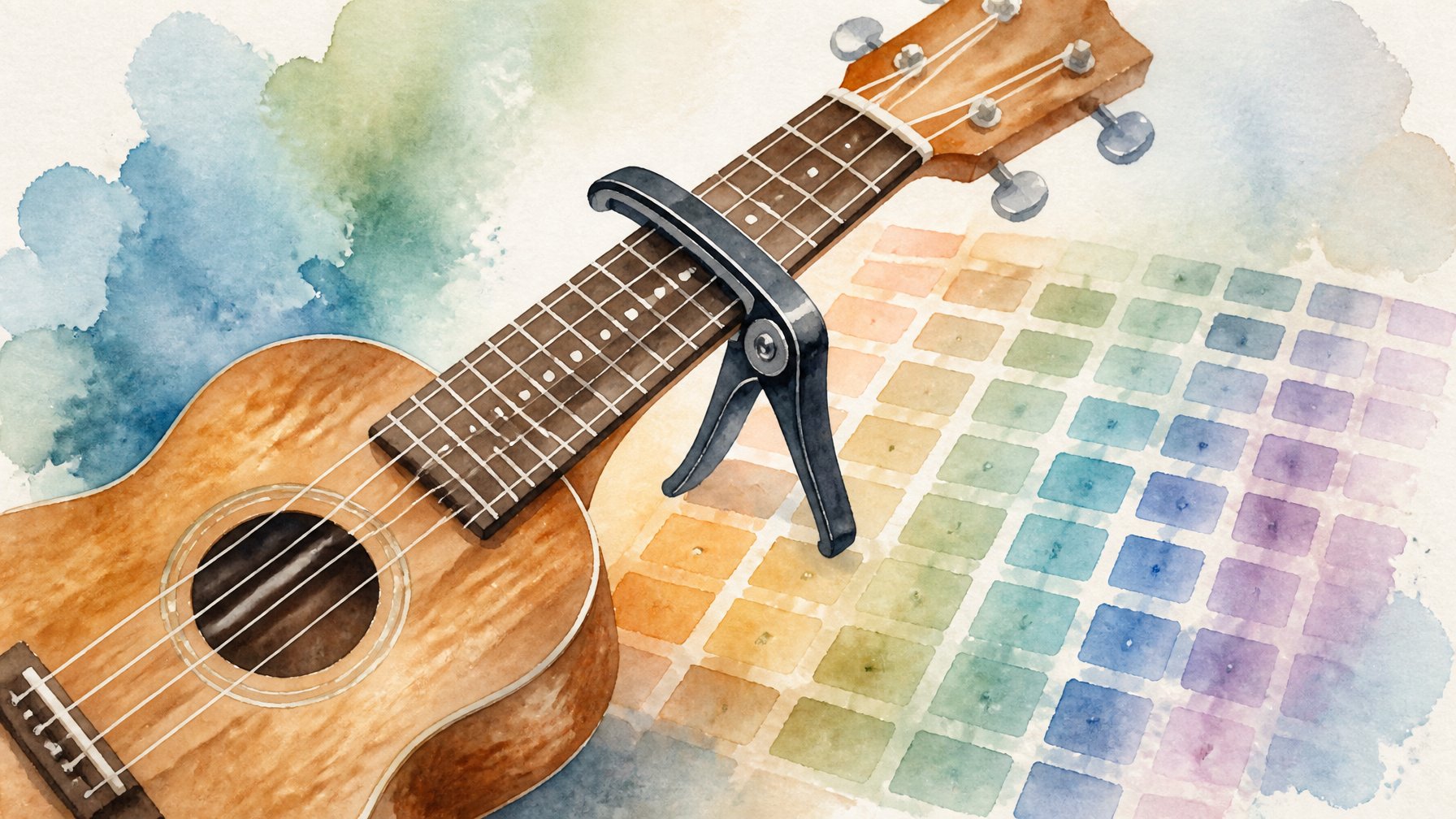
A ukulele capo does exactly what it does on a guitar — it clamps across all strings at a given fret, shortening the vibrating length and raising the pitch of every string by the same number of semitones. Your chord shapes stay identical; only the sounding key changes. A C shape played open gives you C major. Capo on fret 2 and that same C shape sounds like D major.
The main reasons ukulele players use a capo are to match a vocalist’s key without learning new chord shapes, to play in a key that has difficult open chord shapes using easier shapes from a different position, or to achieve a slightly different tonal character by playing higher up the neck.
Most Commonly Used Capo Positions
Capo 2 is the most used capo position on ukulele. It moves the key of C up to D and the key of G up to A — both very common keys for pop and folk songs. If you know your C, F, G and Am shapes, capo 2 gives you D, G, A and Bm for free.
Capo 5 moves C up to F and G up to C — useful when you need to play in F but find the open F chord shape awkward. Playing C shape with capo 5 gives you a cleaner-sounding F without the two-finger stretch.
Capo 7 produces G and D from C and F shapes — the two most common ukulele keys, but now played from a higher position which gives a brighter, more crystalline tone.
For more on ukulele tuning and setup, see our ukulele tuning reference covering standard, low-G, baritone and D-tuning.
Author Profile

- Daniel Johnstone is an English writer and folk musician who has been playing stringed instruments for over twenty years. He started on guitar as a teenager before working his way through cavaco, tenor guitar, autoharp, mountain dulcimer, and harp. He founded Folkstrings.com to provide practical, experience-based buying advice for folk instrument players at every level — the kind of guidance he always wished had existed when he was finding his feet.
Latest entries
 Useful ToolsJuly 11, 2026Tin Whistle Fingering Chart — All Notes in Both Octaves (D and C Whistle)
 Useful ToolsJuly 11, 2026Banjo String Gauges — Complete Guide for 5-String, Tenor and Irish Tenor
 Useful ToolsJuly 11, 2026Harp String Chart — How to Identify and Replace Any Harp String
 Useful ToolsJuly 11, 2026Mountain Dulcimer Chord Chart — Key of D in DAD Tuning