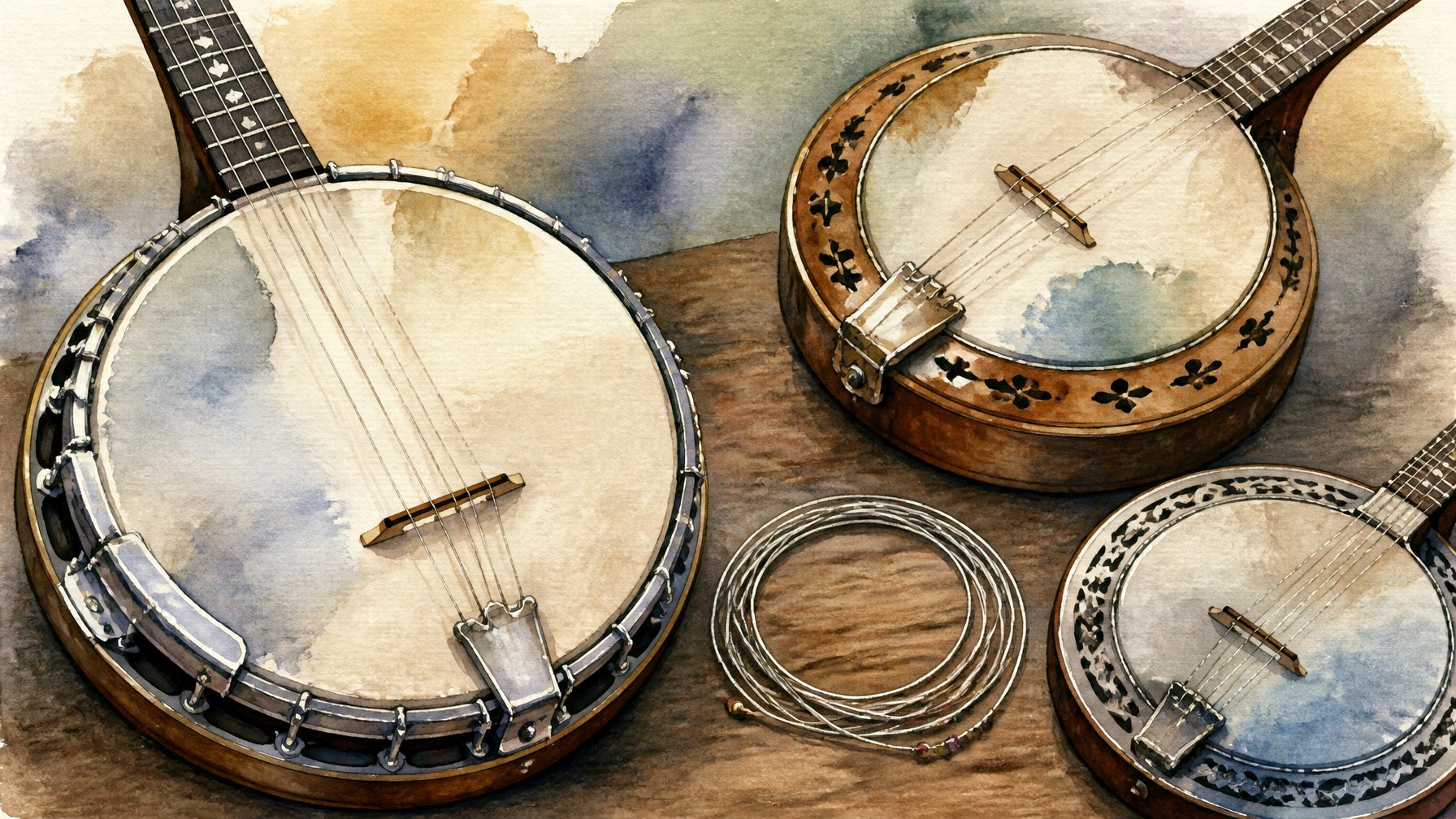
5-string, tenor and Irish tenor banjo. Verified gauge data from D’Addario and GHS specifications.
Your banjo type
Your playing style
5-String Banjo — Bluegrass and Finger-Picking
Bright tone, fast response, light-to-medium tension
D’Addario EJ61 Medium
Top Pick
.010 / .012 / .016 / NW.023 / .010
The most popular 5-string set overall. Ideal balance of brightness and projection for bluegrass. Used by Rob McCoury, Ron Block and many professionals.
D’Addario EJ60 Light
Alternative
.009 / .010 / .013 / NW.020 / .009
One step lighter than EJ61. Good for beginners or players with a light touch. Slightly less volume but easier on the fingers.
Bluegrass playing rewards bright, projecting strings because you are competing with fiddle and guitar for presence in an acoustic mix. Nickel-plated steel gives you that brightness without the harshness of stainless. Start with EJ61 medium and move lighter or heavier depending on whether the feel suits you.
5-String Banjo — Clawhammer and Old-Time
Warmer tone, medium tension, phosphor bronze recommended
D’Addario EJ55 Medium Phosphor Bronze
Top Pick
.010 / .013 / .016 / PB.023 / .010
Phosphor bronze wound 4th string gives the warmer, rounder tone that suits old-time styles. This is the clawhammer player’s version of the EJ61.
GHS PF160
Alternative
.011 / .013 / .016 / PB.026w / .010
Slightly heavier gauges preferred by many experienced clawhammer players. More stiffness in the strings suits the downstroke technique and prevents floppiness at standard tuning.
Clawhammer technique uses the back of the nail on the downstroke rather than fingerpicks. This rewards a slightly heavier gauge with phosphor bronze winding which produces a mid-range, plunky tone rather than the bright snap of bluegrass. Avoid nickel-wound strings if you want the classic old-time sound.
5-String Banjo — Folk and General Playing
Versatile medium gauge, a good starting point for most players
D’Addario EJ61 Medium
Top Pick
.010 / .012 / .016 / NW.023 / .010
The industry standard starting point. Works across styles and is what most banjos ship with or are set up to take.
GHS PF150
Alternative
.010 / .012 / .014 / PB.022w / .010
Called light by GHS but closer to medium in practice. Very popular for general playing. Phosphor bronze wound 4th.
If you are new to banjo or play across multiple styles, start with a medium gauge set. The EJ61 is the single most commonly recommended string by teachers and on forums because it suits almost every playing situation and comes at a price that makes regular changes affordable.
5-String Banjo — Irish Trad
Light-medium gauges, bright nickel strings
D’Addario EJ61 Medium
Top Pick
.010 / .012 / .016 / NW.023 / .010
Most Irish trad 5-string players use standard medium sets. Nickel-wound for brightness to cut through a session.
D’Addario EJ60 Light
Alternative
.009 / .010 / .013 / NW.020 / .009
Some players prefer lighter gauges for faster left-hand movement on ornamented trad melodies.
Irish traditional music on the 5-string is less common than on the tenor but follows similar principles. Brightness is valued in a session context and nickel-wound strings suit this better than phosphor bronze.
Tenor Banjo — Standard Tuning (CGDA)
Standard medium gauge for jazz and traditional styles
D’Addario EJ63 Medium
Top Pick
.009 / .016 / NW.023 / .030
The universally recommended set for CGDA tenor banjo. Covers jazz, early country and traditional plectrum styles.
The EJ63 is D’Addario’s standard tenor set and the starting point for almost all CGDA tenor players. If you are unsure which set to buy, this is the right answer.
Tenor Banjo — Standard Tuning (CGDA)
Standard medium gauge for folk and general use
D’Addario EJ63 Medium
Top Pick
.009 / .016 / NW.023 / .030
Standard set for CGDA tenor banjo. Works well for folk, traditional and acoustic styles.
For standard CGDA tuning, the EJ63 is the right starting point regardless of style. Tenor banjo string variety is narrower than 5-string because the instrument has a more defined playing tradition.
Tenor Banjo — Standard Tuning (CGDA)
Standard medium gauge applies equally to all tenor styles
D’Addario EJ63 Medium
Top Pick
.009 / .016 / NW.023 / .030
The EJ63 is the standard for CGDA tenor. Clawhammer is less common on tenor than 5-string.
Clawhammer on a CGDA tenor is unusual. The EJ63 medium is the right starting point for most tenor players regardless of technique.
Tenor Banjo — Standard Tuning (CGDA) for Trad
Standard set, may move to heavier for volume in a session
D’Addario EJ63 Medium
Top Pick
.009 / .016 / NW.023 / .030
Standard CGDA tenor set suitable for Irish trad. Some players prefer a slightly heavier gauge for more projection in a session environment.
Standard CGDA tenor tuning is used by some Irish trad players. The EJ63 is the standard starting point. For GDAE Irish tenor tuning, use the EJ63i set instead.
Irish Tenor Banjo — GDAE Tuning
Specifically designed for fifths tuning and plectrum playing
D’Addario EJ63i Irish Tenor
Top Pick
.012 / .016 / NW.024 / .036
Designed specifically for GDAE fifths tuning on Irish tenor banjo. Heavier gauge than the standard EJ63 because higher tension is needed to produce the same tone at GDAE pitch.
Gold Tone Irish Tenor Set
Alternative
.010 / .020w / .030w / .040w
Alternative set from Gold Tone designed for Irish tenor tuning. Wound 2nd, 3rd and 4th strings.
The Irish tenor banjo (GDAE tuning, same as fiddle and mandolin) requires significantly heavier strings than standard CGDA tenor. Using a standard EJ63 set on a GDAE-tuned Irish tenor will result in too-light tension, thin tone and strings that feel floppy. The EJ63i is designed exactly for this purpose.
Irish Tenor Banjo — GDAE Tuning
EJ63i for GDAE tuning across folk styles
D’Addario EJ63i Irish Tenor
Top Pick
.012 / .016 / NW.024 / .036
Standard set for GDAE tuning. Works across folk, trad and general playing on an Irish-tuned tenor.
If your tenor is tuned to GDAE (Irish/fiddle tuning), always use the EJ63i rather than the standard EJ63. The gauges are matched to the higher tension requirements of GDAE tuning.
Irish Tenor Banjo — GDAE Tuning
EJ63i for GDAE tuning
D’Addario EJ63i Irish Tenor
Top Pick
.012 / .016 / NW.024 / .036
Designed for GDAE fifths tuning. Use this rather than any 5-string or standard tenor set.
Regardless of the style you play, if your tenor is tuned GDAE use the EJ63i. The gauges are calibrated for GDAE tension.
Irish Tenor Banjo — GDAE Tuning
EJ63i for GDAE tuning
D’Addario EJ63i Irish Tenor
Top Pick
.012 / .016 / NW.024 / .036
Designed for GDAE fifths tuning. Clawhammer on GDAE tenor is unusual but these strings will handle the technique well.
GDAE tenor banjo always requires the EJ63i gauge set regardless of playing style.
Select your banjo type and playing style above to see recommendations.
The most popular winding for 5-string banjo. Produces the classic bright, projecting bluegrass tone. Smooth feel under the fingers and reliable longevity. EJ61 and EJ60 use nickel-wound 4th strings.
Best for: Bluegrass, finger-style, anyone who wants the classic banjo sound
Phosphor Bronze
Warmest
The wound 4th string in PB-wound sets (EJ55, GHS PF150/160) produces a noticeably warmer, rounder tone than nickel. Preferred by clawhammer and old-time players who want less brightness and more mid-range plunk.
Best for: Clawhammer, old-time, folk, any player who finds nickel too bright
Stainless Steel
Bright + Long-Lasting
Brighter and more corrosion-resistant than nickel. Less popular than nickel or phosphor bronze for banjo but available from some makers. Strings last longer before losing tone but feel stiffer under the fingers.
Best for: Players who sweat heavily, high-humidity environments, those who want maximum string life
Plain Steel (treble strings)
Consistent across sets
All banjo treble strings (1st, 2nd, 3rd in 5-string sets) are plain steel regardless of brand or gauge. The wound 4th string is where the material choice matters most. The 5th string on a 5-string banjo is also plain steel.
Best for: N/A — the wound 4th is the variable that matters
Bluegrass / Finger-picking
EJ61 Medium or EJ60 Light — Nickel-wound
Bluegrass rewards brightness and projection. You are competing with loud acoustic instruments in an ensemble. Nickel-wound strings and medium gauges give you the clarity and volume needed without excess tension on the fingers. Many professional bluegrass players use EJ61 as their default, changing strings frequently (weekly or even daily at professional level) to maintain the bright sound that new strings produce.
Clawhammer / Old-Time
EJ55 Phosphor Bronze or GHS PF160 — Phosphor Bronze
The clawhammer downstroke technique uses the nail and the flesh of the finger rather than picks. This favours strings with a warmer, less piercing tone — which phosphor bronze delivers. Many experienced clawhammer players also prefer slightly heavier gauges (PF160 rather than PF150) because the stiffer string handles the downstroke better at standard pitch without going floppy. Avoid strings that are too light if you play in standard G tuning.
Irish Traditional (5-string)
EJ61 Medium — Nickel-wound
Irish trad on 5-string banjo is typically played with picks in a flatpicking or finger-picking style. Brightness is an asset in session playing where you need to be heard. Standard medium nickel-wound sets are the norm.
Irish Traditional (Tenor — GDAE)
EJ63i Irish Tenor — Nickel-wound
This is the only case where the string choice is essentially mandatory rather than stylistic. GDAE tuning puts significantly more tension on each string than CGDA. Using standard EJ63 strings on a GDAE-tuned tenor will result in thin, floppy strings with poor tone. The EJ63i is designed specifically for this tuning and there is no real debate about using anything else as a starting point.
General / Beginner
EJ61 Medium — Start here
If you are new to banjo, do not overthink string choice. Put on a set of D’Addario EJ61 or the GHS PF150 equivalent and focus on playing. String nuances matter when you have developed enough technique to notice them — which takes at least a few months. The EJ61 is what most banjos ship with for a reason.
How often should I change banjo strings?
Professionals change strings before every performance or even more frequently. For regular players, once a month is a reasonable guideline. If your strings look discoloured or feel rough, or if the tone sounds dull even when in tune, change them. Old strings are harder to tune and make it more difficult to diagnose other issues with your instrument.
Can I use guitar strings on a banjo?
No. Banjo strings use a loop-end construction that attaches differently from guitar strings, which typically have ball ends. Even if the gauges looked similar, the attachment mechanism is different. Always buy strings specifically labelled for banjo.
What is the difference between light and medium gauge?
Gauge refers to the physical thickness of the string measured in thousandths of an inch. Heavier strings produce more volume and a fuller tone but require more finger strength and put more tension on the instrument. Lighter strings are easier to play and have a brighter, thinner tone. The difference between light and medium in banjo terms is usually around .001 to .003 inches per string — small but audible.
Why does my tenor banjo need different strings from a 5-string?
Tenor banjo has 4 strings tuned either CGDA or GDAE, compared to the 5-string which is GDGBD. The string lengths, tensions and tuning ranges are completely different. A 5-string set will not give correct tension or tone on a tenor banjo and vice versa.
Do I need to change all strings or just the broken one?
For a single broken string, replacing just that one is fine if the remaining strings are relatively fresh. However, if the strings are old and the new string sounds noticeably brighter than the others, the sonic mismatch can be quite obvious. If your strings are more than a couple of months old, replacing the whole set gives a more consistent result and is often worth the small extra cost.
What gauge should a beginner use?
D’Addario EJ61 medium for 5-string, or EJ63 for standard tenor. These are the industry standard starting points and what most banjos are set up for from the factory. Do not experiment with gauges until you have been playing for several months and have a feel for what you want from your strings.
Tool by Folkstrings.com — all gauges verified from D’Addario and GHS official specifications
Why Banjo String Gauge Matters More Than Brand
Most discussions about banjo strings focus on brand names, but the gauge — the physical thickness of the string — has a bigger effect on your playing experience than which company made it. Two sets of the same gauge from different brands will sound more similar to each other than two sets from the same brand in different gauges. Get the gauge right for your style first, then experiment with brands once you have a baseline.
The 4th String Is the Most Important Choice
The treble strings (1st, 2nd and 3rd on a 5-string) are all plain steel across virtually every brand and gauge range. The tonal difference between string sets comes almost entirely from the wound 4th string. Nickel-wound 4th strings produce a brighter sound; phosphor bronze-wound 4th strings produce a warmer sound. If you find your banjo sounds too bright, switching to a phosphor bronze-wound set like the D’Addario EJ55 or GHS PF150 is the most effective single change you can make.
Daniel Johnstone is an English writer and folk musician who has been playing stringed instruments for over twenty years. He started on guitar as a teenager before working his way through cavaco, tenor guitar, autoharp, mountain dulcimer, and harp. He founded Folkstrings.com to provide practical, experience-based buying advice for folk instrument players at every level — the kind of guidance he always wished had existed when he was finding his feet.
The four-string banjo world splits into banjolele, tenor and plectrum — and they’re not interchangeable. My picks and honest guidance on which type you actually need.


 Useful ToolsJuly 11, 2026Tin Whistle Fingering Chart — All Notes in Both Octaves (D and C Whistle)
 Useful ToolsJuly 11, 2026Banjo String Gauges — Complete Guide for 5-String, Tenor and Irish Tenor
 Useful ToolsJuly 11, 2026Harp String Chart — How to Identify and Replace Any Harp String
 Useful ToolsJuly 11, 2026Mountain Dulcimer Chord Chart — Key of D in DAD Tuning