Lyre Harp Tuning Guide For Beginners
Folkstrings.com is reader-supported. When you buy through links on our site, we may earn a small commission.
Last Updated on June 19, 2026 by Daniel Johnstone
When I first picked up a lyre harp, I had no idea how to get it in tune. I turned one peg, the pitch jumped way too high, I panicked, and I almost snapped a string.
If that sounds familiar, you’re in the right place.
Tuning a lyre harp is a learnable skill. Once you understand the basic steps and tools, you’ll feel confident tuning before every session.
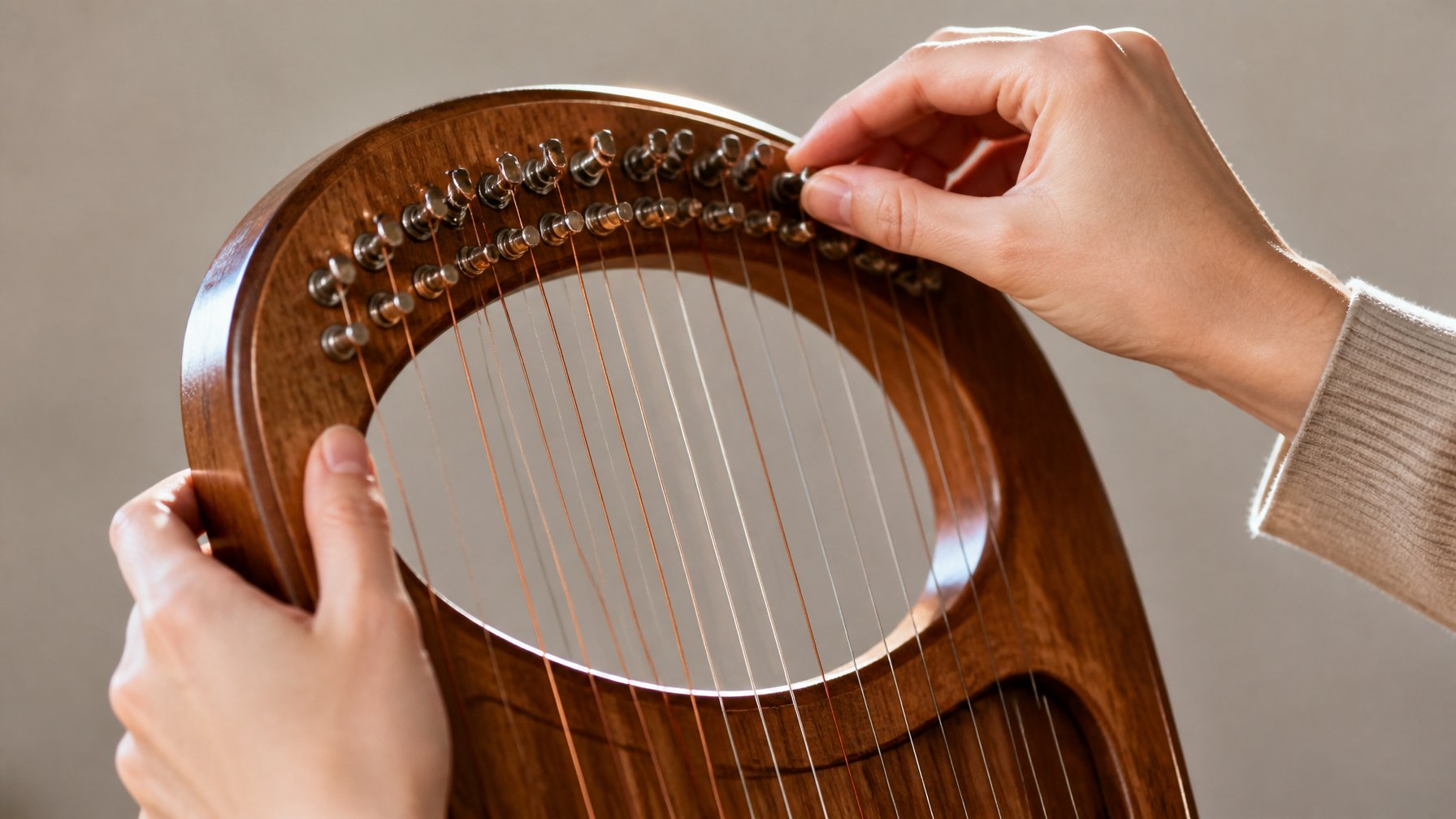
Tuning your lyre harp matters more than most beginners expect. A lyre that’s even a little out of tune just sounds muddy and dissonant, which makes learning harder and honestly, less enjoyable.
Getting it right unlocks the warm, resonant tone you’re hoping for. Tuning is also a surprisingly good way to start bonding with your instrument from day one.
This guide walks you through every part of the process in plain language. From the tools you need to common problems like slipping pegs, I cover it all in one place.
Key Takeaways
- You only need two tools to tune a lyre harp: a chromatic tuner and a tuning wrench.
- Most beginner lyres start in C major, but pentatonic and alternative tunings are easy to explore once you’re comfortable.
- New strings slip out of tune a lot at first. This is normal and settles within a week or two.
What You Need Before You Start
Having the right tools ready before you touch a tuning pin saves a lot of frustration. You’ll need a wrench that fits your instrument, a reliable tuner, and a quiet spot where you can actually hear each string.
Choosing A Tuning Wrench And Tuning Pin Fit
A tuning wrench is the small tool you use to rotate the tuning pins on your lyre. This isn’t optional.
Trying to turn pins by hand just doesn’t work, and using the wrong size wrench can strip the pin or mess up the wood. Most beginner lyre harps come with a wrench in the box.
If yours didn’t, check the string gauge or contact the seller for the right fit. The wrench should slide onto the tuning pin snugly, with no wobble.
A loose fit makes it tough to make small, controlled adjustments.
Using A Chromatic Tuner, Electronic Tuner, Or Tuner App
A chromatic tuner reads the pitch of whatever you pluck and tells you the note name, plus whether you’re sharp (too high) or flat (too low). You can use a standalone electronic tuner or a free tuner app on your phone.
I’ve had good luck with GuitarTuna and insTuner on iOS, and Chroma on Android. Clip-on tuners also work well and pick up vibrations even if there’s a bit of noise around.
Either option is fine for a beginner lyre harp.
Finding A Quiet Space And A Reliable Reference Note
Tuning by ear means you need to actually hear each string. Background noise makes that a pain, so I always tune in a quiet room before playing elsewhere.
Start with a reference note, ideally middle C, to anchor your first string. Your chromatic tuner will display this automatically when you pluck the lowest string.
Once that string is locked in, you work your way up from there. This keeps things organized and less overwhelming.
How To Tune Each String Step By Step
The actual tuning process is simpler than it looks once you know where to start. The key is to work slowly, check often, and always approach the correct pitch from below rather than above.
Where To Begin On A Beginner Lyre
On a beginner lyre, I always start with the lowest-pitched string. For most beginner lyre harp models tuned to C major, that’s the C below middle C.
Pluck it, watch your tuner, and see what note comes up. On a 16-string lyre, the range spans two full octaves, so there’s more to manage.
Take it one string at a time. Never try to rush through the whole set without checking each string carefully.
Lyre tuning rewards patience.
How To Raise Or Lower Pitch With Tuning Pegs
Turn the tuning peg clockwise to raise the pitch and counter-clockwise to lower it. Move slowly—seriously, even a tiny quarter-turn can shift the pitch more than you’d expect.
If a string is sharp (too high), go slightly below the target note first, then come back up. This seats the string better and helps it hold pitch longer.
Never yank the peg quickly or force it past the target.
Why You Need To Recheck The Full Set After One Pass
After you tune every string once, go back and check them all again. Adjusting one string changes tension across the instrument, which can pull nearby strings out of tune.
This is totally normal on any stringed instrument, not just a lyre. One or two passes through the full set is usually enough to get things stable.
By the second pass, most strings need only tiny touch-ups.
Standard Note Layouts And Common Scale Setups
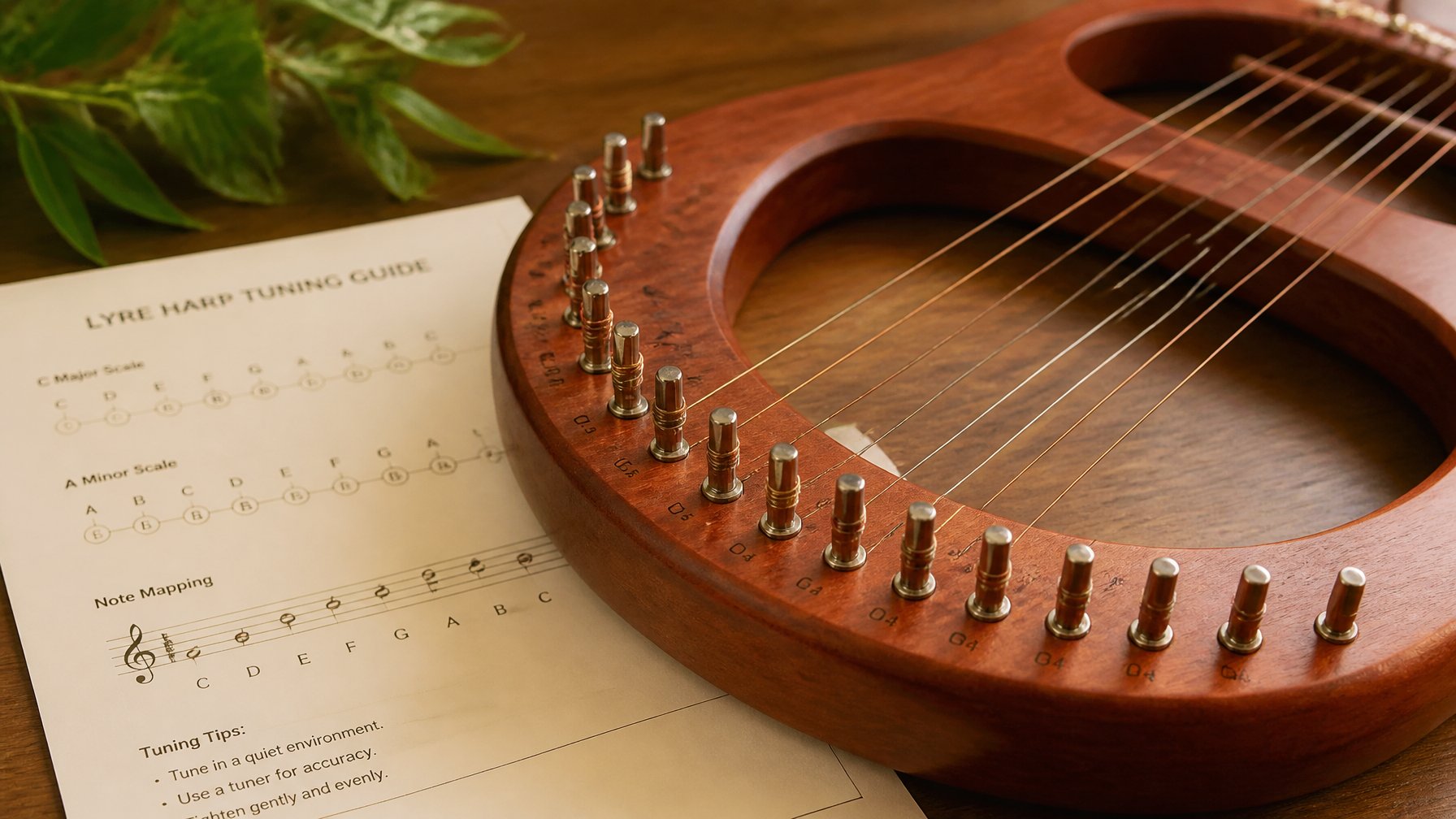
The scale you tune your lyre to shapes everything about how it sounds and what you can play. Most modern lyre players start with C major, but pentatonic and chromatic options are worth knowing about even early on.
C Major Scale On A Diatonic Lyre
A diatonic lyre is tuned to a set scale with no sharps or flats between the strings. The C major scale is the most common starting point: C, D, E, F, G, A, B.
On an 8-string version, you add a second C at the top. This layout maps right onto the white keys of a piano, which makes it easy to follow along with sheet music or online tutorials.
For any beginner working through their first songs, C major on a diatonic lyre is the most accessible place to start.
When A Pentatonic Scale Makes More Sense
The pentatonic scale uses five notes per octave instead of seven. A common version removes F and B from C major, leaving C, D, E, G, A.
This layout is very forgiving because almost any combination of notes sounds pleasant together. I recommend pentatonic tuning if you want to improvise freely without worrying about wrong notes.
It’s also great for relaxation and meditative music because of its smooth, open sound. Many players find it less intimidating than a full diatonic scale when starting out.
How A Chromatic Lyre Differs From A Diatonic Lyre
A chromatic lyre includes all twelve notes of the octave, including sharps and flats. Many chromatic lyres have two rows of tuning pins, one for natural notes and one for semitones.
This gives you a much wider musical range. The trade-off is complexity.
A chromatic lyre takes longer to tune and asks for a bit more music theory knowledge. For most beginners, a diatonic lyre in C major is the better starting point before moving to a chromatic setup.
Fixing Common Tuning Problems
Tuning challenges trip up almost every beginner at some point. None of them mean your instrument is broken.
Slipping tuning pegs, drifting new strings, and overtightening mistakes are all fixable with the right approach.
New Strings That Will Not Stay In Tune
New strings stretch. It’s just physics.
For the first week or two after you restring a lyre, you may need to retune before every session or even mid-session. This is normal and not a sign of a defective instrument.
To speed things up, gently stretch each new string by pulling it slightly away from the soundboard after tuning, then retune. Repeat this a few times per session.
Within a week or two, the strings stabilize and hold pitch much better.
Loose Or Slipping Pegs
A tuning pin that slips back after you set it is frustrating but fixable. Usually, the peg has worn slightly loose in its hole.
One practical fix is to apply a small amount of peg compound or even a touch of rosin to the tuning pin before reinserting it. For more serious slipping, some players remove the peg entirely, mix a small amount of wood glue with fine wood shavings, fill the hole lightly, and reinsert the peg once dry.
This snugs up the fit without permanent damage.
Avoiding Broken Strings And Over-Tightening
Strings break when you go past their tension limit, usually from turning the tuning pin too far too fast. Always tune up slowly and stop as soon as your tuner reads the correct note.
If you lose track of which direction you’re turning, pluck the string as you move the peg and listen. Pitch going up means you’re tightening, pitch going down means you’re loosening.
Never force a peg that feels stiff. Ease it gently in small increments.
Beyond Standard Tuning
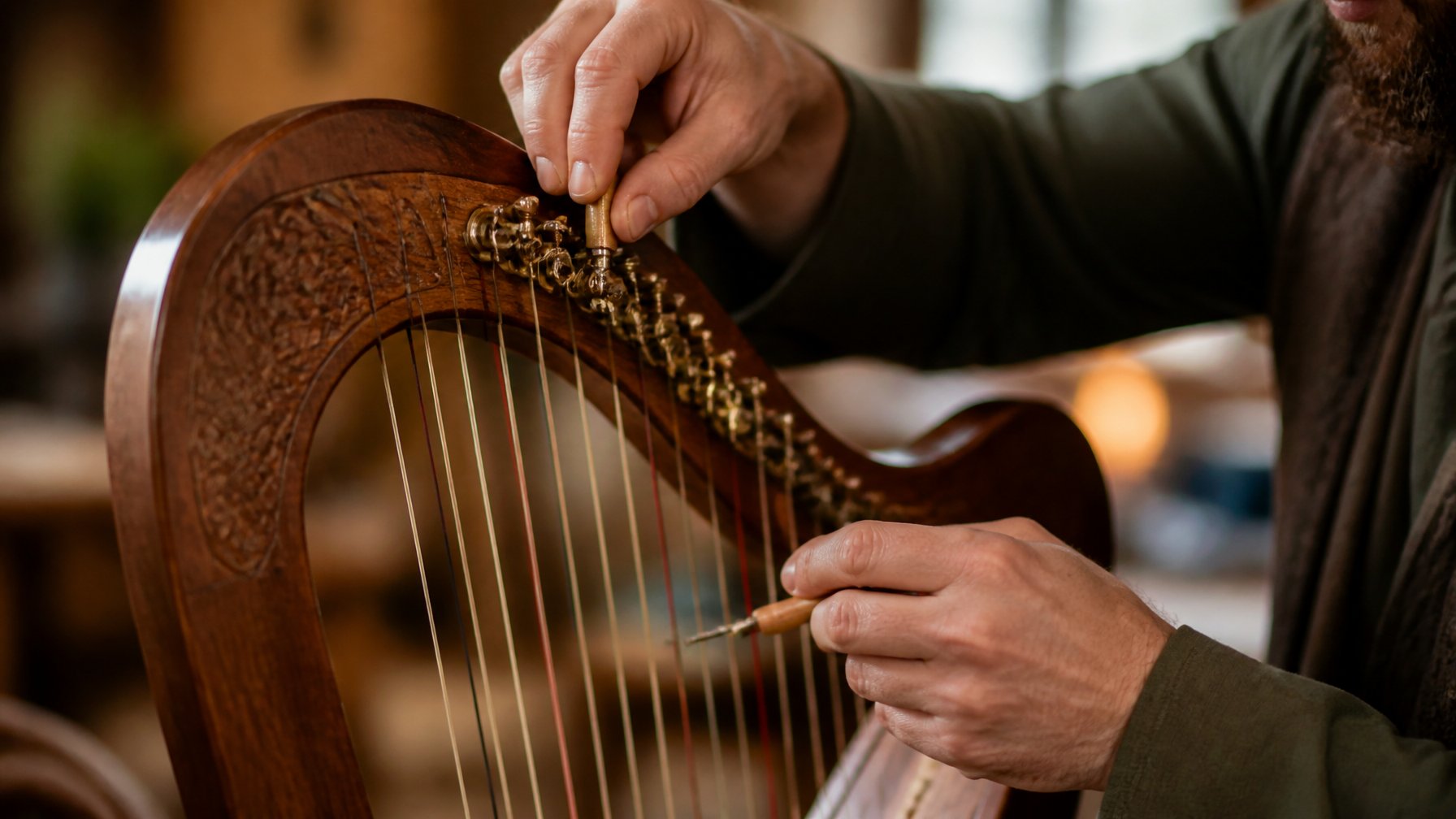
Once you’re comfortable with standard C major tuning, the lyre opens up to a wide range of alternative tunings. These aren’t reserved for advanced players; honestly, many beginners find them easier and more expressive than standard setups.
Trying Alternative Tunings Safely
Before switching to any alternative tuning, write down your current tuning so you can return to it easily. Make small adjustments one string at a time and check your tuner after each change.
Avoid raising any string dramatically in a single session, as this increases the risk of snapping it. G major is one of the most common alternatives to C major and only requires adjusting one string.
Modal tunings like D Dorian or A Aeolian are also popular and give the instrument a distinctly different emotional quality.
Using Tuning Choices For Melodies And Harmonies
Different tunings shape which melodies and harmonies feel natural on the instrument. A lyre in G major naturally favors folk and Celtic-style melodies, while a modal tuning opens up meditative, minor-key harmonies.
Pentatonic tunings are especially useful for improvising because any two strings you play together sound harmonious. This makes it much easier to create flowing, expressive melodies without needing to think through music theory in real time.
Why Some Players Use Tunings For Therapeutic Music
The lyre’s got a long history in healing and therapeutic spaces. Some players tune to 432 Hz instead of the usual 440 Hz, thinking it gives a warmer, more resonant sound for relaxation.
Pentatonic and modal tunings are favorites in sound therapy. They skip those tension-filled intervals and help keep things calm and gentle.
Honestly, whether or not you’re into the healing side, messing with different tunings is one of the most creative parts of playing the lyre.
Building Confidence As A New Player

Getting the hang of tuning is just the start of building a real relationship with your instrument. Regular practice, helpful resources, and a supportive community all make a difference in how fast you improve.
How Often To Check Your Instrument
I check my lyre’s tuning before every single session. No exceptions.
Strings drift—temperature, humidity, or just time will do that. A quick two-minute check before playing saves you from accidentally practicing with bad intonation.
Some new players only tune when something sounds way off. But tuning proactively, even when things sound close, really builds your ear and keeps your playing sounding its best right from the start.
When To Learn More From Lyre Academy
Lyre Academy is an online resource with tuning tools made for lyre players. Their interactive tuner lets you pick your string count, starting note, and tuning mode, then gives you the exact notes your instrument needs.
This is especially handy if you’ve got an unusual string count or want to try out non-standard scales. It takes the guesswork out of figuring out a new tuning for the first time.
Communities Like The International Lyre Association
The International Lyre Association brings together lyre players from all over, including plenty of beginners. Being part of a group like this means you can tap into shared knowledge about tuning, instrument care, and repertoire.
It’s honestly so helpful to see how others approach tuning challenges, scale choices, and different lyre styles. Forums, social groups, and events through the International Lyre Association make it easy to ask questions and get answers from people who’ve been there.
Frequently Asked Questions
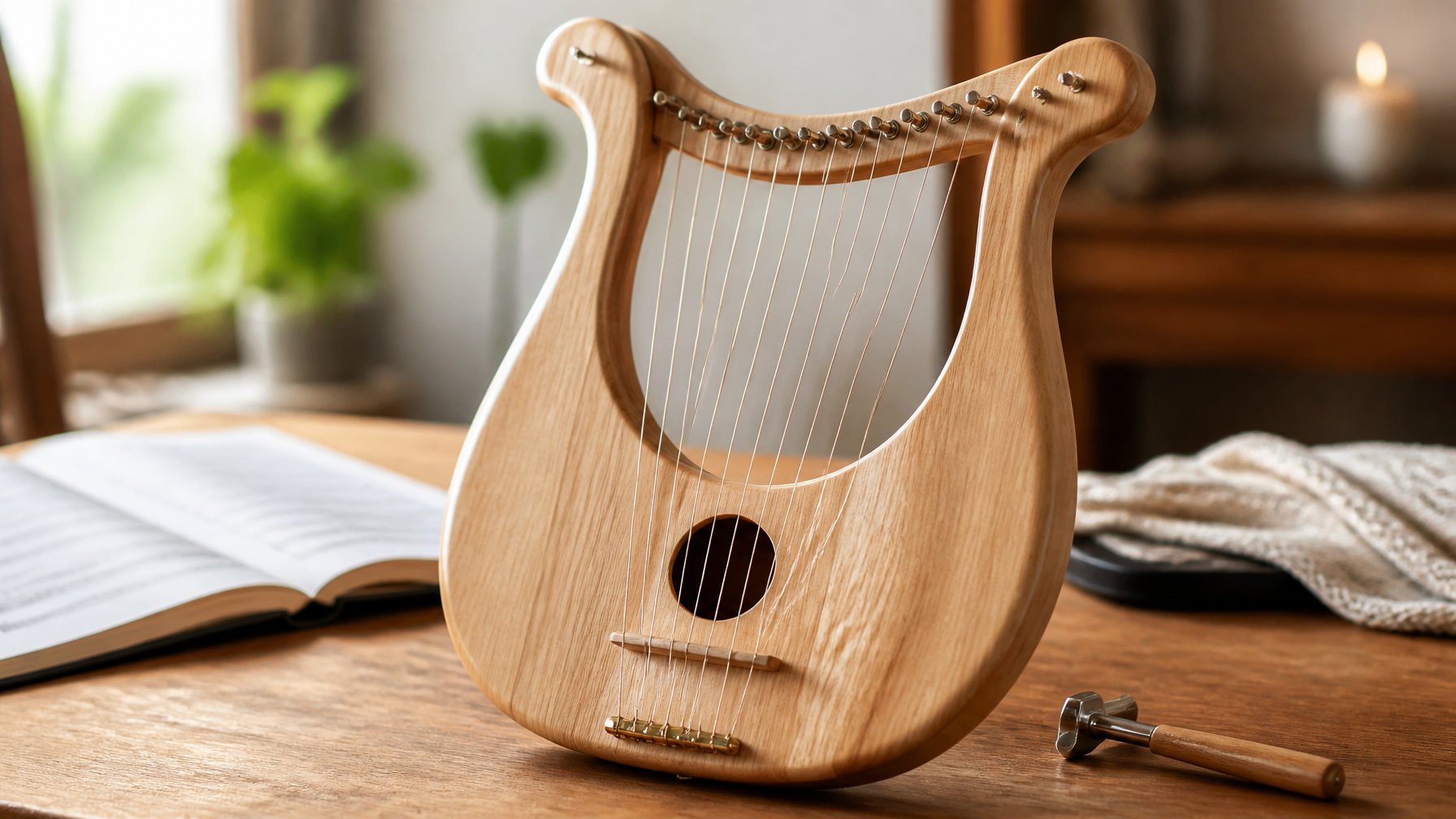
How do I tune a lyre harp if I’m a complete beginner?
Start with a chromatic tuner app on your phone and a tuning wrench that fits your lyre’s pins. Pluck each string one by one, check the note on your tuner, and use the wrench to adjust until you hit the right pitch.
Work from the lowest string up, and do a second pass when you’re done with the first. Don’t stress if it takes a few tries to get used to—everyone starts somewhere.
What tuning should I use for a 16-string lyre harp?
Most 16-string lyres use a two-octave C major scale, from a low C up through two full octaves of C, D, E, F, G, A, B, C. It’s a wide melodic range but still familiar and beginner-friendly.
Once you feel comfortable, you can experiment with pentatonic or modal alternatives. There’s no rush—just explore when you feel ready.
What are common tunings for a 7-string lyre?
A 7-string lyre usually gets tuned to a single octave of C major: C, D, E, F, G, A, B. Some folks go for G major instead.
Pentatonic tunings like C, D, E, G, A are also popular if you want something more forgiving and meditative.
Which apps can help me tune my lyre harp accurately?
GuitarTuna, insTuner (iOS), and Chroma (Android) all work well for lyre harps. They use your phone’s mic to pick up pitch and show if you’re sharp or flat in real time.
A clip-on electronic tuner is another solid choice, especially if your space gets noisy. Honestly, whatever helps you tune quickly and confidently is the best tool for you.
Do I need to tune my lyre harp every time I play it?
Yep, tuning before each session is just a good habit. Strings drift with temperature, humidity, and regular use.
Even if your lyre was perfect yesterday, it might need a little tweak today. It’s just part of the process.
Why won’t my lyre harp stay in tune, and what can I do about it?
New strings are honestly the main culprit when your lyre keeps slipping out of tune. They just need a bit of time to stretch and settle in—usually a week or two of steady playing and retuning does the trick.
Loose tuning pins can also mess with your tuning. You can try putting a little peg compound on the pin, or even a touch of wood glue mixed with wood shavings, to tighten things up.
Author Profile

- Daniel Johnstone — Dániel to his friends back in Miskolc — is a Hungarian folk musician and writer who has been playing stringed instruments for over twenty years. Growing up in northeastern Hungary with a family steeped in folk music, he developed an early obsession with Celtic and Appalachian styles that eventually brought him to the UK. He worked his way through tenor banjo, 5-string banjo, autoharp, mountain dulcimer, mandolin, ukulele, harp and kalimba — most of them acquired through trial, error and more money than he'd like to admit. He founded Folkstrings.com to cut through the noise: practical, experience-based guides to instruments, strings, gear and accessories for folk players at every level.
Latest entries
 BanjoJuly 14, 2026Is Banjo Hard to Learn? Here’s What Nobody Tells You
 MandolinJuly 14, 2026Online Mandolin Lessons — What YouTube Can’t Teach You (And What Can)
 Useful ToolsJuly 13, 2026Recorder Fingering Chart — Complete Guide for Soprano Recorder (Baroque and German)
 UkuleleJuly 12, 2026Gifts For Ukulele Players: 10 Best Picks