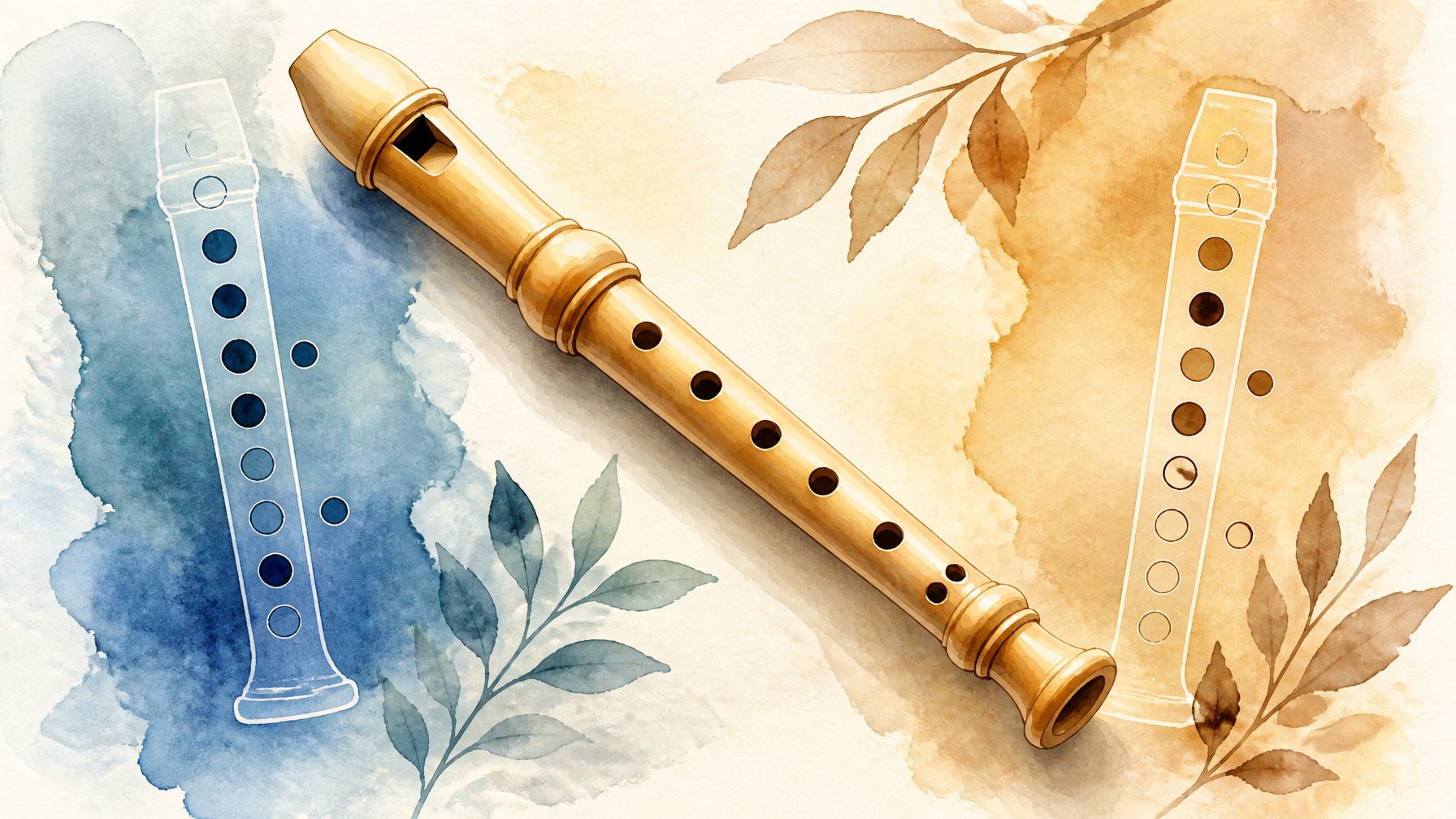
Recorder Fingering Chart — Complete Guide for Soprano Recorder (Baroque and German)
Folkstrings.com is reader-supported. When you buy through links on our site, we may earn a small commission.
Last Updated on July 13, 2026 by folkstrings
Recorder Fingering Chart
Soprano recorder — complete fingering reference for both octaves. Baroque and German fingering systems.
How to read each card: The thumb hole (Th) is shown on the left, the seven front holes are shown vertically. Filled ● = cover that hole. Empty ○ = leave it open. Half ◐ = pinch the thumb hole (second octave only).
Baroque vs German fingering: The only note that differs is F. Baroque uses a fork fingering (hole 5 open, 6-7 re-closed). German uses a simple fingering (hole 4 open). Check under the thumb hole on the back of your recorder — B = Baroque, G = German. Use the toggle above.
Click any note card to see the full diagram and breath guidance.
All holes covered — the lowest note on a soprano recorder. The starting point for the C major scale. Make sure every hole is fully sealed for a clean tone.
Bottom hole (hole 7) open. The second note of the C major scale.
Bottom two holes open. Third note of the C major scale.
The Baroque fork F: hole 5 is open but holes 6 and 7 are closed again. This is the key difference between Baroque and German fingering. The German alternative uses hole 4 open instead. The Baroque fork F is required on Baroque fingering instruments — using the German version will produce a flat pitch.
Holes 4, 5, 6 and 7 all open. Only the left hand fingers and thumb remain on the instrument.
Only the left hand thumb, index and middle fingers covering holes Th, 1 and 2. One of the first notes children learn — the recorder school sequence often starts B, A, G.
Thumb and index finger only. The very first note most recorder players learn. Just two holes covered.
Only the thumb hole covered. The top of the first octave. This note can be unstable on some instruments — if it squeaks or sounds sharp, try adding hole 7 as a supporting hole.
The start of the second octave. Pinch the thumb hole — partially uncover it by rolling the thumb back slightly to expose a small opening. This is also called the register hole. The fingering is otherwise similar to the first octave.
Same as first octave D fingering but with pinched thumb for the second register.
Second octave fork F — same Baroque fork fingering as the first octave (hole 5 open, 6 and 7 closed) but with pinched thumb for the second register.
Same left hand pattern as first octave G but with pinched thumb for the second register.
Same pattern as first octave A with pinched thumb.
Same as first octave B with pinched thumb. Very exposed note — good breath control needed.
High C — pinched thumb only, all other holes open. The top of the standard range. Requires clean breath control to avoid squeaking.
How to Read This Recorder Fingering Chart
The soprano recorder has eight holes: one thumb hole on the back and seven finger holes on the front. Your left hand covers the top four (thumb plus the first three front holes), and your right hand covers the bottom four. The recorder is held with the mouthpiece at the lips and the body pointing downward at roughly a 45-degree angle.
The Two Octaves
The soprano recorder covers two octaves, from C5 to around C7 in its standard range. The first octave uses the same gentle breath throughout — think of blowing through a cold straw rather than a hot one. The second octave uses the same finger patterns as the first, but with the thumb hole partially uncovered (pinched or half-holed). This is called using the register hole. The transition between octaves is entirely controlled by the thumb and the speed of the breath.
Baroque vs German Fingering — The F Note
The only significant difference between Baroque (English) and German recorder fingering is the note F. Baroque uses a fork fingering — hole 5 is opened while holes 6 and 7 are closed again, skipping back over them. German uses a simpler approach — hole 4 is opened and holes 5, 6 and 7 remain closed. The German version is easier to learn but produces a slightly flat pitch on instruments designed for Baroque fingering. Most recorders made today are Baroque instruments. You can identify yours by checking the underside of the instrument near the thumb hole — a B indicates Baroque, G indicates German.
The Easiest Notes to Start With
The traditional school sequence for recorder is B, A, G — the three simplest notes, each adding one more hole. B uses only the thumb and index finger. A adds the middle finger. G adds the ring finger. From those three notes you can already play several simple songs, which is why the recorder is one of the most accessible instruments for beginners of all ages.
For other folk instrument fingering charts: our tin whistle fingering chart covers D and C whistle across both octaves, and our folk instrument tools page has the complete library of free reference tools.
Author Profile

- Daniel Johnstone is an English folk musician and writer with over twenty years of experience playing stringed instruments. Starting on guitar as a teenager, he worked his way through tenor banjo, 5-string banjo, autoharp, mountain dulcimer, mandolin, ukulele, harp and kalimba — most of them acquired through trial, error and more money than he'd like to admit. He founded Folkstrings.com to cut through the noise: practical, experience-based guides to instruments, strings, gear and accessories for folk players at every level.