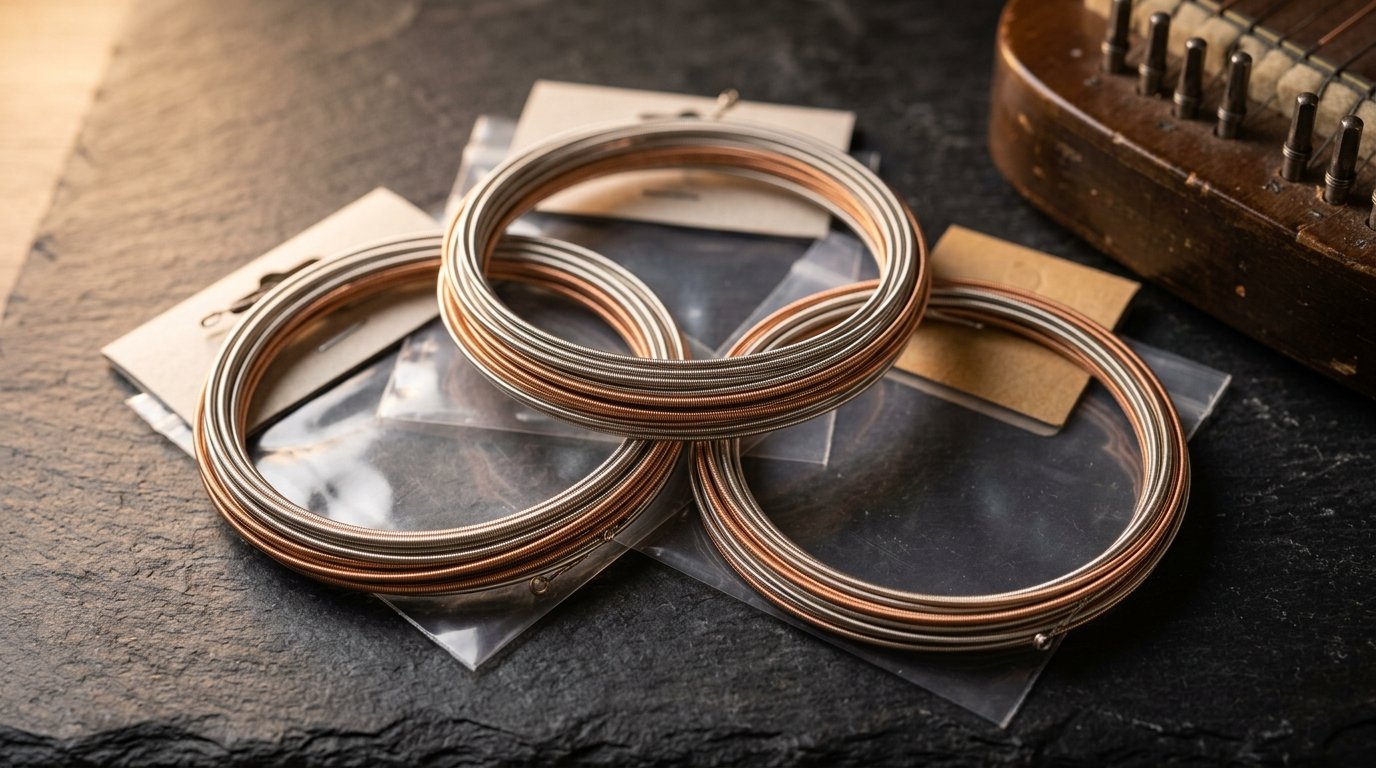
Best Autoharp Strings: The Right Set for Your Model
Folkstrings.com is reader-supported. When you buy through links on our site, we may earn a small commission.
Last Updated on June 30, 2026 by folkstrings
This post contains affiliate links. If you buy through a link on this page, I may earn a small commission at no extra cost to you.
The most common mistake when buying autoharp strings is ordering the wrong type for your model. Oscar Schmidt — the brand behind most of the autoharps sold today — makes two main instrument families, and they use completely different string configurations. Order the wrong one and the strings won’t fit correctly.
Here are the three sets worth knowing about, along with the key information you need to pick the right one for your instrument.
Loop End vs Ball End: The First Thing to Check
Before you buy, you need to know whether your autoharp takes loop end or ball end strings:
- Model A instruments (including the popular OS21C) take loop end strings — the string ends in a small loop that hooks over a pin at the bottom rail.
- Model B instruments (including the OS15B) take ball end strings — the ball sits flush against a plate, similar to a ball-end guitar string.
The two types are not interchangeable. If you’re not sure which model you have, check the label inside the soundhole or the back of the instrument — the model number should be printed there.
Oscar Schmidt ASA Loop End Set

Oscar Schmidt ASA Loop End
- 4.2 stars across 32 reviews
- Steel construction, warm tone — the correct set specifically for Model A instruments
- Around $115 — check your model before ordering, loop and ball ends aren’t interchangeable
Best for: OS21C and Model A autoharps | Price: $114.99 | Rating: 4.2★ (32 reviews)
The standard replacement set for Model A Oscar Schmidt autoharps, covering all 36 strings in one purchase. A full restring is better than replacing individual strings — old and new strings have different tension and age, which makes consistent tuning across the range very difficult.
Tone is warm and rounded, which is the classic autoharp sound. Once the strings have had time to stretch in after fitting, they hold tune well. If your OS21C is sounding dull or losing pitch between sessions, this is the set to reach for.
At $114.99 it’s not cheap — but autoharp strings are significantly more expensive than guitar strings simply because you’re replacing 36 of them at once. For an official Oscar Schmidt replacement set, this is a fair price.
Oscar Schmidt 36 Ball-End String Set

Oscar Schmidt Ball-End Set
- 4.5 stars across 43 reviews — the highest-rated set here
- The correct set specifically for Model B instruments — ball-end, not loop-end
- Around $125, full 36-string set
Best for: OS15B and Model B autoharps | Price: $124.99 | Rating: 4.5★ (43 reviews)
The ball-end counterpart for Model B instruments — same idea, same full-set approach. The slightly higher rating and review count suggest it’s a reliable set that players come back to. If you have an OS15B, this is the one.
Oscar Schmidt ASB Stainless Steel Set

Oscar Schmidt ASB Stainless Steel
- 4.2 stars across 65 reviews — the most-reviewed set on this list
- Stainless steel gives a brighter tone with longer sustain than the standard steel sets
- Around $119
Best for: Players wanting brighter tone and longer string life | Price: $119.99 | Rating: 4.2★ (65 reviews)
The ASB is a stainless steel alternative to the standard steel sets. Stainless strings are noticeably brighter and have more sustain — whether that suits you is a matter of preference. Some players find it gives the autoharp more presence; others prefer the warmer character of the standard sets.
The practical case for stainless is durability. Stainless steel resists corrosion better than plain steel, which matters if you play frequently or live somewhere humid. With 65 reviews at 4.2★ it’s the most-reviewed of the three sets, which gives a bit more confidence in the rating. Check the product listing to confirm compatibility with your specific model before ordering.
How Often Should You Replace Autoharp Strings?
Most players restring every one to three years, depending on how much they play. The signs it’s time: strings that won’t hold tune even after proper adjustment, visible rust or discolouration, or a noticeably dead tone. When you do restring, replace all 36 rather than individual strings to keep tension even across the range.
What Else You’ll Need
A proper autoharp tuning wrench is essential for restringing — standard guitar tuning tools won’t fit the autoharp’s tuning pins. Once the strings are on, a chromatic clip-on tuner makes getting all 36 strings to pitch a much less painful process.
Author Profile

- Daniel Johnstone — Dániel to his friends back in Miskolc — is a Hungarian folk musician and writer who has been playing stringed instruments for over twenty years. Growing up in northeastern Hungary with a family steeped in folk music, he developed an early obsession with Celtic and Appalachian styles that eventually brought him to the UK. He worked his way through tenor banjo, 5-string banjo, autoharp, mountain dulcimer, mandolin, ukulele, harp and kalimba — most of them acquired through trial, error and more money than he'd like to admit. He founded Folkstrings.com to cut through the noise: practical, experience-based guides to instruments, strings, gear and accessories for folk players at every level.
Latest entries
 MandolinJuly 14, 2026Online Mandolin Lessons — What YouTube Can’t Teach You (And What Can)
 Useful ToolsJuly 13, 2026Recorder Fingering Chart — Complete Guide for Soprano Recorder (Baroque and German)
 UkuleleJuly 12, 2026Gifts For Ukulele Players: 10 Best Picks
 MandolinJuly 12, 2026Gifts For Mandolin Players: 10 Best Picks