Is Banjo Hard to Learn? Here’s What Nobody Tells You
Folkstrings.com is reader-supported. When you buy through links on our site, we may earn a small commission.
Last Updated on July 14, 2026 by folkstrings
Is banjo hard to learn? Yes and no. The chords are not the problem. The rolls are. Three-finger banjo picking is a physical technique that has to be built carefully, and how you build it in the first few months determines how long everything else takes. Here is the honest version.
Banjo is moderately hard. Harder than ukulele, easier than violin. The rolls are the hard part — not the chords.
The difference is not talent. It is feedback. Banjo rolls are a physical technique and without someone watching your pick angle and wrist position, you can spend months building habits that hold you back.
What Actually Makes Banjo Hard
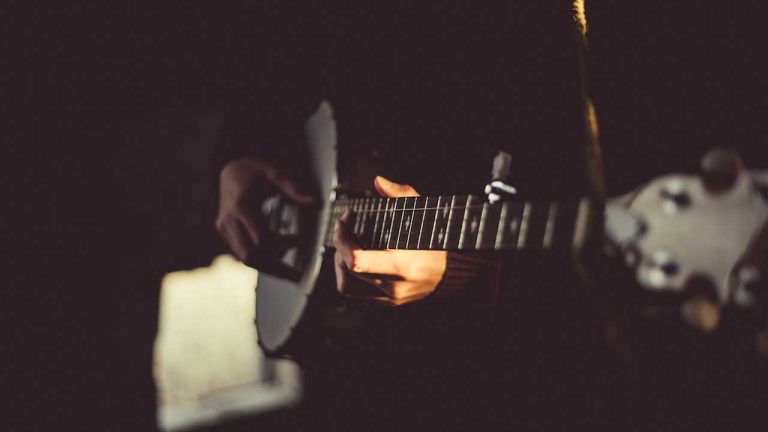
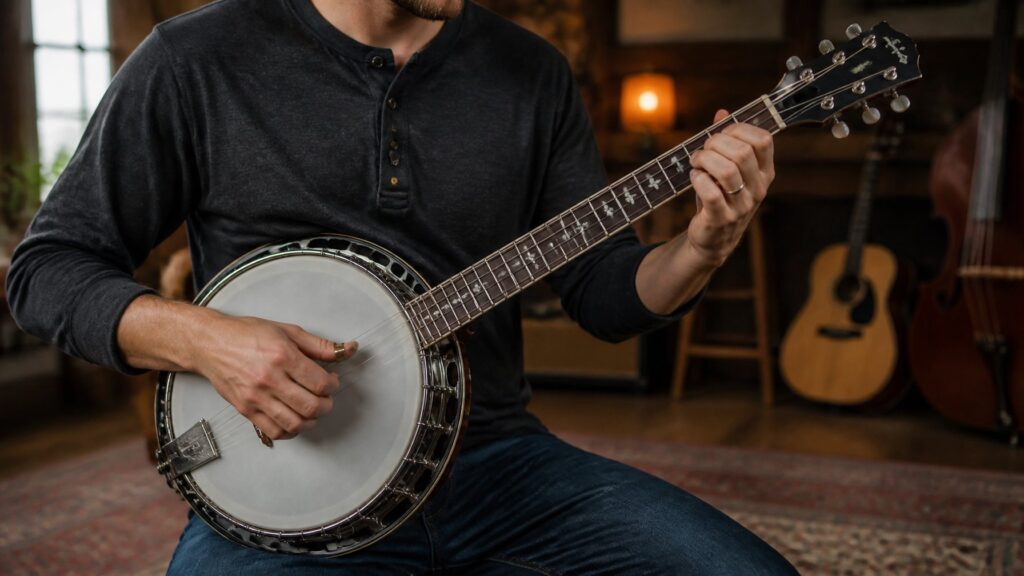
The right hand. Three-finger picking uses fingerpicks on your index and middle fingers plus a thumbpick. You play rolling patterns across the strings. These rolls have to be built into muscle memory, and they feel unnatural at first. This is the part that takes the most time and is most sensitive to technique errors.
The fingerpicks. Playing with metal picks on your fingers is strange for the first few weeks. They catch strings you did not mean to hit. Most people who quit banjo in the first month quit because of the picks, not because of anything musical. Push through this — it passes.
The 5th string. The banjo has a short drone string that re-enters the neck halfway up. Beginners do not always know what to do with it. Used well it gives the banjo its characteristic ringing sound. A good course teaches you this from the start; YouTube often glosses over it.
What Makes It Easier Than People Think
The open tuning. In standard G tuning, strumming the open strings with no fretting gives you a G major chord. From day one you are making music. Left-hand requirements are much lighter than guitar at the start.
Simple repertoire. A huge chunk of bluegrass and old-time music uses G, C and D. You can play real songs with basic chord shapes and the rolls doing the heavy lifting. Progress feels faster than on many instruments.
Why YouTube Takes So Much Longer
Rolls are muscle memory. Watching someone else play them correctly tells you nothing about whether your pick angle is right or whether your wrist is tensing. Bad roll technique is not just slow to fix — it can cause real physical tension over months of practice. YouTube cannot see you. That gap is much more costly here than on most instruments.
I have spoken to players who spent six months learning rolls from YouTube and then spent another six months undoing tension they had built into their wrist without realising it. That is a year of slower progress that structured lessons would have largely prevented. YouTube is also not structured — there is no progression, no one telling you what to work on next, no way of knowing what gaps you have until they become problems.
The Thing That Cut My Learning Time in Half
I use ArtistWorks and I want to be upfront: I have an affiliate relationship with them. I was using the platform before that and my view of it has not changed. I keep coming back because of one specific thing.
You record yourself playing and submit the video. A professional instructor watches it and sends back a personal video response about your specific playing — pick angle, wrist position, timing. Not a generic answer. A response to you. That exchange goes into a library that every student can learn from. It is the closest thing to having a teacher in the room, and for banjo technique it is the single thing that cut my learning time in half.
For banjo in particular, having someone watch your right hand and tell you specifically what is happening was the most useful thing I did in my first year. You cannot see your own pick angle. A Video Exchange response catches that in minutes. Last time I checked they still offer a 7-day free trial where you can submit an exchange before spending anything.
Which Banjo School Would I Recommend?
First decide: bluegrass three-finger style, or clawhammer old-time? Different techniques, different sounds. Most beginners mean bluegrass when they think of banjo. If you are not sure, start with bluegrass.
Bluegrass — Three-Finger Style
Tony Trischka — Banjo
Bluegrass, melodic, single-string, old-time, Celtic — beginner to advanced
Grammy nominee • IBMA winner • Taught Steve MartinTry Tony’s course free for 7 days7-day free trial — no card required
Alison Brown — Banjo
Scruggs fundamentals to intermediate-advanced — structured progression
Grammy winner • Compass Records founderTry Alison’s course free for 7 days7-day free trial — no card required
Noam Pikelny — Banjo
Advanced bluegrass and progressive technique
Grammy winner • 2x IBMA Banjo Player of the Year • Punch BrothersTry Noam’s course free for 7 days7-day free trial — no card required
Old-Time — Clawhammer Style
Allison de Groot — Clawhammer Banjo
Old-time, clawhammer technique — beginner to advanced
2024 Steve Martin Banjo Prize winnerTry Allison’s course free for 7 days7-day free trial — no card required
Frequently Asked Questions
Is banjo harder than guitar?
For the first few weeks, banjo is easier — the open tuning means you make music immediately and the left hand does less. Over time, mastering three-finger rolls to session standard is comparable to intermediate guitar. The fingerpicks add a physical adjustment guitar does not have.
What is the difference between clawhammer and three-finger banjo?
Three-finger picking uses fingerpicks and creates the rolling, driving sound of bluegrass. Clawhammer uses the back of the fingernail in a downward striking motion, creating the more rhythmic, percussive sound of old-time music. They are completely different techniques. Pick one and commit to it rather than trying to learn both at once.
Can I learn banjo without reading music?
Yes. Banjo is almost entirely tab-based in folk and bluegrass tradition. All four ArtistWorks banjo schools include tablature. Reading music is not required.
How many strings does a banjo have?
A bluegrass banjo has 5 strings. The 5th is the short drone string that enters the neck at the 5th fret. Tenor banjos (used in Irish trad and early jazz) have 4 strings. All ArtistWorks banjo schools cover 5-string unless specified.
For more on banjo: our banjo string gauges guide and our tenor banjo capo chart.
Author Profile

- Daniel Johnstone — Dániel to his friends back in Miskolc — is a Hungarian folk musician and writer who has been playing stringed instruments for over twenty years. Growing up in northeastern Hungary with a family steeped in folk music, he developed an early obsession with Celtic and Appalachian styles that eventually brought him to the UK. He worked his way through tenor banjo, 5-string banjo, autoharp, mountain dulcimer, mandolin, ukulele, harp and kalimba — most of them acquired through trial, error and more money than he'd like to admit. He founded Folkstrings.com to cut through the noise: practical, experience-based guides to instruments, strings, gear and accessories for folk players at every level.
Latest entries
 BanjoJuly 14, 2026Is Banjo Hard to Learn? Here’s What Nobody Tells You
 MandolinJuly 14, 2026Online Mandolin Lessons — What YouTube Can’t Teach You (And What Can)
 Useful ToolsJuly 13, 2026Recorder Fingering Chart — Complete Guide for Soprano Recorder (Baroque and German)
 UkuleleJuly 12, 2026Gifts For Ukulele Players: 10 Best Picks