How to Read Kalimba Tabs for Beginners
Folkstrings.com is reader-supported. When you buy through links on our site, we may earn a small commission.
Last Updated on June 16, 2026 by folkstrings
When I first picked up a kalimba, I stared at a row of numbers like “1 3 5 3 1” and had no idea what to do with them.
Then I plucked a few keys in order and suddenly heard a real melody come out. That moment of clicking is exactly what I want to help you reach right away.
Kalimba tabs are a numbered shortcut system that tells you exactly which metal tine to pluck, in what order, so you can play real songs within minutes of picking up your thumb piano.
Unlike traditional sheet music, you don’t need to know any music theory. If you can count to 17, you can read kalimba tabs.
This guide is for people who have a 17-key kalimba in their hands right now and want to play something today.
I’ll walk you through the number system, the physical layout, common symbols, rhythm, and the different tab formats you’ll find online.
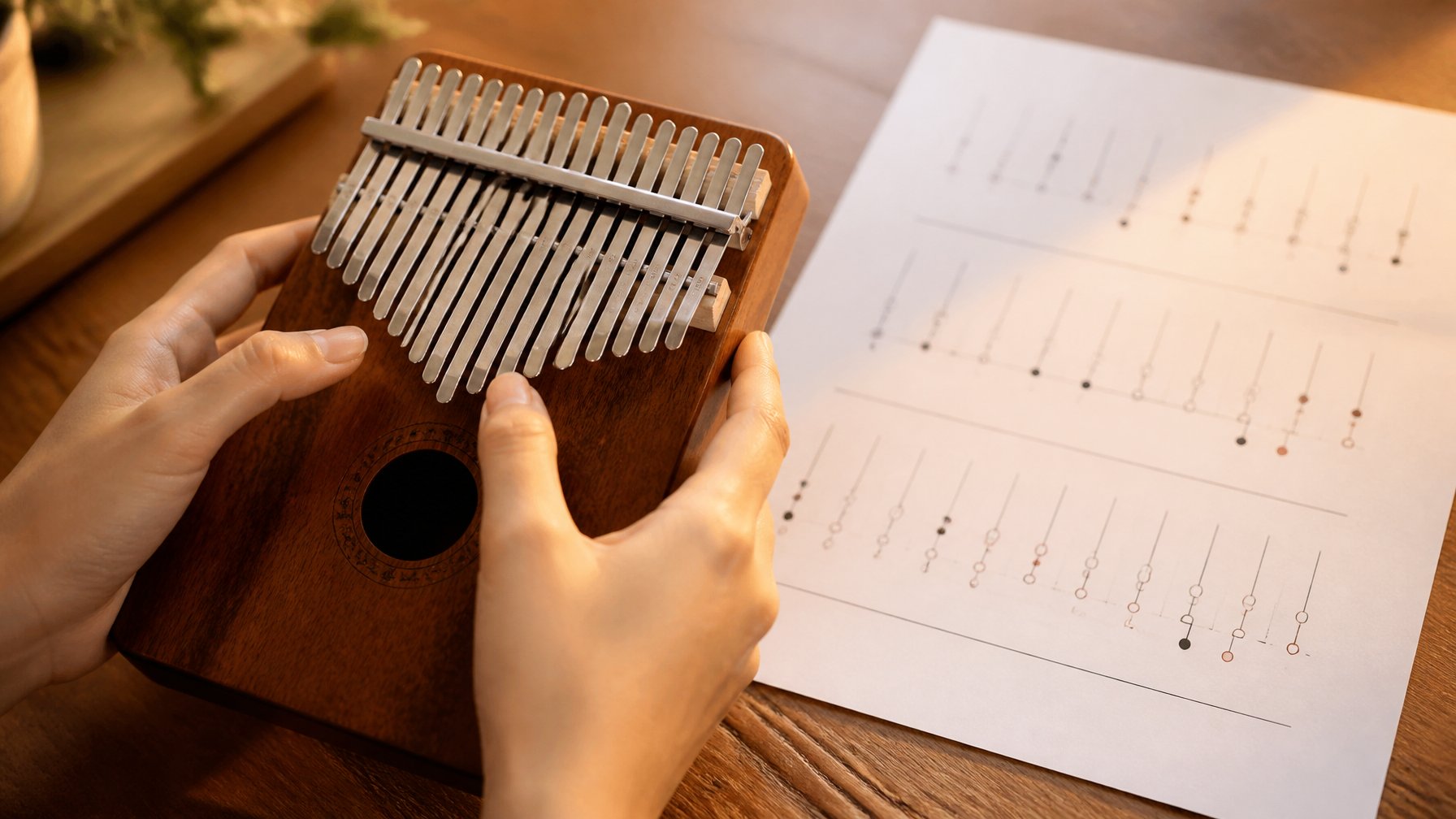
Learning to read kalimba music doesn’t have to feel overwhelming.
The notation system was literally designed so that non-musicians could start playing immediately. That’s a big part of why kalimba has exploded in popularity.
Key Takeaways
- Kalimba tabs use a simple number system that maps directly to the tines on your instrument, no music theory required.
- The physical layout of a 17-key kalimba follows a predictable left-right alternating pattern that makes reading tabs feel natural quickly.
- Knowing the difference between number tabs, letter notation, and vertical tablature helps you use any source you find online without confusion.
Read Your First Tab in Minutes
Reading kalimba tabs comes down to three simple ideas: numbers stand for tines, you follow them left to right, and the spacing gives you a rough sense of rhythm.
Once those three things click, you can decode almost any beginner tab you find online.
What the Numbers Mean
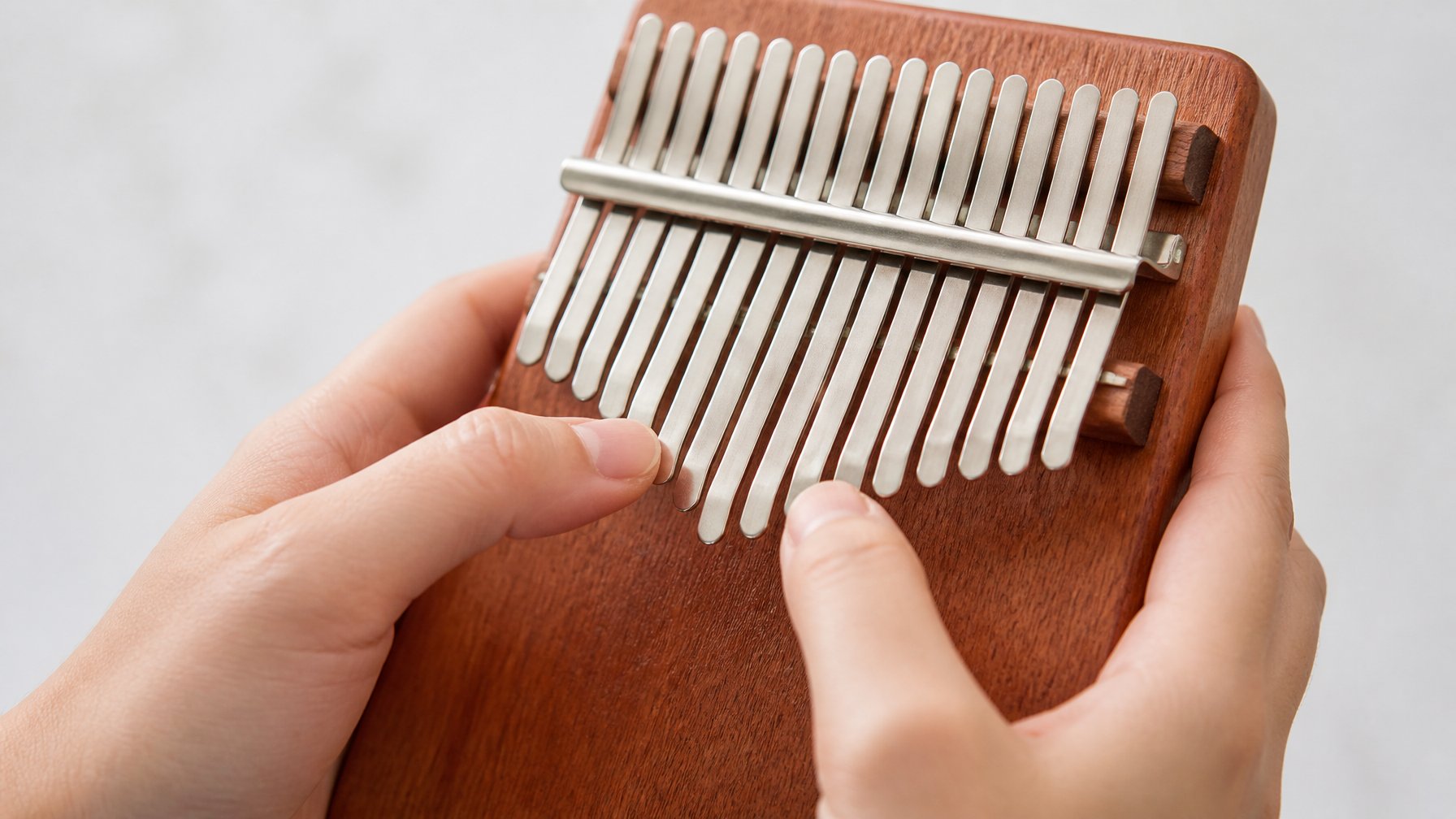
Each number in a kalimba tab represents one specific tine on your instrument.
On a standard 17-key kalimba, the tines are numbered 1 through 17. Number 1 is the longest tine and produces the lowest note. Number 17 is the shortest and gives you the highest note. Number 8 sits in the center and is often the anchor note for many melodies.
Think of it like a map. The tab is telling you exactly where to put your thumb, in what order.
How to Follow Notes in Order
Read a kalimba tab exactly like a sentence in a book: left to right, one number at a time.
Each number means pluck that tine once. If you see the same number twice in a row, pluck that tine twice. A vertical bar symbol (|) separates measures, which just means a natural pause point in the song.
When numbers are stacked vertically, that means play them at the same time as a chord.
I’ll cover that more in the symbols section.
A Simple Beginner Example
Here’s a tab for the opening of “Hot Cross Buns”:
3 3 5 | 3 3 5 | 5 6 8 6 5 | 3 3 5
Try it right now. Pluck tine 3 twice, then tine 5 once. Repeat that. Then play 5, 6, 8, 6, 5 in sequence. Finish with 3, 3, 5.
That’s a real song, and you just read your first kalimba tab.
Understand the Keyboard Layout
The layout of a 17-key kalimba follows a specific alternating pattern that surprises most beginners at first glance.
Once you understand how the tines are arranged and which thumb reaches which side, matching tab numbers to the real instrument gets way easier.
How a 17-Key Kalimba Is Arranged
A 17-key kalimba is a modern version of the traditional mbira, refined for easy tuning and playability.
The 17 tines are arranged from longest in the center to shortest on the outer edges. This is the opposite of a piano, where the lowest notes are on the far left.
The tines don’t run left to right in simple number order. Instead, they alternate: left side, right side, left side, right side, getting shorter and higher in pitch as they move outward from the center.
Center Note and Left-Right Pattern
Tine 8 is the center tine and plays middle C (C5).
It’s the easiest landmark to find because it sits right in the middle of the instrument. From there, tines spread outward in alternating directions.
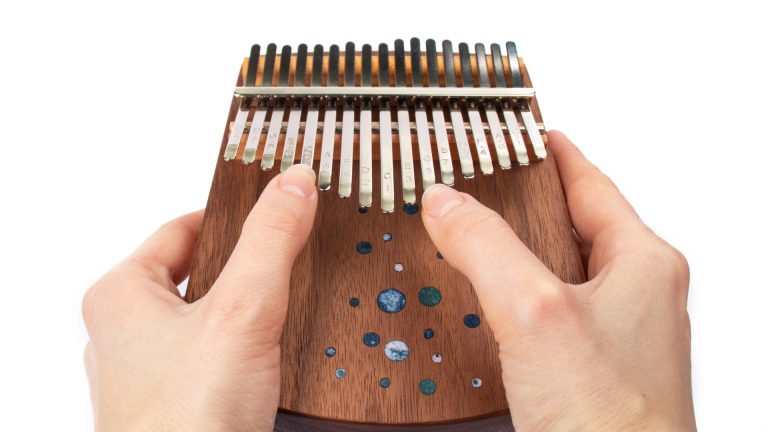
- Left side tines (1-7): played with your left thumb
- Center tine (8): played with either thumb
- Right side tines (9-17): played with your right thumb
This alternating layout is what gives kalimba music its natural, fluid sound when played correctly.
Matching Tab Numbers to Real Tines
When I see a tab number, I match it to a tine by starting from the center and counting outward.
Tine 8 is center. Tine 9 is one step to the right. Tine 7 is one step to the left.
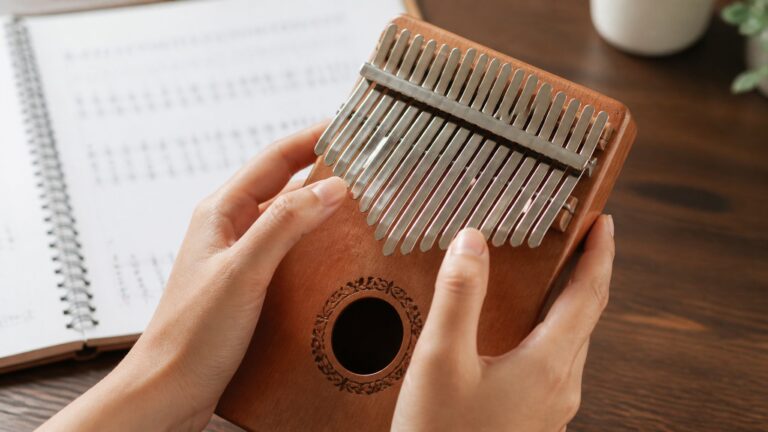
Many kalimbas come with the numbers already printed or engraved on each tine, which makes this process even simpler.
If yours doesn’t have markings, a small sticker label on each tine solves that immediately.
Decode Common Tab Symbols
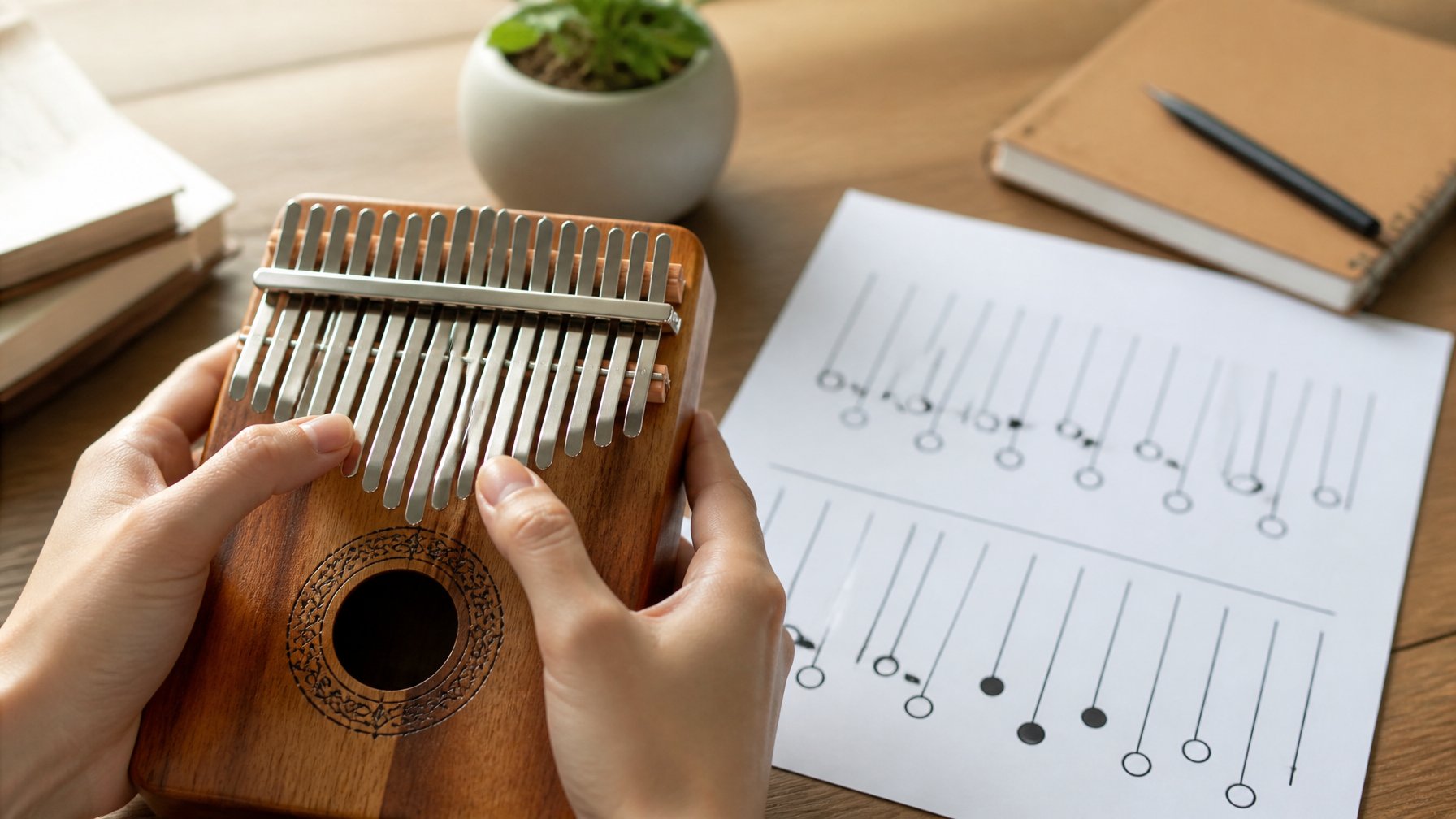
Beyond simple numbers, kalimba tabs use a small set of extra symbols to handle higher notes, chords, and timing.
These symbols look unfamiliar at first, but each one follows a clear logic that makes sense once you see it in action.
Octave Dots and High Notes
A dot above or below a number signals a different octave.
In kalimba notation, most tab systems use a number range of 1 through 7, repeating across multiple octaves. A dot above the number (like ·1) means play that note one octave higher. A dot below (like 1·) means one octave lower.
On a 17-key kalimba, the note C appears three times at different pitches.
The dots tell you which version of that note to play. Once you recognize this pattern, high-note passages in tabs become much less confusing.
Chords, Brackets, and Stacked Notes
When you see two or more numbers stacked vertically in a tab, that means play them at the same time as a chord.
Some tabs use brackets or parentheses instead, like (3 5), to show the same thing.
Chords on a kalimba are played by pressing two tines simultaneously, one with each thumb.
This is easier than it sounds and adds a lot of fullness to the sound. Start with simple two-note combinations before attempting three-note chords.
Pauses, Bars, and Repeated Notes
A vertical bar (|) marks the end of a measure and signals a natural pause or breath in the melody.
A dash (-) or blank space between numbers often indicates a brief rest. Some tabs use a colon (:) at the start and end of a section to show a repeat, meaning you play that section twice.
Repeated notes just mean pluck the same tine again.
There’s no special symbol needed beyond seeing the same number appear again in sequence.
Follow Rhythm Without Getting Stuck
Rhythm is the part of reading kalimba music that trips up most beginners, and honestly, that’s completely normal.
Kalimba tablature doesn’t use formal rhythmic notation the way sheet music does, so the key is learning to use your ear alongside the tab.
How Timing Is Shown in Beginner Tabs
Most beginner kalimba tabs show timing loosely through spacing.
Numbers that are grouped closely together are played in quick succession. Numbers that are separated by spaces or bars are held slightly longer or followed by a brief pause.
Some tabs use dashes to show held notes, like 5 --- 3 3, which suggests tine 5 rings out before you move on.
This isn’t a strict system, but it gives you a workable rhythm guide while you learn the song.
When to Listen Along Instead of Overthinking
Here’s my honest advice: find a recording of the song first and listen to it once before you start playing the tab.
Your brain already knows the rhythm of songs you recognize. When I tried to figure out rhythm from spacing alone, I got it wrong. When I listened first and then followed the tab, it clicked immediately.
For songs you don’t know, slow playback videos on YouTube are incredibly helpful.
Match what you hear to the numbers on the page, and the rhythm becomes intuitive fast.
Thumb Coordination for Smooth Playing
Smooth rhythm comes partly from good thumb technique.
Use the fleshy pad of each thumb to pluck each tine with a downward flicking motion. Avoid pressing down or dragging across the tine.
Practice alternating your thumbs on a simple scale like 1 2 3 4 5 6 7 8 to build coordination before tackling a full song.
Even five minutes of this daily will noticeably improve how evenly you play through a tab.
Switch Between Tabs and Sheet Music
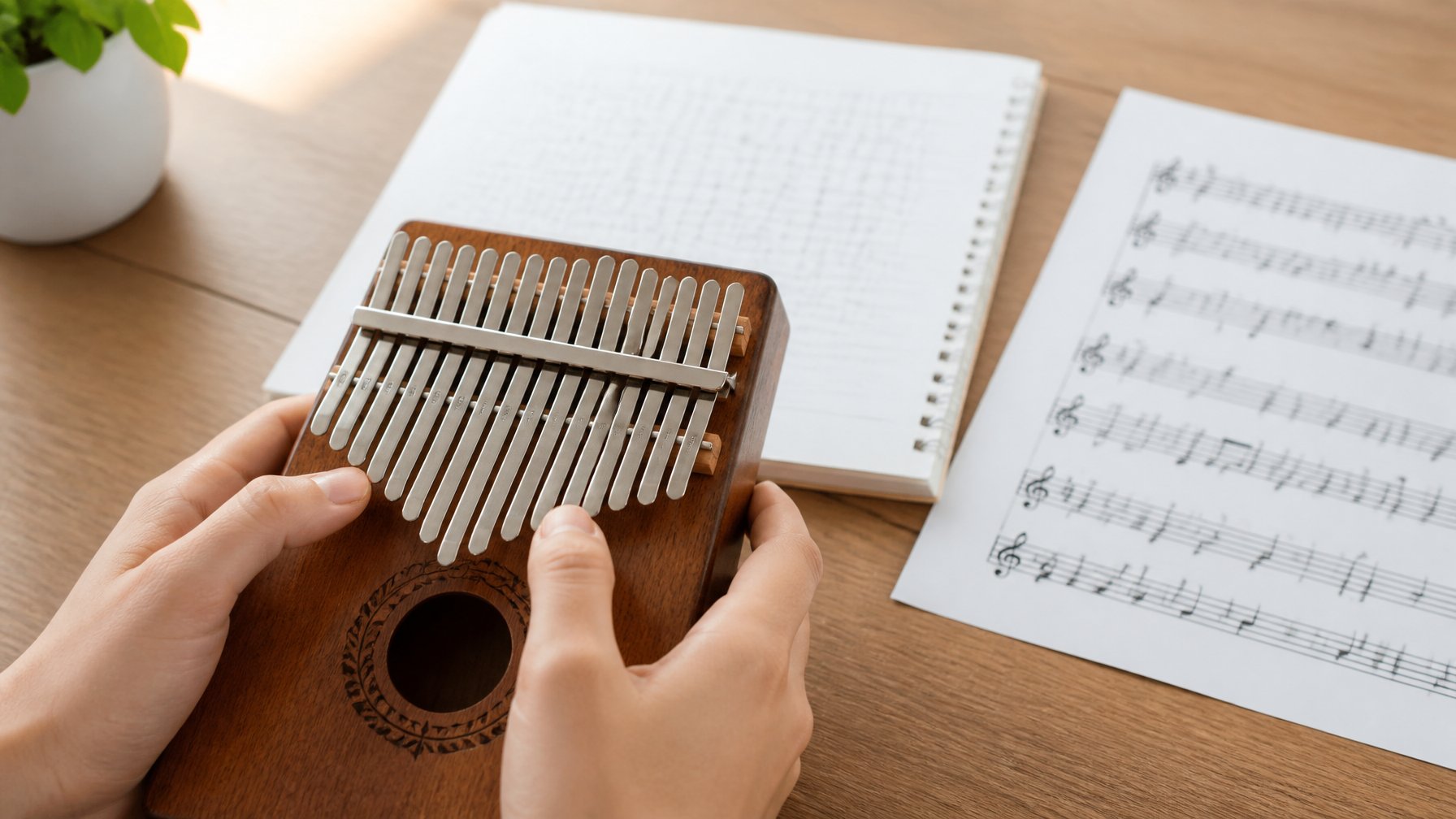
When you search for kalimba music online, you’ll encounter at least three different formats: number tabs, letter notation, and vertical kalimba tablature.
Each one looks different, but they all point to the same tines on your instrument. Knowing how each format works saves a lot of frustration when switching between sources.
Number Tabs vs Letter Notes
Number tabs use digits—usually 1 through 17, or sometimes 1 through 7 with octave dots—to identify each tine. Letter notation sticks with note names like C, D, E, F, G, A, B, sometimes adding a number for the octave, like C4 or D5.
If you see a tab like C D E D C, that matches up with tines 1, 2, 3, 2, 1 on a standard C-tuned 17-key kalimba. The numbers and note names both point you to the same tines, just in different ways.
Most kalimbas come with a little chart pairing numbers and letter names, so switching between the two is usually a breeze.
How Vertical Tablature Works
Vertical kalimba tablature pops up a lot in printed sheet books and some kalimba apps. Instead of reading left to right, you read from the bottom of the page up.
Each column stands for one tine, and dots or marks along the columns show you when to pluck. It might look a bit overwhelming at first glance, but really, every mark just means “pluck this tine now.”
Time moves from bottom to top, which is a twist, but you get used to it pretty quickly.
When to Read Kalimba Sheet Music
Traditional kalimba sheet music usually pairs a musical staff with number or letter notes underneath. If you ever want to play from classical or piano arrangements, it’s worth learning this format.
Most beginners don’t need it right away, but once you’re comfortable with the basics, it opens up a much bigger library of songs.
Set Yourself Up for Easier Practice
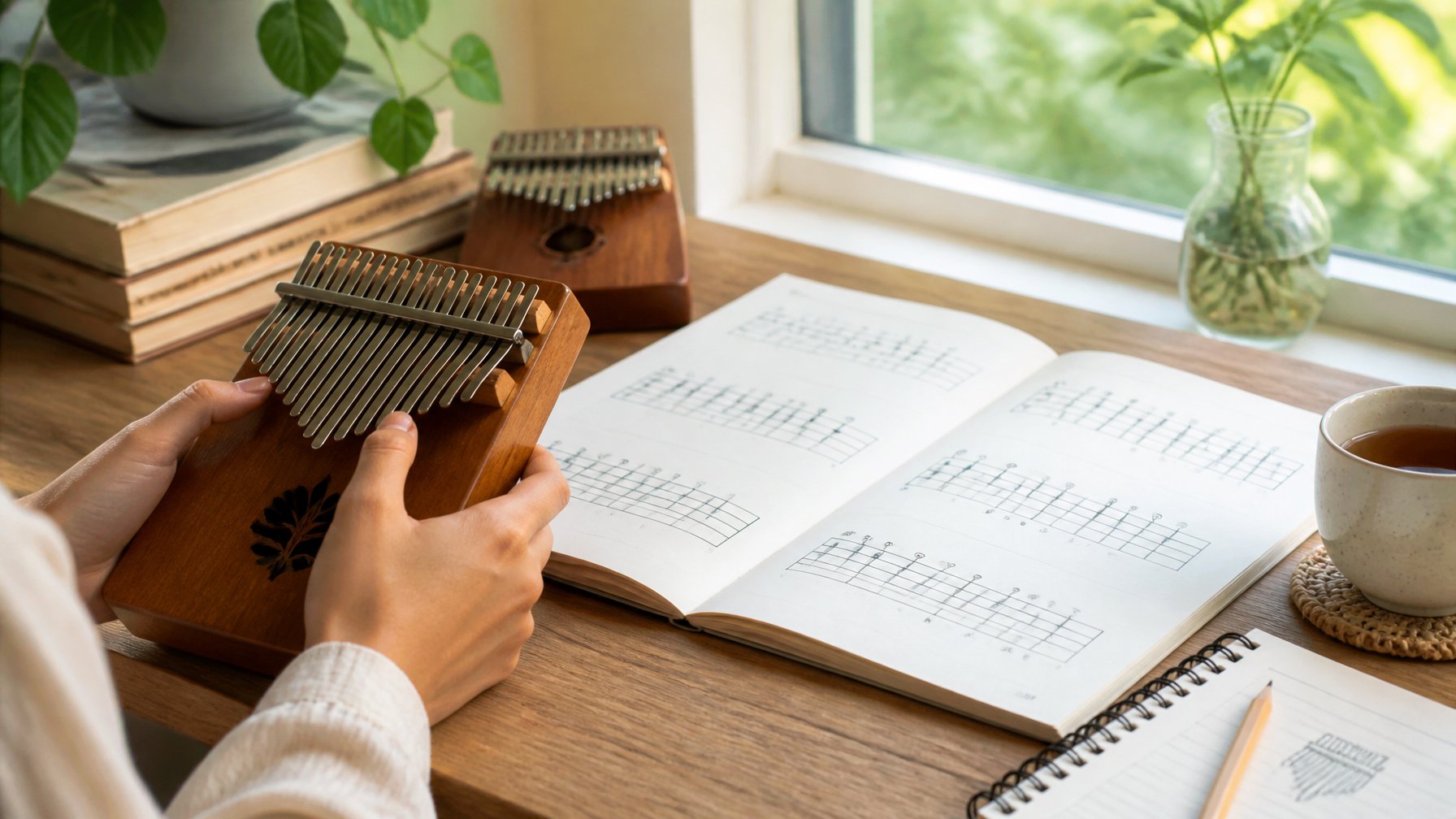
Even the clearest notation won’t help if your kalimba’s out of tune or your practice habits are working against you. A few simple setup steps can make your practice time way more enjoyable—and honestly, more productive too.
Check Tuning Before You Start
If your kalimba’s even a little out of tune, matching what you hear in recordings gets tough, and learning slows down. Before I start, I quickly check tuning using a tuner app on my phone.
Most 17-key kalimbas come tuned to C by default. I pluck each tine and make sure it matches its note. If something’s off—flat or sharp—I tweak it before playing.
When You Need a Tuning Hammer
Most kalimbas include a small tuning hammer, a metal rod for gently tapping tines to adjust pitch. Tap the tine downward to raise the pitch, which shortens it.
To lower the pitch, tap upward and lengthen the tine. I move in tiny steps and check the tuner after each tap. Kalimbas are sensitive, so a light touch is best.
If your kalimba didn’t come with a hammer, a small coin or even the flat end of a butter knife can work in a pinch.
Best Habits for Faster Progress
I always start practice with something I already know. It warms up my thumbs and gets me in the right mindset.
Then I’ll try a new tab, going slow and listening closely. Short, daily sessions—10 to 15 minutes—help me improve faster than one long weekly session.
I like to keep a few printed tabs nearby so I can just pick up and play, no searching needed.
If you’re new to the instrument entirely, start with my guide on what a kalimba is, and then how to play the kalimba for beginners before working through tabs.
Frequently Asked Questions
What do the numbers in kalimba tabs mean?
Each number in a kalimba tab matches a specific tine on your instrument. On a 17-key kalimba, 1 is the lowest-pitched tine and 17 is the highest.
You just pluck the tines in the order the numbers show, reading left to right.
How can I tell which tine to play from a kalimba tab?
Match the number in the tab to the number printed or engraved on your tine. If your kalimba doesn’t have numbers, count out from the center tine (tine 8) to find the right one.
A quick reference chart that pairs numbers with note names makes this even faster, honestly.
What’s the difference between kalimba tabs and letter notation?
Kalimba tabs use numbers for tines, while letter notation uses note names like C, D, or E. Both systems point to the same tines on a C-tuned kalimba.
For example, C4 is the same as tine 1, and D4 is tine 2. It’s easy to cross-reference once you get the hang of it.
Are kalimba tabs easy to learn for complete beginners?
Absolutely, kalimba tabs are super beginner-friendly. No music theory background needed.
Most people can follow a basic tab within their first practice session. It’s really that simple.
Where can I find beginner-friendly kalimba tabs for popular songs?
There are websites dedicated to kalimba tabs with free libraries and numbered notation. Some even have interactive players so you can hear the melody as you follow along.
YouTube’s also packed with tutorial videos that show tabs on screen while the creator plays the song in real time. It’s a great place to start.
How can I write my own kalimba tabs from a melody?
Try humming or singing the melody, just one note at a time. Find each note on your kalimba by ear—this part can take a bit of patience, honestly.
Once you match a note to a tine, jot down its number. Keep going, mapping out the whole melody as a sequence of numbers.
It’s a pretty solid ear-training exercise. You’ll probably notice your tab-reading skills get stronger the more you do it.
Author Profile

- Daniel Johnstone — Dániel to his friends back in Miskolc — is a Hungarian folk musician and writer who has been playing stringed instruments for over twenty years. Growing up in northeastern Hungary with a family steeped in folk music, he developed an early obsession with Celtic and Appalachian styles that eventually brought him to the UK. He worked his way through tenor banjo, 5-string banjo, autoharp, mountain dulcimer, mandolin, ukulele, harp and kalimba — most of them acquired through trial, error and more money than he'd like to admit. He founded Folkstrings.com to cut through the noise: practical, experience-based guides to instruments, strings, gear and accessories for folk players at every level.
Latest entries
 BanjoJuly 14, 2026Is Banjo Hard to Learn? Here’s What Nobody Tells You
 MandolinJuly 14, 2026Online Mandolin Lessons — What YouTube Can’t Teach You (And What Can)
 Useful ToolsJuly 13, 2026Recorder Fingering Chart — Complete Guide for Soprano Recorder (Baroque and German)
 UkuleleJuly 12, 2026Gifts For Ukulele Players: 10 Best Picks