Mandolin Tuning Made Simple
Last Updated on June 10, 2026 by folkstrings
Getting a mandolin in tune is the first thing I do before playing a single note. Honestly, it makes a bigger difference than most beginners expect.
The mandolin has eight strings arranged in four pairs called courses. Each course is tuned to the same pitch, so you’ve got twice as many strings to wrangle compared to a four-string instrument, which can feel a bit overwhelming at first.
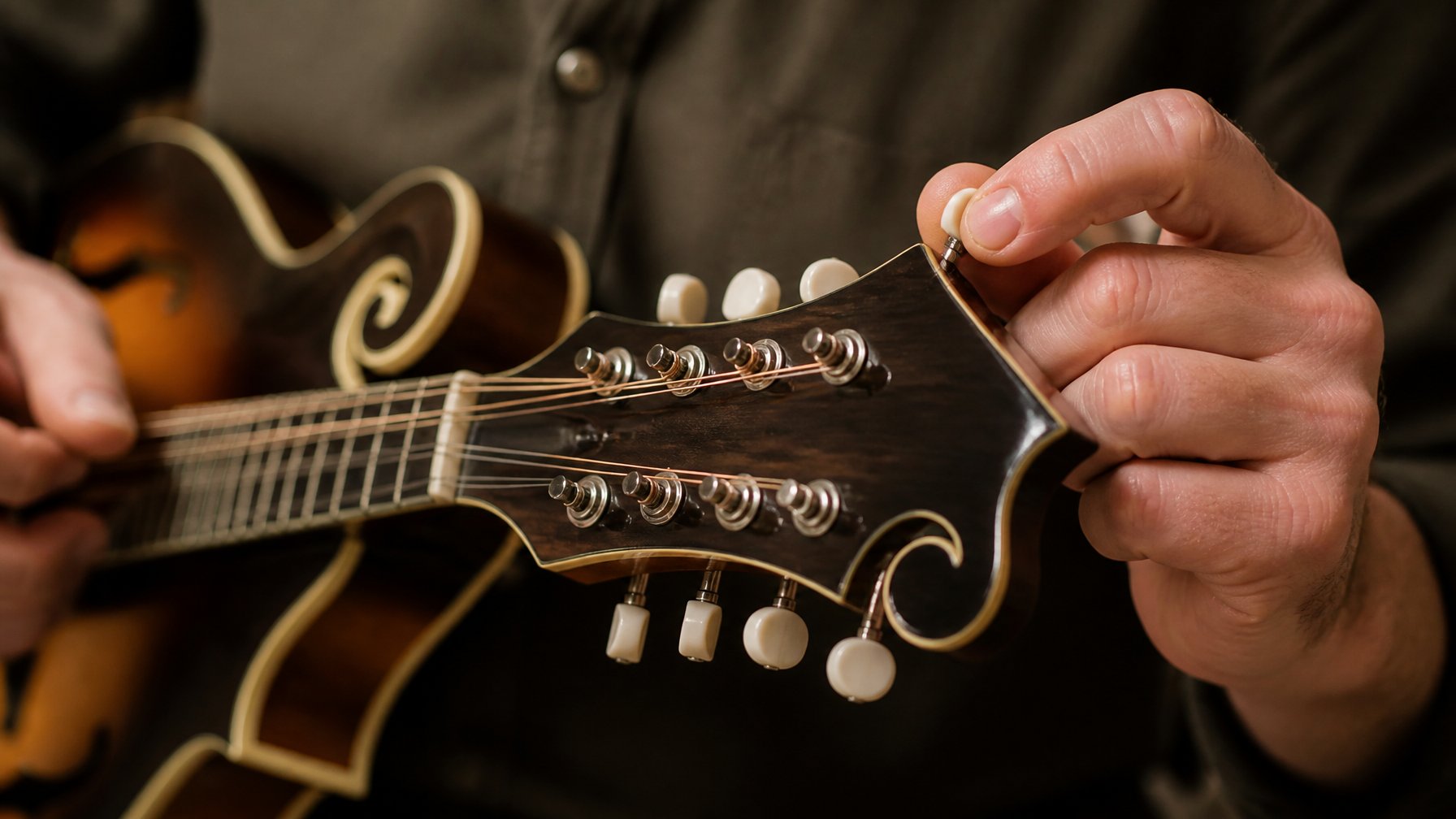
Standard mandolin tuning runs G-D-A-E from the lowest course to the highest. Getting those eight strings to ring together cleanly is, honestly, the whole game.
Whether you’re coming from guitar, violin, or picking up a stringed instrument for the first time, the process is pretty straightforward once you know the order and what to listen for. This guide covers everything from the basic notes to alternate tunings, tuner tools, and fixes for common problems.
Key Takeaways
- Standard GDAE tuning matches violin tuning exactly, with each note doubled across two strings in a course.
- A clip-on chromatic tuner is the most reliable starting point, but tuner apps and online tuners work well in quiet settings.
- New strings drift out of tune quickly, so stretching them after installation saves a lot of frustration.
Know The Notes Before You Start
Standard mandolin tuning is built around four notes spaced a fifth apart. Knowing those notes before you touch a tuning peg saves time and confusion.
The paired string setup adds a bit of extra work that guitar players might not expect. It really helps to picture the instrument clearly from the start.
Standard GDAE And What Each Course Means
The four courses on a mandolin are tuned, from lowest to highest: G3, D4, A4, and E5. Each pitch name represents a pair of strings, so your full lineup is G-G-D-D-A-A-E-E.
When both strings in a course are perfectly matched, you get that rich, shimmering tone the mandolin is known for. If they’re even slightly off, the sound turns wobbly and unfocused—no amount of good playing will fix that.
Why Mandolin Matches Violin Tuning
Mandolin and violin share identical standard tuning: G-D-A-E in fifths. That means violin sheet music, scales, and fingering patterns transfer directly to the mandolin neck.
If you’re coming from violin, note names and positions will feel immediately familiar. The main difference? Mandolin strings are paired, while violin strings are single.
How The Tuning Pegs Map To The Strings
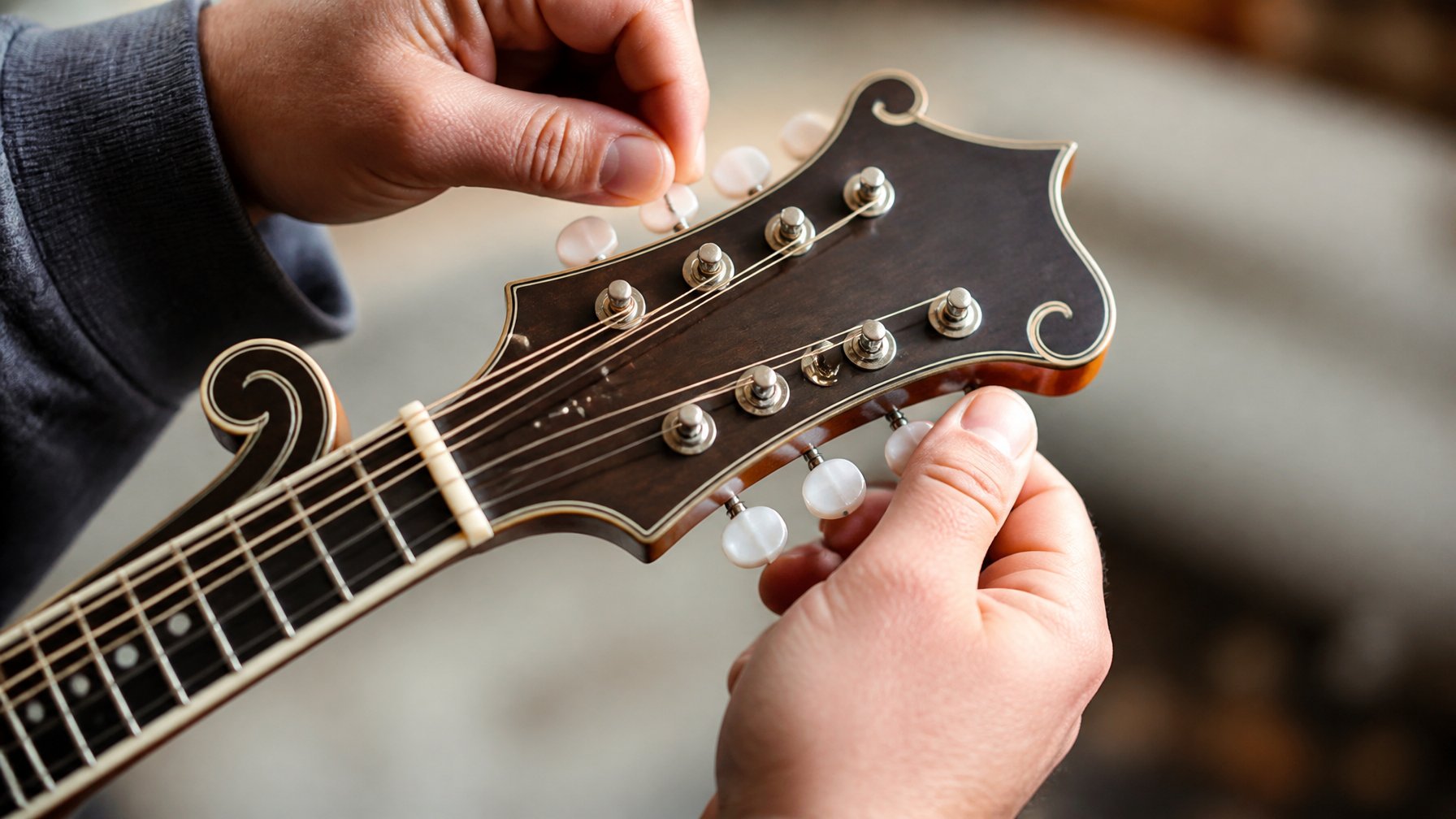
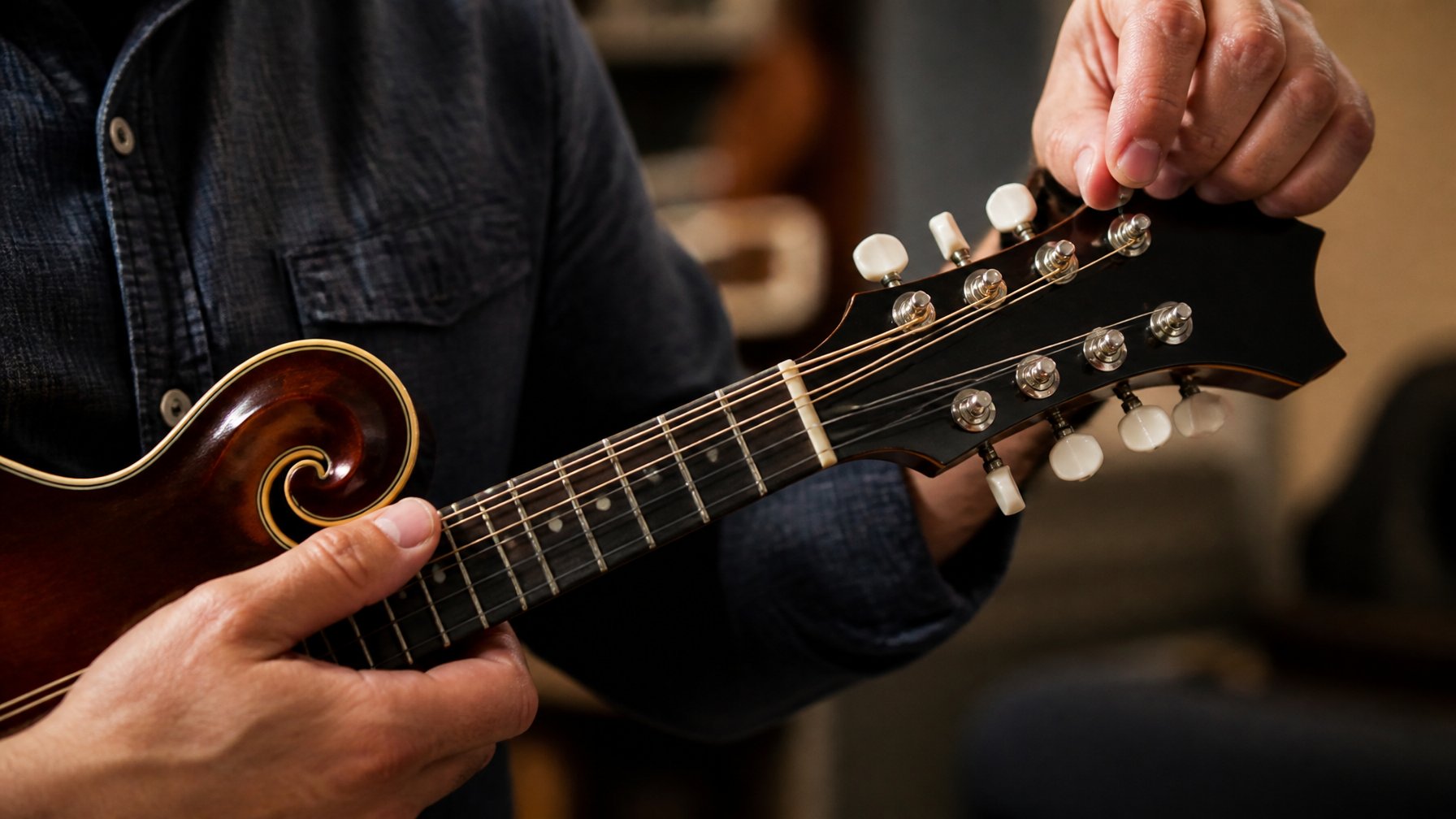
This part trips up a lot of beginners. On most mandolins, the tuning pegs on the left side of the headstock control the strings on the left, and the pegs on the right control the strings on the right.
The pegs on opposite sides turn in opposite directions to raise pitch, which is easy to forget. I always pluck the string while slowly turning the peg so I can hear and feel which direction raises or lowers the note before making a big adjustment.
Tune It Correctly Step By Step
The actual tuning process is about working in a consistent order. Make small, deliberate adjustments instead of big ones.
Knowing how to tell if a string is sharp or flat—and why you should always approach pitch from below—makes every session faster and more stable.
Which Course To Start With
I always start tuning from the lowest course and work up: G first, then D, then A, then E. Starting at the bottom gives the instrument a stable foundation before you adjust the higher, more tension-sensitive strings.
Jumping around between courses tends to throw off strings you’ve already set, especially on a mandolin where string tension is tightly interconnected.
How To Adjust When A String Is Sharp Or Flat
- Flat (too low): Turn the tuning peg to increase tension until the note rises to pitch.
- Sharp (too high): Drop the string below the target pitch first, then tune back up to it.
That last point really matters. Always approach the target note from below, not from above.
If you tune down to a note, the string can slip back flat under playing pressure. Tuning up locks the string in place more reliably.
How To Match Both Strings In A Pair
Tune the first string in a course to your reference. Then tune the second string to match.
Play both together and listen carefully. If you hear a pulsing or beating sound, the two strings are slightly different in pitch.
Slow the beating down by nudging one string closer to the other until the pulse disappears and the two strings ring as one clean tone.
Choose The Best Tuning Method
Each tuning method has a real use case. The right choice depends on where you’re playing, how much background noise there is, and how quickly you need to get in tune.
Clip-on tuners, chromatic tuners, online mandolin tuners, and apps all have their own strengths worth knowing.
Using A Clip-On Or Chromatic Tuner
A clip-on tuner attaches to the headstock and reads pitch through the vibration of the wood, not a microphone. This makes it accurate even in loud environments like a jam session or noisy rehearsal space.
A chromatic tuner works the same way in terms of reading all twelve notes, which is exactly what you need for GDAE tuning. I use a clip-on chromatic tuner as my default because it’s fast, reliable, and doesn’t care what’s happening in the room around me.
When An Electronic Tuner Makes Sense
An electronic tuner with a display needle is ideal when I want a precise read on each string, especially when matching the two strings in a course. The visual feedback makes it easier to see how close I am before I even start listening.
For new strings that keep drifting, repeated quick checks with an electronic tuner are much less frustrating than trying to tune by ear every time.
Using An Online Mandolin Tuner Or Online Tuner
An online mandolin tuner works through your device’s microphone and displays whether each string is in tune in real time. These are genuinely useful at home or in a quiet studio.
Many online tuners support GDAE and alternate tunings, which is a nice bonus. The limitation is background noise—a barking dog or TV in the next room can throw off the microphone detection noticeably.
Best Tuner App Options For Quick Checks
For phone-based tuning, three apps I’d recommend checking out are GuitarTuna, Pano Tuner, and Cleartune. GuitarTuna has a specific mandolin mode and a simple display that’s easy to read at a glance.
Pano Tuner offers a strobe-style view for more precision. Cleartune is particularly clean and responsive. All three rely on your phone’s microphone, so they work best in quiet rooms.
Tune By Ear With Confidence
Tuning by ear is a skill worth building, even if you always carry a tuner. It trains you to hear small pitch differences that really affect how you play.
The key is starting from a reliable reference pitch and using the natural acoustic feedback the mandolin gives you.
Using A Tuning Fork As Your Reference
A standard A440 tuning fork gives me a consistent reference pitch whenever I need one. I strike it against my knee, hold the stem against the mandolin body, and let the resonance fill the instrument while I pluck the A course and adjust.
Once the A course is locked in, I can build the rest of the tuning by ear from there. A tuning fork never needs batteries and isn’t affected by room noise.
How To Tune By Ear From A Single Note
With a reliable A reference, I tune the A course first, then work outward. The D course is a fifth below A, and the E course is a fifth above A.
The G course is a fifth below D. I play the fifth fret of one course against the open string of the next to check the interval, adjusting until both notes lock together without wavering.
It takes some practice, but the logic is consistent and repeatable. Once you get the hang of it, it’s actually pretty satisfying.
Listening For Beating Between Paired Strings
Beating is the acoustic pulse you hear when two strings are close to—but not exactly—the same pitch. It sounds like a slow wobble or tremolo in the tone.
To match both strings in a course by ear, I play them together and listen for that wobble. As I adjust one string closer to the other, the beating slows down. When it stops completely, the strings are in unison.
This is probably the most useful listening skill for tuning a mandolin well.
Fix Common Problems That Throw Off Pitch
New strings, cold rooms, and confused tuner readings are the three most common reasons a mandolin won’t stay in tune. Knowing the cause makes the fix a lot less mysterious.
Why New Strings Drift Out Of Tune
New mandolin strings stretch a lot in the first few days after installation. Every time I play, the string tension settles a bit, pulling the pitch flat.
This is totally normal and not a sign that anything’s wrong with the instrument. The fix is to speed up that stretching process intentionally before expecting the strings to hold pitch.
How To Stretch New Strings Safely
After installing new strings and tuning to pitch, I gently pull each string away from the fretboard with my fingers, working along its length from the nut to the bridge. Then I retune and repeat the process two or three times.
This manually compresses the stretching process from several days into a single session. The strings will still need tuning more often for the first day or two, but the dramatic drift stops much sooner.
What To Do If The Tuner Reads The Wrong Note
If your tuner flashes a weird, unexpected note, chances are the string’s tuned to the wrong octave or has drifted way off. I usually pluck the string gently and see if the tuner responds clearly.
In a noisy room, phone and online tuners sometimes pick up background noise instead of the string. Switching to a clip-on tuner usually fixes that right away.
If the tuner shows a note that’s just one step off, the string probably just needs to be brought closer to the right pitch range. After that, the tuner can lock onto the correct note.
Explore Alternate Setups For Different Styles
Standard GDAE tuning covers most situations. But alternate tunings open up new chord shapes, drone options, and those modal sounds you hear in certain styles.
Cross tuning and sawmill tuning are the two main alternatives you’ll find in American and Celtic traditions. They’re both pretty common if you hang around old-time or folk musicians.
When To Try Alternate Tunings
Honestly, I’d get comfortable with standard GDAE before jumping into the world of alternate tunings. Once you can tune by ear and spot when something’s off, experimenting with an alternate setup feels a lot less confusing.
You’ll run into alternate tunings most often in folk and old-time settings. There, open chord shapes and certain keys just work better than they do in standard tuning.
Cross Tuning And Sawmill Tuning Basics
Cross tuning means raising or lowering one or more strings to get an open chord or new intervals. Sawmill tuning bumps the G course up to A, so you end up with A-D-A-E.
This setup is super popular for old-time fiddle tunes, since you can get those open-string drones in D and A. The term “sawmill” comes from its roots in early American folk music.
How Alternate Setups Change Chords And Drones
In sawmill tuning, the lowest string rings as A instead of G. That gives you a steady low drone for tunes in D or A.
Chord shapes change a lot compared to standard GDAE, so your usual fingerings won’t always work. A lot of players keep a second mandolin set up for alternate tunings instead of retuning their main one back and forth, since all that retuning can wear out the strings and even stress the neck after a while.
Frequently Asked Questions
What are the standard string notes from low to high?
The four courses go G-D-A-E, lowest to highest. Each course has two strings tuned to the same note.
So, from low to high, that’s G-G-D-D-A-A-E-E. The octaves are G3, D4, A4, and E5.
How do I tune it using a chromatic tuner?
Clip the tuner onto the headstock. Pluck a string, check the display for the note name, and see if the needle is flat, sharp, or centered.
Turn the tuning peg until the needle sits right in the middle. Do this for every string. Chromatic tuners read all twelve notes, so they’re good for both standard and alternate tunings.
What’s the easiest way to tune by ear if I’m a beginner?
Start by tuning your A course to a reliable reference—could be a tuning fork, piano, or even an online tone. Then use the fifth-fret method to match the other courses.
Play both strings in each course at once. Listen for a smooth, steady sound with no pulsing or wobble.
Why won’t my strings stay in tune, and how can I fix it?
New strings are almost always the culprit. They need time or a bit of stretching to settle in.
After tuning, gently pull each string away from the fretboard a few times, then retune and repeat. Changes in temperature and humidity can also mess with tuning, so it’s a good idea to tune before every session, no matter how recently you played.
Should I tune the paired strings exactly the same, and how do I check?
Yep, both strings in a course should match exactly. Play them together and listen for any beating or wobble.
When they’re in tune, the sound is clean and steady. You can also check each string with a tuner to make sure they both register the same note.
How often should I tune, especially when changing strings or temperature shifts?
Tune every time you pick up the instrument. Mandolins react a lot to temperature, humidity, and even just being played.
It’s normal for the pitch to shift between sessions. When you put on new strings, you’ll probably need to tune several times per session for the first few days.
Eventually, the strings settle down, but patience is key. Honestly, if it sounds off—just tune it again. No shame in that.
Author Profile

- Daniel Johnstone — Dániel to his friends back in Miskolc — is a Hungarian folk musician and writer who has been playing stringed instruments for over twenty years. Growing up in northeastern Hungary with a family steeped in folk music, he developed an early obsession with Celtic and Appalachian styles that eventually brought him to the UK. He worked his way through tenor banjo, 5-string banjo, autoharp, mountain dulcimer, mandolin, ukulele, harp and kalimba — most of them acquired through trial, error and more money than he'd like to admit. He founded Folkstrings.com to cut through the noise: practical, experience-based guides to instruments, strings, gear and accessories for folk players at every level.
Latest entries
 Useful ToolsJuly 15, 2026Violin Fingering Chart — First Position Notes on All Four Strings
 BanjoJuly 14, 2026Is Banjo Hard to Learn? Here’s What Nobody Tells You
 MandolinJuly 14, 2026Online Mandolin Lessons — What YouTube Can’t Teach You (And What Can)
 Useful ToolsJuly 13, 2026Recorder Fingering Chart — Complete Guide for Soprano Recorder (Baroque and German)