F-Style vs A-Style Mandolin: What’s the Difference and Which Should You Buy?
Folkstrings.com is reader-supported. When you buy through links on our site, we may earn a small commission.
Last Updated on June 30, 2026 by folkstrings
When you start looking into mandolins, the question comes up almost immediately: A-style or F-style? The two shapes are visually very different — one is simple and understated, the other is elaborate and ornate — but the distinction runs a little deeper than appearance. Understanding it helps you buy with more confidence rather than just going by aesthetics.
I’ll walk through what the difference actually is, which style suits which player, and which specific instrument I’d point to for each.
What’s the Actual Difference?
The tuning is identical (GDAE, same as a violin but an octave higher), the string setup is the same (eight strings in four pairs), and the scale length is similar across both styles. If you closed your eyes and played a well-made A-style and F-style back to back, you might not hear a significant difference — especially at the beginner and intermediate level. The tonal distinction, where it exists, is subtle.
What you’re really choosing between is shape, tradition, and price:
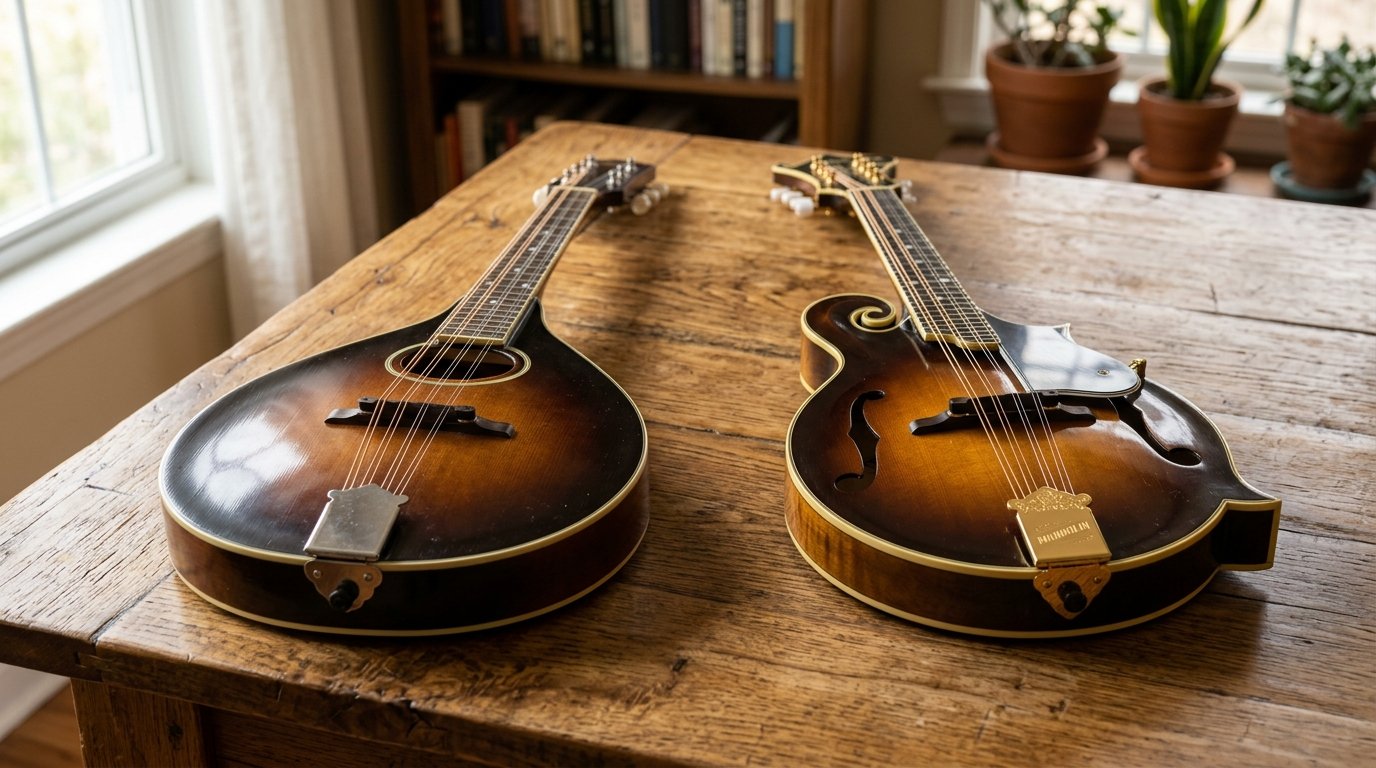
A-style has a simple teardrop or pear-shaped body. It’s the original mandolin design, with roots in European classical instruments and a long history in folk, Celtic, and old-time American music. It’s the more practical shape — lighter, easier to manufacture, and consequently less expensive. For a first mandolin, an A-style is almost always the right starting point.
F-style adds an ornate scroll at the headstock and two pointed projections (called “points”) on the upper bout of the body, giving it a silhouette that’s become iconic in American bluegrass. Gibson introduced this design in the 1920s, and it was Bill Monroe — widely regarded as the father of bluegrass — who made it the defining instrument of the genre. The extra craftsmanship required to build the scroll and points means F-style mandolins cost more at every price point. You’re paying partly for sound, but also for the instrument’s heritage and visual identity.
Which Style Should You Choose?
The honest answer for most beginners is A-style. The price difference is significant, the tonal difference is modest, and at the early stage of learning — building calluses, understanding tuning, developing picking technique — those things matter more than which body shape you’re holding.
The case for F-style from the start is if you know you want to play bluegrass specifically and you respond to having an instrument that looks the part. There’s something to the motivational value of owning an instrument you love the appearance of. But go in aware that you’re paying a premium that isn’t primarily acoustic.
If you’ve already played an A-style for a year or two and you’re ready to step up, an F-style makes more sense — not because the sound is dramatically better, but because at that stage you’re more likely to appreciate the craft and to stick with the investment.
Best A-Style Mandolin: Vangoa

Vangoa A-Style
- The bestselling beginner mandolin on Amazon — 4.4 stars across 1,500+ reviews
- Short 13.9-inch scale and narrow nut — an easy transition if you’re coming from guitar
- Complete starter kit: case, strap, picks and tuner included. Around $114
The Vangoa A-style is the bestselling beginner mandolin on Amazon with good reason. It has a short 13.9-inch scale, a narrow nut width, and a glossy mahogany body that looks more expensive than its price. The starter kit includes a case, strap, picks, and tuner, which means you’re not sourcing accessories separately on day one. Over 1,500 reviews with a 4.4-star average tells a clear story about how it performs for real beginners.
I’d particularly recommend it for anyone coming to mandolin from guitar — the A-style shape is close enough in feel to a small guitar body that it doesn’t feel completely alien in your lap. And the short scale removes the main physical complaint about guitar, which is the hand strain of reaching for chord positions.
Sound: Bright and clear, typical phosphor bronze tone. For a mahogany-bodied instrument at this price, it produces more volume than you might expect.
Who it suits: Beginners, folk and Celtic players, anyone who wants a complete starter kit without paying for features they won’t use yet.
Best F-Style Mandolin: The Loar LM-310F Honey Creek

The Loar LM-310F
- Hand-carved solid spruce top — most manufacturers use laminate at this price point
- Grover tuners and D’Addario strings straight from the factory, not generic fittings
- Around $390 — a genuine upgrade instrument, not a toy
The Loar is one of the most frequently recommended brands when mandolin players and teachers are asked about entry-level F-style instruments — the Honey Creek series in particular occupies the sweet spot where quality becomes noticeable without the price becoming unreasonable. The hand-carved solid spruce top is the specification that matters most here: at this price point, most manufacturers use laminate tops, and you can hear the difference. A solid carved top resonates and projects in a way laminate doesn’t.
The Grover tuners and D’Addario strings straight from the factory are also notable — name-brand components, not generic fittings. Multiple buyers mention that local luthiers endorsed this instrument before they bought it, and several describe it as a genuine upgrade from their first cheap A-style. That framing is accurate. This isn’t a toy or a decoration — it’s a playable instrument that will stay useful as your technique develops.
Sound: The hand-carved spruce top gives the kind of “chop” — that percussive, cutting attack on chord strums — that defines the bluegrass mandolin sound and is hard to replicate with a laminate instrument.
Who it suits: Intermediate players moving up from a budget A-style, or anyone serious about bluegrass who wants to start with an instrument that won’t need replacing within a year.
Frequently Asked Questions
Do A-style and F-style mandolins sound different?
Minimally, and mainly in the hands of experienced players on quality instruments. The scroll and points on an F-style don’t produce a meaningfully different acoustic resonance from an A-style at the same build quality. The more audible difference comes from top material (solid vs laminate) and craftsmanship — factors that exist within both styles, not between them.
Is F-style better than A-style?
Neither is objectively better. F-style is associated with bluegrass and is more ornate; A-style is simpler and more affordable. For most beginners, A-style is the sensible choice. For players committed to bluegrass who can afford the step-up, F-style makes more sense.
Can I play bluegrass on an A-style mandolin?
Yes. The style of instrument doesn’t determine the genre you can play. Bill Monroe’s F-style became iconic partly because of the man playing it, not because an A-style is physically incapable of bluegrass. Many players learn bluegrass on A-style mandolins, particularly when starting out.
What is the scroll on an F-style mandolin?
The scroll is the decorative carved curl at the bass side of the upper bout — visually similar to the scroll on a violin headstock but located on the body. Gibson introduced this design in the early twentieth century and it became associated with American bluegrass. Along with the two body points, it gives the F-style its distinctive silhouette.
What mandolin should a complete beginner buy?
An A-style in the $120–160 range. The Vangoa A-style kit is the most sensible starting point — it comes with everything you need, has a track record across thousands of buyers, and keeps the initial cost low enough that you’re not overcommitting before you know whether you’ll stick with the instrument.
Author Profile

- Daniel Johnstone — Dániel to his friends back in Miskolc — is a Hungarian folk musician and writer who has been playing stringed instruments for over twenty years. Growing up in northeastern Hungary with a family steeped in folk music, he developed an early obsession with Celtic and Appalachian styles that eventually brought him to the UK. He worked his way through tenor banjo, 5-string banjo, autoharp, mountain dulcimer, mandolin, ukulele, harp and kalimba — most of them acquired through trial, error and more money than he'd like to admit. He founded Folkstrings.com to cut through the noise: practical, experience-based guides to instruments, strings, gear and accessories for folk players at every level.
Latest entries
 Useful ToolsJuly 15, 2026Violin Fingering Chart — First Position Notes on All Four Strings
 BanjoJuly 14, 2026Is Banjo Hard to Learn? Here’s What Nobody Tells You
 MandolinJuly 14, 2026Online Mandolin Lessons — What YouTube Can’t Teach You (And What Can)
 Useful ToolsJuly 13, 2026Recorder Fingering Chart — Complete Guide for Soprano Recorder (Baroque and German)