Sound Healing Instruments: A Practical Guide to Getting Started
Folkstrings.com is reader-supported. When you buy through links on our site, we may earn a small commission.
Last Updated on June 7, 2026 by folkstrings
Sound healing is one of those areas I came to gradually, rather than all at once. As someone who has spent years around folk stringed instruments — guitar, cavaco, and more recently the harp — I was already drawn to the meditative quality of certain tones. The sustained resonance of a well-played harp string, the gentle decay of a plucked cavaco note. There is something in the physics of vibrating strings that invites stillness.
But sound healing instruments take that a step further. These are tools designed — or at least used — specifically for their effect on the body and mind rather than their musical expressiveness. I have spent time with a number of them over the past few years, and what follows are the ones I would genuinely recommend: what they are, what they do, and who they are best suited for.
What Are Sound Healing Instruments?
Sound healing is a broad term for the practice of using sound — specifically certain frequencies and timbres — to promote relaxation, reduce stress, and support wellbeing. The instruments used range from ancient Tibetan singing bowls to modern precision-tuned forks. What they share is an ability to produce sustained, resonant tones that encourage the nervous system to slow down.
Whether you approach this from a scientific angle (acoustic frequency, nervous system response) or a more traditional one (chakra balancing, energy work), the instruments themselves are real and the experience of using them is genuinely different from playing conventional instruments.
Tibetan Singing Bowl
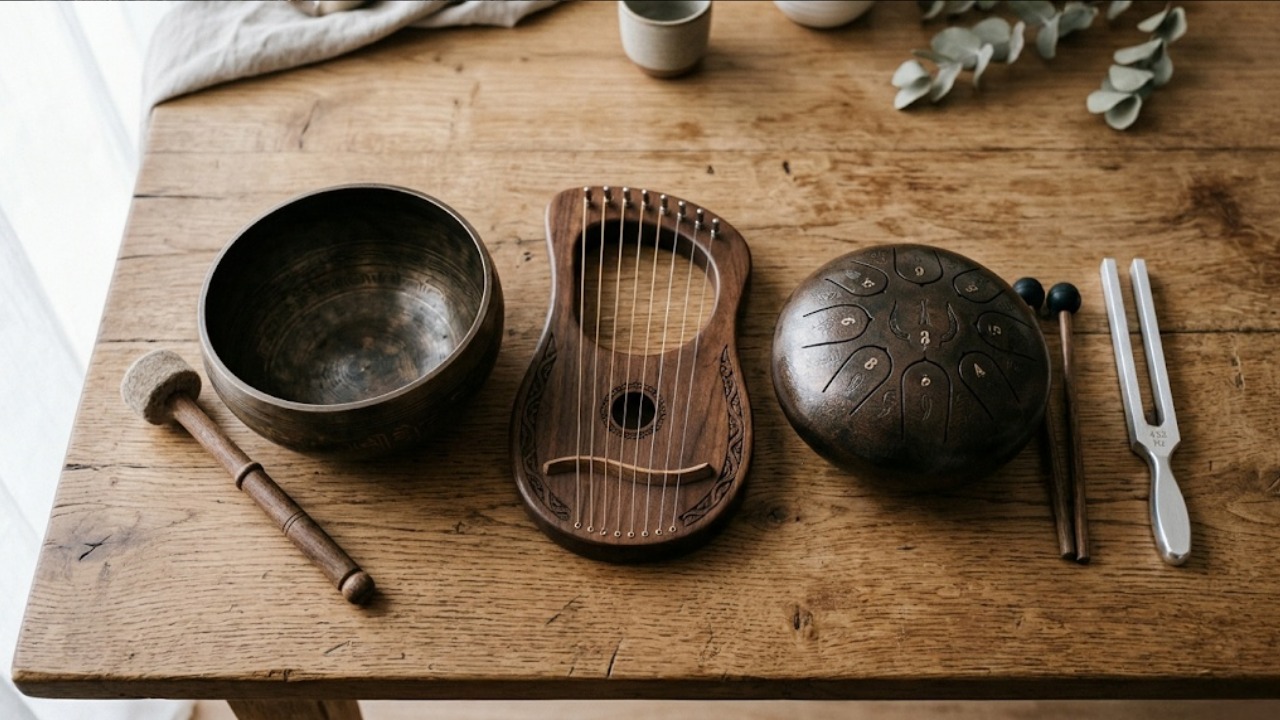
If you only try one sound healing instrument, make it a singing bowl. I came to them through the reiki and meditation community — they are ubiquitous in that world for good reason. The sustained harmonic tone a quality bowl produces when struck or rimmed is unlike anything else. It fills a room and seems to work on the room, not just the listener.
The technique takes a few sessions to get right. Striking the bowl with the mallet gives you an immediate, bell-like tone; drawing the mallet slowly around the rim builds a continuous resonance that can last for a minute or more. Both approaches are worth exploring.
For beginners, I would always recommend an authentic handcrafted bowl over a machine-made one. The difference in tone quality is significant, and a good Tibetan bowl will last a lifetime. The Ohm Store bowl is one I keep returning to — handcrafted in Nepal, consistently well-reviewed, and the 4-inch size is manageable for a first instrument while still producing a full, rich tone.
Check price — Ohm Store Tibetan Singing Bowl on Amazon
If you want to go deeper on choosing a singing bowl — different sizes, metals, and what the differences mean for tone — there is a thorough guide worth reading over at RestoreQi: best singing bowls for beginners.
Lyre Harp
This one sits closest to my own background. The lyre is one of the oldest stringed instruments in the world — predating the modern harp by thousands of years — and its use in healing and ritual contexts goes back just as far. In practice, what you get is a small, lap-held instrument with a warm, intimate tone that is genuinely easy to learn.
Unlike the autoharp or the folk harp, a lyre does not require significant technique to produce something beautiful. The seven strings on most beginner models are tuned pentatonically or diatonically, which means almost any combination of notes sounds harmonious. I find it naturally conducive to slow, meditative playing in a way that the guitar, for all its range, is not always.
The Mulucky 7-string lyre is my pick for anyone new to the instrument. Mahogany body, comes with a gig bag and tuning wrench, and the steel strings have a clear, sustained tone that works well in a healing or meditation context. The 7-string layout is enough to play simple melodies and explore freely without the complexity of a larger instrument.
Check price — Mulucky 7-String Lyre Harp on Amazon
Steel Tongue Drum
The steel tongue drum emerged in the early 2000s as a more accessible version of the handpan, and it has found a genuine home in sound healing practice since. The tongues — petal-shaped cutouts in the steel — are tuned to specific notes, usually a pentatonic scale, and struck with mallets or fingertips to produce warm, metallic tones with long sustain.
What I find particularly useful about the tongue drum in a healing context is its forgiving tuning. Because the notes are fixed and arranged pentatonically, you cannot really play a wrong note. That removes the cognitive load of playing music and lets you focus on listening, breathing, and the sound itself — which is exactly the point in meditative practice.
The Lronbird 6-inch 8-note model is one of the most popular on Amazon, and for good reason. It is compact, solidly built, and the tone is warm rather than harsh. For home practice or small group sessions, the 6-inch size is more than adequate.
Check price — Lronbird Steel Tongue Drum on Amazon
432Hz Tuning Fork
Tuning forks are among the most precise sound healing instruments you can own. A calibrated fork vibrates at an exact frequency when struck, producing a pure tone that can be held near the body, placed on acupressure points, or used as a meditation anchor. The precision is the point — there are no overtones, no harmonics, just a single, unwavering frequency.
The 432Hz frequency is particularly associated with sound healing practice. The argument — accepted among practitioners, contested in some scientific circles — is that 432Hz resonates more naturally with the body than the standard concert pitch of 440Hz. Whether or not you take that on board, working with a single pure frequency is a distinctly different meditative experience from playing a complex instrument, and worth exploring.
This precision-machined aluminium fork from Omnivos is made in the USA and has a solid reputation in the sound therapy community. It comes with a velvet pouch and is accurate to within a fraction of a hertz — the kind of thing that matters when precision is the whole reason you are buying it.
Check price — 432Hz Tuning Fork (Omnivos) on Amazon
How to Choose the Right Instrument
What experience are you trying to create? If you want to use sound with others — in a reiki session or sound bath — a singing bowl or tuning fork lets you direct resonance toward a specific person or area. If you want something for your own daily practice, the lyre and tongue drum are more satisfying to play solo.
Do you have a musical background? If yes, the lyre harp will feel most natural — it responds to touch and technique in a way the others do not. If you have no musical background, the singing bowl and tongue drum are far more immediately accessible. There is genuinely nothing to learn before you can get something useful out of them.
How much space do you have? All four instruments above are compact and portable. None requires a dedicated space. The tongue drum and tuning fork travel particularly easily; the lyre fits in a gig bag; the singing bowl packs well in a padded case.
Budget. Check current prices using the links above — Amazon pricing on these instruments does shift regularly.
Final Thoughts
Sound healing instruments are not mystical objects, but they are not nothing either. Spending time with a quality singing bowl or a well-tuned lyre produces a tangible shift in attention — something I have experienced enough times to take seriously, even approaching it with some scepticism initially.
If I were starting from scratch, I would begin with a singing bowl and a lyre harp: one for pure resonance, one for melody. The tongue drum and tuning fork are excellent additions once you know you want to go further with this.
Whatever you choose, the practice is in the listening rather than the performing. That is really the whole point.
Author Profile

- Daniel Johnstone is an English writer and folk musician who has been playing stringed instruments for over twenty years. He started on guitar as a teenager before working his way through cavaco, tenor guitar, autoharp, mountain dulcimer, and harp. He founded Folkstrings.com to provide practical, experience-based buying advice for folk instrument players at every level — the kind of guidance he always wished had existed when he was finding his feet.
Latest entries
 Useful ToolsJuly 11, 2026Tin Whistle Fingering Chart — All Notes in Both Octaves (D and C Whistle)
 Useful ToolsJuly 11, 2026Banjo String Gauges — Complete Guide for 5-String, Tenor and Irish Tenor
 Useful ToolsJuly 11, 2026Harp String Chart — How to Identify and Replace Any Harp String
 Useful ToolsJuly 11, 2026Mountain Dulcimer Chord Chart — Key of D in DAD Tuning