Best Banjo Picks: My Top Choices for Finger Picks and Thumb Picks
Folkstrings.com is reader-supported. When you buy through links on our site, we may earn a small commission.
Last Updated on June 30, 2026 by folkstrings
Banjo picks are a small purchase but they matter more than most beginners expect. Bluegrass 3-finger picking style requires two finger picks and a thumb pick — without them, you can’t produce the attack and volume the style demands. Clawhammer players typically don’t use picks at all, relying instead on the nail of the index finger. If you’re playing 3-finger style, picks are non-negotiable.
Dunlop dominate this market for good reason — consistent manufacturing, wide availability, and a gauge range that covers most players. Here are the three options worth considering.
Quick Picks at a Glance
Finger Picks vs Thumb Pick — What You Actually Need
For 3-finger bluegrass style (the Scruggs style), you wear finger picks on the index and middle fingers and a thumb pick on the thumb. The ring finger and pinky don’t pick strings in standard bluegrass technique. For melodic style playing, some players also use the ring finger, adding a third finger pick.
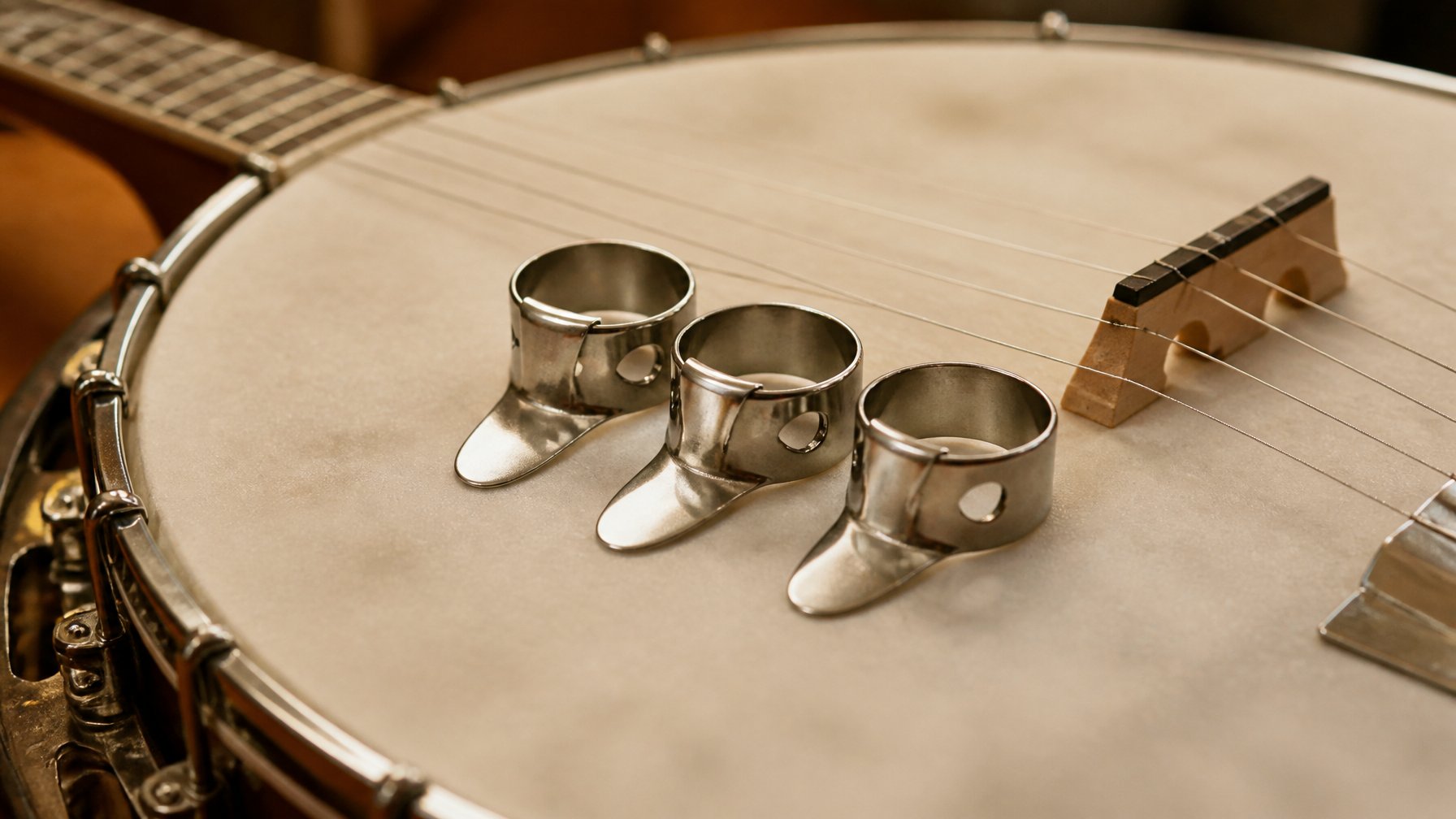
Finger picks and thumb picks are different shapes and not interchangeable. Finger picks are curved metal bands that wrap around the fingertip. Thumb picks have a flat striking surface with a loop that goes around the thumb. If you buy a pack of finger picks only, you’ll still need a thumb pick separately — the Dunlop Player’s Pack solves this by including both.
1. Dunlop .018 Nickel Silver Fingerpicks — Best Standard Choice

Dunlop .018 Nickel Silver
- The lightest gauge and the most popular choice among 3-finger players
- Nickel silver construction — consistent, durable, widely available
- Pack of 5, around $10
The .018-inch gauge is the most commonly used finger pick for banjo, and the Dunlop nickel silver version is the default starting point for the vast majority of players. Nickel silver gives a bright, consistent tone with a clear attack. The .018 gauge is light enough to feel natural on the finger without stiffness, which matters during the early learning period when you’re still adjusting to the sensation of picks.
Over 1,600 reviews at 4.6 stars makes these the most validated banjo pick on Amazon by a significant margin. At $10.49 for a 5-pack you’re covered for experimentation — picks can be bent slightly to adjust the fit, and having spares matters when you inevitably launch one across the room mid-session.
For new players: Start here. The light gauge is forgiving and the nickel silver gives a clear, clean tone that will suit most folk and bluegrass styles without being aggressive.
For clawhammer players: Clawhammer uses the back of the fingernail, not picks. If you’re playing clawhammer, you don’t need finger picks at all — focus on growing and shaping your right-hand index fingernail instead.
2. Dunlop .020 Finger & Thumbpicks — More Attack and Volume

Dunlop .020
- A slightly heavier gauge than the .018 — genuinely more attack and volume
- Worth trying if the standard gauge feels too thin for your playing
- Pack of 5, around $11
The .020-inch gauge is noticeably stiffer than the .018, which translates to a more aggressive attack and slightly more volume. For players who want to drive through an ensemble or have naturally light touch, moving up a gauge makes the instrument project more. The pack includes both finger picks and thumb picks, which is useful if you want to try a heavier-gauge thumb pick alongside.
The trade-off is that a stiffer pick takes more adjustment to wear comfortably. Some players find the .020 feels slightly clunky compared to .018 when they’re learning technique, then appreciate it later when projection becomes a priority. It’s worth having both gauges to compare.
For bluegrass and ensemble playing: The heavier gauge cuts through more clearly when playing alongside fiddle, guitar and bass. If you find your tone getting swallowed in a band context, moving from .018 to .020 is the simplest fix.
For comparing gauges: Buy one pack of .018 and one of .020 — total cost is around $21. Playing both back to back is the only reliable way to know which suits your touch and the sound you want.
3. Dunlop Player’s Pack .0225 — Best for Beginners

Dunlop Player’s Pack
- Includes both thumb and finger picks together — no separate shopping needed
- Medium .0225 gauge, a sensible starting point if you’re not sure what you need yet
- Pack of 5, around $10
The Player’s Pack includes three finger picks and two thumb picks at .0225 gauge — slightly heavier than the .020 but the most practical starter purchase if you don’t already have picks. You get everything you need for 3-finger style in a single pack without ordering separately. The .0225 gauge is on the medium-heavy side, which suits players who want a firm, projecting tone.
669 reviews at 4.6 stars is strong for a starter set. The gauge is slightly heavier than most beginners would choose by default, but the inclusion of thumb picks alongside finger picks is the main practical advantage — it removes the common beginner mistake of buying finger picks only and then realising a thumb pick is also needed.
If you’re starting from scratch: This is the most practical first purchase — one pack covers the full set of picks you need for 3-finger style. Sort out gauge preferences once you’re playing; getting started is more important than finding the perfect gauge.
On fit: All these picks can be adjusted by gently bending the metal band to match your finger size. Too tight and they’re uncomfortable; too loose and they fly off mid-song. A pair of needle-nose pliers makes adjustments easier.
What to Think About When Buying Banjo Picks
Gauge. .018 for a lighter touch and easier learning. .020 or .0225 for more attack and volume once your technique is established. There’s no single right answer — it depends on your natural touch and the sound you’re aiming for.
Material. Nickel silver is standard. Some players prefer plastic thumb picks (softer attack, less projection) but most bluegrass players use metal throughout. Start with nickel silver and experiment later.
Fit. Picks that don’t fit won’t stay on during playing. These can be bent slightly to adjust — always adjust gradually to avoid cracking the metal.
Frequently Asked Questions
Do I need picks to play banjo?
It depends on your style. 3-finger bluegrass style requires picks — you can’t produce the volume and attack without them. Clawhammer and frailing styles use the fingernail, not picks. If you’re playing Scruggs-style bluegrass or melodic style, you need picks. If you’re playing clawhammer, you don’t.
What gauge banjo picks should I start with?
.018 is the most common starting point — light enough to feel natural while learning, with enough brightness for most styles. Some players move up to .020 later for more projection. Buy a pack of .018 first and adjust from there once you have a feel for what you want.
Can I use guitar picks for banjo?
Flat guitar picks are used for plectrum banjo and jazz banjo styles, but not for 3-finger bluegrass picking. For Scruggs-style, you need finger picks (worn on the fingertip) rather than flat picks held between finger and thumb.
Author Profile

- Daniel Johnstone — Dániel to his friends back in Miskolc — is a Hungarian folk musician and writer who has been playing stringed instruments for over twenty years. Growing up in northeastern Hungary with a family steeped in folk music, he developed an early obsession with Celtic and Appalachian styles that eventually brought him to the UK. He worked his way through tenor banjo, 5-string banjo, autoharp, mountain dulcimer, mandolin, ukulele, harp and kalimba — most of them acquired through trial, error and more money than he'd like to admit. He founded Folkstrings.com to cut through the noise: practical, experience-based guides to instruments, strings, gear and accessories for folk players at every level.
Latest entries
 MandolinJuly 14, 2026Online Mandolin Lessons — What YouTube Can’t Teach You (And What Can)
 Useful ToolsJuly 13, 2026Recorder Fingering Chart — Complete Guide for Soprano Recorder (Baroque and German)
 UkuleleJuly 12, 2026Gifts For Ukulele Players: 10 Best Picks
 MandolinJuly 12, 2026Gifts For Mandolin Players: 10 Best Picks