Autoharp Chords Guide For Beginners
Folkstrings.com is reader-supported. When you buy through links on our site, we may earn a small commission.
Last Updated on June 10, 2026 by folkstrings
Ever pressed a chord button on an autoharp and heard a clean, full chord ring out on your first try? That instant musical payoff is a huge part of why people fall for this instrument.
There’s basically no delay between pressing down and making real music. But knowing which chords to learn, in what order, and what kind of instrument to use can really change how quickly you get comfortable.
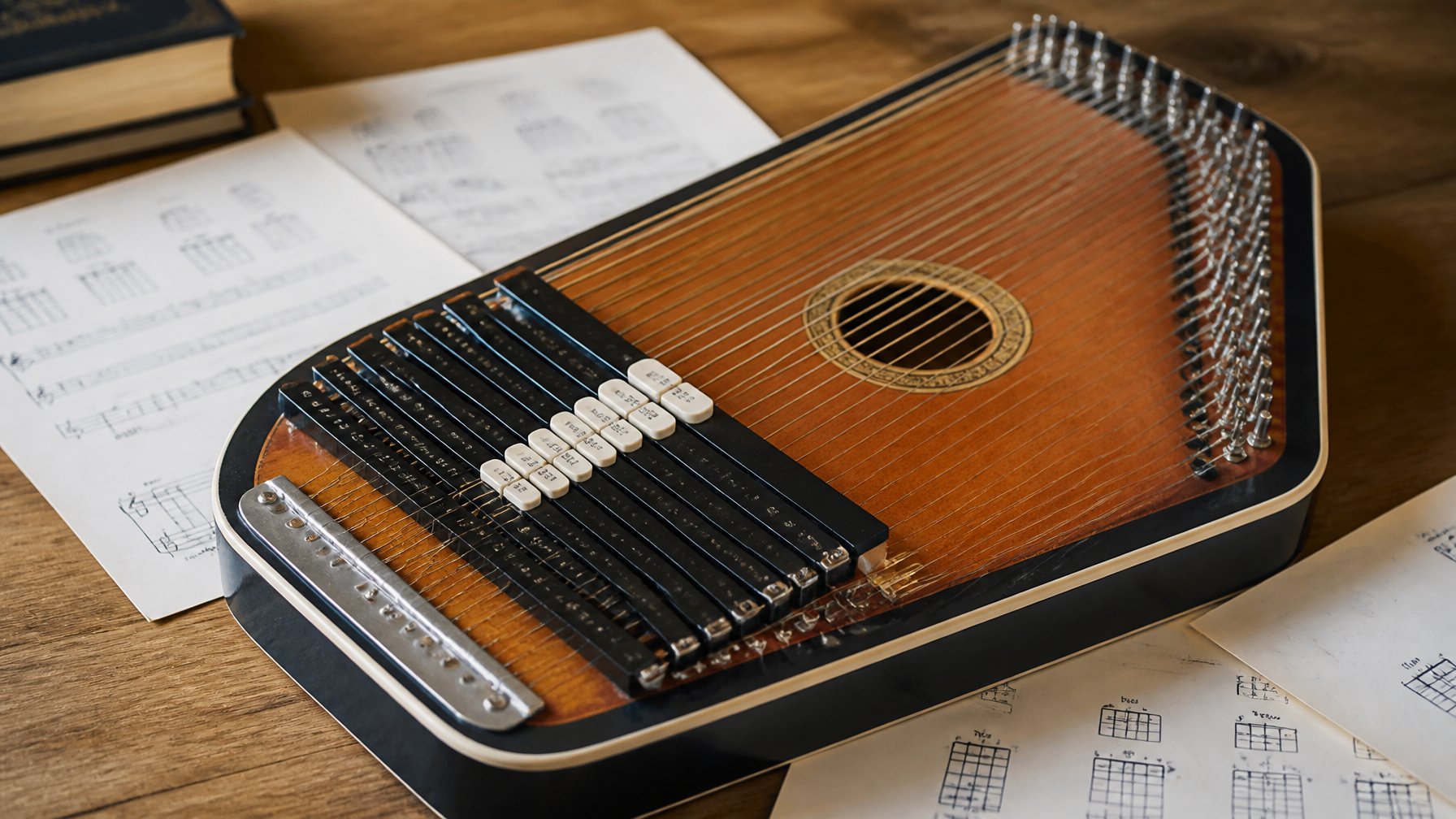
Learning a handful of chords and a couple of basic progressions puts dozens of real songs within reach almost immediately. This guide covers the chords you need first, how to use them in simple progressions, tips for holding and strumming, and how the number of chord bars on your autoharp shapes what you can play.
I’ll also talk about main brands and layouts, so you can make a smarter choice if you’re buying or upgrading.
Key Takeaways
- Start with just three chords in a familiar key and you can play a surprising number of songs right away.
- The number of chord bars on your autoharp directly affects which keys and songs are available to you.
- Brand and layout choices like Oscar Schmidt and Chromaharp matter more as your song list grows beyond beginner tunes.
Start With The Chords You Will Use First
The autoharp makes chord-playing unusually easy because the chord bars mute the strings you don’t need. If you know how the bars work, which major and minor shapes to focus on, and how to read chord names, you’re off to a good start.
How Chord Bars Create Autoharp Chords
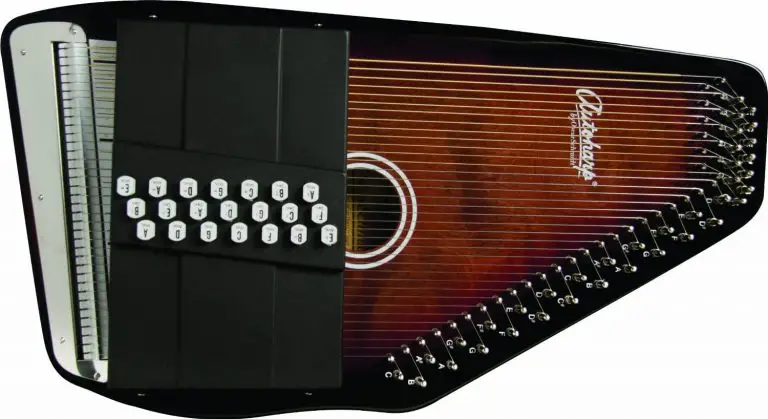
Each chord bar has little felt pads underneath. When you press a bar and strum, the pads mute every string that doesn’t belong to that chord.
What you hear is only the strings that match the chord name on the bar. That’s way different from a guitar, where you have to shape the chord yourself with your fingers.
The autoharp or chromaharp does the filtering for you. Your job? Press firmly and strum cleanly.
One thing I noticed early: a light press gives you buzzing or muted notes. Press each chord bar with enough weight so the felt touches the strings, but don’t tense up your whole arm.
The First Major And Minor Shapes To Learn
I always suggest starting with three major chords: C major, F major, and G major. Those cover the I, IV, and V spots in the key of C, which comes up in tons of folk, country, and basic pop songs.
Once those feel comfortable, add A minor and D minor. These two minor chords expand your options without needing a new key.
Most standard autoharp and chromaharp models have all five of these bars in easy-to-reach spots.
| Chord | Type | Common Role |
|---|---|---|
| C | Major | Home chord (I) |
| F | Major | Subdominant (IV) |
| G | Major | Dominant (V) |
| Am | Minor | Relative minor (vi) |
| Dm | Minor | Secondary minor (ii) |
Reading Chord Names Without Getting Lost
Chord names on autoharp bars are pretty straightforward. A single letter (like C or G) means a major chord.
If there’s a lowercase “m” (like Am or Dm), that’s a minor chord. Sometimes you’ll see “7” after a letter, like G7, which adds a bit of tension or a bluesy feel.
Don’t stress about memorizing theory. Think of the chord name as an address—it tells you exactly which bar to press, nothing more.
Play Simple Progressions That Unlock Real Songs
A chord progression is just a repeating sequence of chords that gives a song its shape. The I-IV-V progression forms the backbone of way more songs than you’d expect, and adding a couple minor chords opens up a much bigger setlist.
Using The I-IV-V Progression In Common Keys
The I-IV-V progression means you cycle through the home chord (I), the chord built four steps up (IV), and the chord built five steps up (V). In the key of C, that’s C, F, and G. In G, it’s G, C, and D.
Here’s a tip I picked up: put your middle finger on the home chord bar, your index on the IV above it, and your ring finger on the V below. That way, you don’t have to hunt for the next chord in a three-chord song.
The I-IV-V works for “Twinkle Twinkle Little Star,” tons of country tunes, and a bunch of folk standards. It’s hands-down the most useful pattern to get under your fingers first.
Adding Minor Chords For More Songs
Once the I-IV-V feels solid, try the I-V-vi-IV pattern. In C, that’s C, G, Am, and F. You’ll hear this one everywhere in modern songs, and it adds a lot more emotion than all-major progressions.
Adding Am changes the vibe without needing to retune or find tricky bars. The Dm-G-C (ii-V-I) sequence is also worth a shot if you like a jazzier sound.
Practicing Smooth Chord Changes And Rhythm
Smooth chord changes come from being ready, not just playing fast. As the change approaches, start moving your finger to the next bar a little early.
Even anticipating by half a beat helps smooth things out. Use a metronome or a basic drum track at a slow tempo (60 bpm works well). Keep strumming even if the change isn’t perfect yet.
Stopping every time you fumble actually slows you down. If you stay in rhythm, even with mistakes, your hands learn faster.
Hold And Strum The Instrument Comfortably
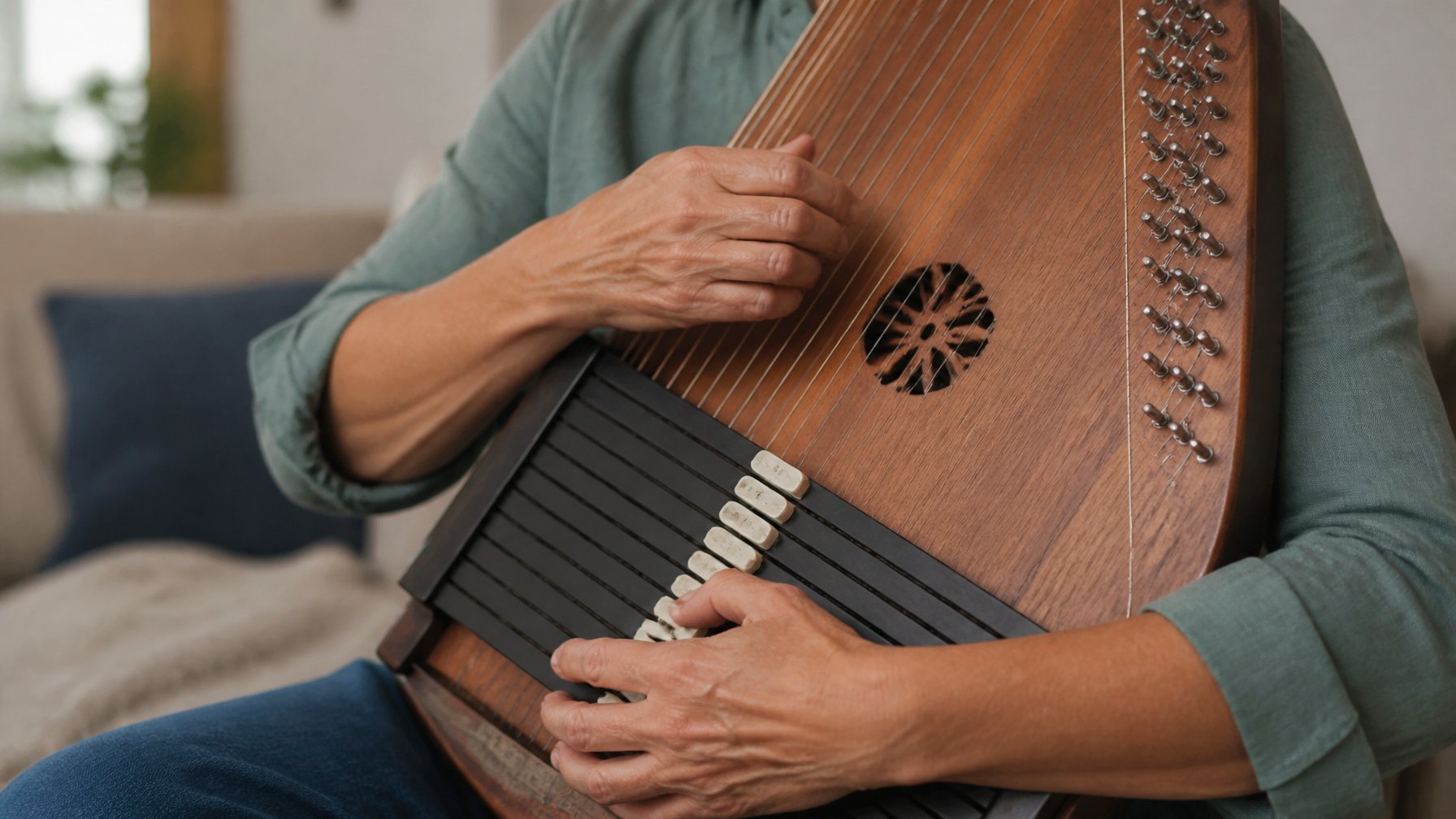
How you hold the autoharp really matters. It’s not just posture—your pressing hand needs to reach the bars easily, and your strumming hand should move freely.
Holding The Autoharp On The Lap Or With A Strap
There are two main ways. The flat or lap position means the instrument sits across your knees or on a table, bars facing up toward your dominant hand.
The upright or chest position props it against your body, with the chord bars on the side your non-dominant hand can reach. Most beginners find the lap position easier because it’s stable and doesn’t need a strap.
The chest position—sometimes called Appalachian or Carter Family style—is popular for performing because your strumming hand can move more freely. I started with it on my lap and switched to upright after a few weeks, mostly so I could play standing up.
Choosing Between Full Strums And Light Picking
A full strum across all the strings gives you a big, rich sound—great for rhythmic folk or country. Light picking, where you pluck individual strings or small groups while holding a chord, lets you bring out a simple melody inside the chord.
For beginners, start with steady full strums in a back-and-forth rhythm. Once that feels natural, try strumming just the bass strings on beat one and the treble strings on two and three.
Even that basic pattern sounds a lot more musical than a flat, even strum.
Avoiding Tension In Your Pressing And Strumming Hands
Tension is the biggest issue I see in new autoharp players. The pressing hand grips too hard, and the strumming hand clenches the pick. Both make you tired fast and kill your tone.
Keep your pressing fingers curved and relaxed, and use your hand’s weight instead of squeezing. For the strumming hand, hold the pick loose—loose enough that it might fall if you shook your hand.
That looseness keeps your wrist flexible and your sound more even.
Choose A Setup That Matches The Music You Want To Play
The number of chord bars on your autoharp isn’t just a spec sheet thing—it’s a real musical boundary. A 5-chord, 15-chord, or 21-chord autoharp all suit different kinds of players.
What A 5-Chord Autoharp Can And Cannot Do
A 5-chord autoharp usually covers the I, IV, V, and maybe one or two minors in a single key. It’s genuinely useful for young kids or total beginners because the layout is simple and you can’t really get lost.
The limitation is real, though. You’re stuck in one key, and even basic song requests outside that key are out of reach unless you retune and move bars around.
I wouldn’t suggest a 5-chord model if you want to play with other musicians or have a varied song list.
When A 15-Chord Autoharp Is Enough
A 15-chord autoharp opens up several keys and covers the three-chord song territory really well. For most folk, hymn, and country players, 15 bars is plenty for years of fun.
One thing to know: standard 15-chord models often miss the key of D, which guitar players use a lot. If you want to play with guitarists, you’ll notice that gap. For solo playing or simple groups, though, 15 chords covers a lot of beginner and intermediate songs.
Why A 21-Chord Autoharp Gives More Flexibility
A 21-chord autoharp gives you more minor chords, sevenths, and key options. You can play in D, E, and other keys that the 15-chord version just can’t handle easily.
The extra bars open up new chord colors—minor sevenths, diminished chords, all that good stuff. If you want to go beyond basic progressions, you’ll appreciate these extra choices.
The downside? The bar layout gets a bit crowded, and you’ll pay more. For beginners, the extra chords might feel like a lot at first, but the instrument really does grow with you in a way the smaller models just… don’t.
Understand Brands And Layouts Before You Buy Or Upgrade
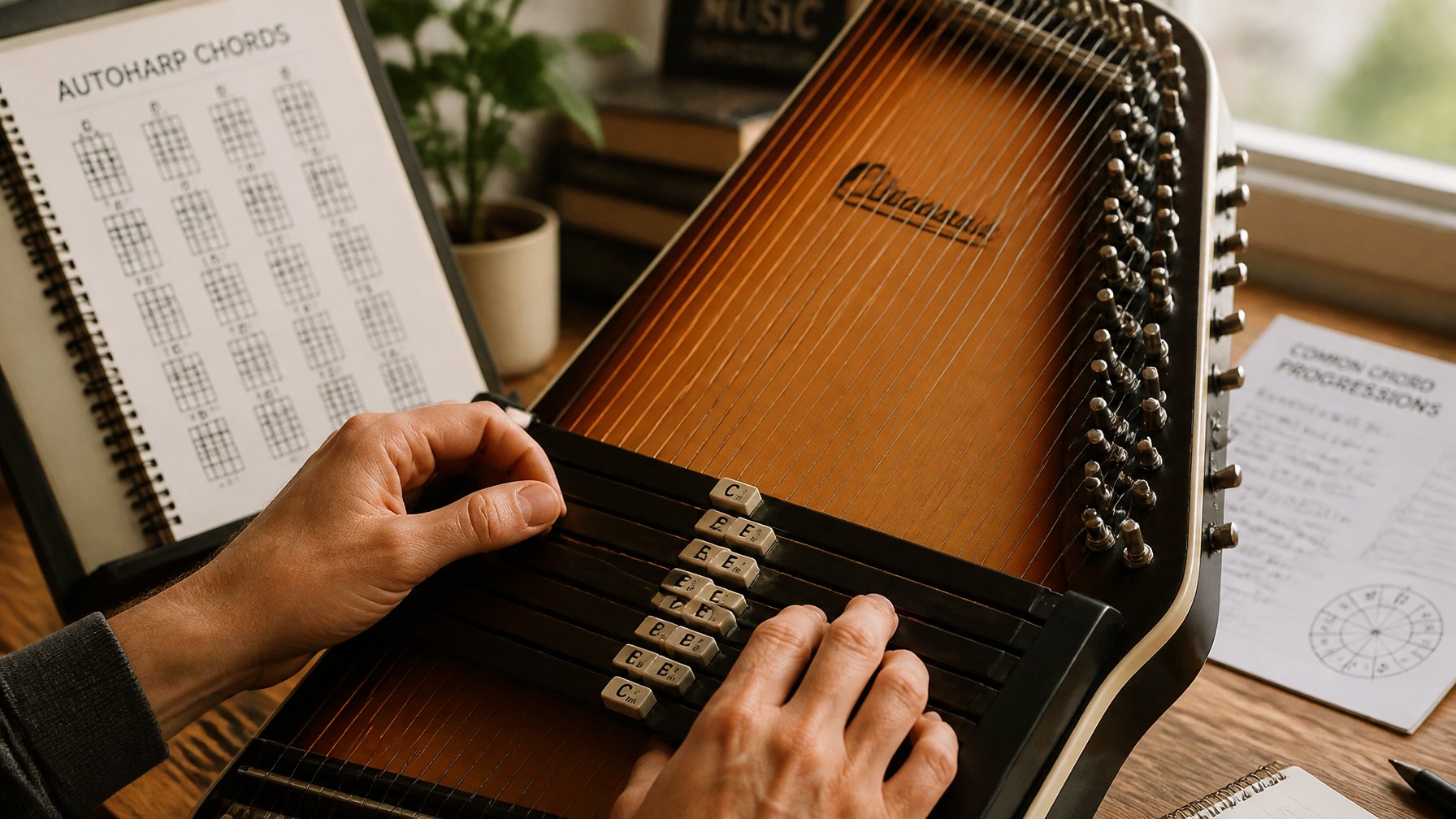
Brand and layout choices matter more than most folks expect. The chords printed on the bars and the way they’re arranged actually shape how your hand moves during a song.
Oscar Schmidt and Bryan Bowers have totally different ideas about how those bars should be organized. It’s a bit surprising how much it changes the feel.
Oscar Schmidt And Chromaharp Factory Approaches
Oscar Schmidt is probably the most common autoharp brand in the U.S. Its instruments are what most people picture when they think of a standard autoharp.
The Chromaharp is similar, with almost the same factory layout and chord bar setup. Both brands design their factory layouts to work across the keys you’ll run into in folk and country music.
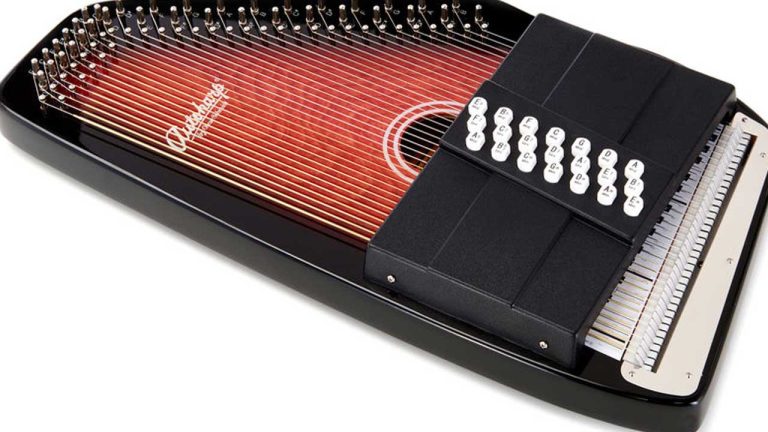
The Oscar Schmidt 21-chord model uses three rows to organize major, minor, and seventh chords in a pretty logical order. Most beginner resources, chord charts, and songbooks line up with these layouts, which makes life easier.
Why Some Players Prefer Bryan Bowers Style Layouts
Bryan Bowers is a legend in American folk music, and his approach to autoharp really shook things up. He likes to set up his bars for the keys and chords he uses most in folk, old-time, and Celtic tunes instead of sticking to the factory defaults.
People drawn to his style often move chord bars around so their most-used chords land under their favorite fingers. This kind of tinkering definitely isn’t for beginners, but it’s good to know the factory layout is just a starting point, not some unbreakable rule.
When Reconfiguring Chord Bars Makes Sense
Swapping out a chord bar for one you actually use makes sense once you know your own setlist. If you never play in B-flat but always need A major, why not switch them?
Let your real playing habits guide you, not some theoretical “perfect” setup. I’d say play the factory layout for at least six months or so before changing anything. You’ll need that time to figure out which missing chords actually trip you up.
Frequently Asked Questions
Which chords should I learn first as a beginner on the autoharp?
Start with C major, F major, and G major. These three chords cover the classic three-chord song pattern in the key of C and pop up all over folk, country, and even simple pop songs.
Once those feel comfortable, add A minor and D minor. That’ll give you a lot more room to explore.
How do I read an autoharp chord chart and match it to the chord buttons?
A chord chart just lists names like C, G7, or Am. Match the name on the chart to the same name printed on your chord bar, press it down, and strum.
You don’t need to know theory or anything fancy to get started—just read the letters.
What’s the easiest way to change chords smoothly while strumming?
Start moving your finger toward the next chord bar a little before the beat hits, not right on it. This anticipation closes the gap and avoids that awkward clunk beginners sometimes get.
Practicing slowly with a steady beat helps your hands learn the transitions on their own. It’s all about muscle memory in the end.
Can I get a printable chord chart in PDF format, and how do I use it for practice?
Yep, printable chord charts are out there from several autoharp-specific music resources. They’re sized to fit in your case for easy reference.
Use the chart during practice to double-check which bars cover which keys. Try to set it aside as soon as you can remember the names—it’s better to internalize the layout than rely on the chart forever.
How can I play common songs with just a few basic autoharp chords?
Most beginner songs only need three chords: the home chord, the one four steps up, and the one five steps up. In C, that’s C, F, and G.
Seriously, “Twinkle Twinkle Little Star,” a bunch of hymns, and endless folk songs all fit inside those three chords. It’s amazing how much you can do with just a handful.
How do autoharp chords compare to guitar or ukulele chords when playing the same songs?
The chord names and progressions stay the same across instruments. If you play a C-F-G progression on the autoharp, it’s got the same harmonic structure as on a guitar or ukulele.
On the autoharp, you create chords by pressing a bar instead of shaping your fingers. This makes switching chords physically easier, but you lose the ability to voice chords in different ways.
Author Profile

- Daniel Johnstone — Dániel to his friends back in Miskolc — is a Hungarian folk musician and writer who has been playing stringed instruments for over twenty years. Growing up in northeastern Hungary with a family steeped in folk music, he developed an early obsession with Celtic and Appalachian styles that eventually brought him to the UK. He worked his way through tenor banjo, 5-string banjo, autoharp, mountain dulcimer, mandolin, ukulele, harp and kalimba — most of them acquired through trial, error and more money than he'd like to admit. He founded Folkstrings.com to cut through the noise: practical, experience-based guides to instruments, strings, gear and accessories for folk players at every level.
Latest entries
 MandolinJuly 14, 2026Online Mandolin Lessons — What YouTube Can’t Teach You (And What Can)
 Useful ToolsJuly 13, 2026Recorder Fingering Chart — Complete Guide for Soprano Recorder (Baroque and German)
 UkuleleJuly 12, 2026Gifts For Ukulele Players: 10 Best Picks
 MandolinJuly 12, 2026Gifts For Mandolin Players: 10 Best Picks