What Is The Best Accordion for Beginners? – Easy-to-Play Models for New Musicians
Folkstrings.com is reader-supported. When you buy through links on our site, we may earn a small commission.
Last Updated on July 3, 2026 by folkstrings
Accordions are expensive enough that getting the first choice wrong is genuinely painful. I’ve seen too many beginners buy cheap accordions that sound poor, go out of tune constantly, and can’t be repaired when something breaks — which it always does. The accordion market has a lot of instruments that look the part but aren’t worth buying. This guide cuts to the actual options worth considering.
One important thing to sort out first: what kind of music do you want to play? The answer determines which type of accordion you need, because a diatonic (button) accordion and a piano accordion are genuinely different instruments that suit different genres.
Best Beginner Accordion Brands and Models
Hohner Accordions
Hohner is the most trusted name in beginner accordions and the brand I point most people toward. They’ve been making accordions since 1857 and their instruments are repairable — which matters because accordions need maintenance and you want to be able to find a technician who’ll work on it. Their budget models aren’t perfect, but they’re serviceable and hold their value reasonably well on the secondhand market if you decide to upgrade.
The Panther is their most recommended diatonic for folk and traditional music players:

Hohner Panther G/C/F 3-Row Diatonic Accordion
- 3-row diatonic layout in G/C/F — covers the most common folk and norteño keys
- Hohner’s most popular beginner diatonic — 4.6 stars from 650+ verified buyers
- Around $640 — more expensive than entry-level, but durability and repairability make it worth the investment
For players interested in piano accordion — where the right hand has a standard piano keyboard layout — Hohner’s Student series is worth considering, though quality piano accordions start at a higher price point than comparable diatonic instruments. Expect to pay $500–800 for something that’ll last.
Rossetti Accordions
Rossetti make diatonic accordions targeted primarily at norteño and tejano players. They’re louder and brasher in tone than Hohner, which suits that style, and they’re solidly built. Less appropriate for European folk styles where Hohner’s tone is more traditional. You’ll find Rossetti instruments at a similar price to mid-range Hohner models — not cheap, but not the top of the market either.
What to Avoid
Avoid unbranded or generic accordions sold under various house brands for under $200. They look like real accordions in photographs but use cheap reeds that go out of tune easily, bellows that leak within months, and components that can’t be sourced for repair. Spending $200 on one of these is a worse decision than spending $600 on a Hohner — not because beginners deserve expensive instruments, but because a broken accordion that can’t be repaired is genuinely worthless.
Key Features to Consider When Choosing an Accordion
Size and Weight
Full-sized accordions can weigh 7–12 kg and become physically tiring to hold for extended periods. For younger players or anyone with back or shoulder concerns, a smaller diatonic instrument is worth prioritising. The Hohner Panther is compact by accordion standards and genuinely manageable for most adult beginners. If you’re buying for a child, look for instruments specifically sized for younger players.
Number of Keys and Buttons
For a diatonic (button) accordion, a 3-row instrument in G/C/F gives you the most flexibility for folk and traditional music. Two rows are more limited; more than three rows adds complexity without much benefit for beginners. For piano accordions, 34 keys is the minimum practical size for most repertoire; 37 keys is more comfortable. 96 bass buttons is standard — fewer than that limits what you can play.
Reeds and Sound Quality
Reeds are the heart of the accordion — small metal strips that vibrate to produce sound. Italian-made reeds (the best are made in factories in the Castelfidardo region) are generally superior to Chinese-made reeds in terms of tone and stability. Mid-range Hohner models use mixed reed sourcing; their higher-end instruments use primarily Italian reeds. Two reed ranks gives you a basic sound; three reed ranks allows you to switch between a single-reed tone (cleaner, quieter) and a double-reed or musette tone (fuller, slightly trembling). Three ranks gives more tonal variety for the same learning investment.
Understanding Accordion Types
Piano vs Button Accordions
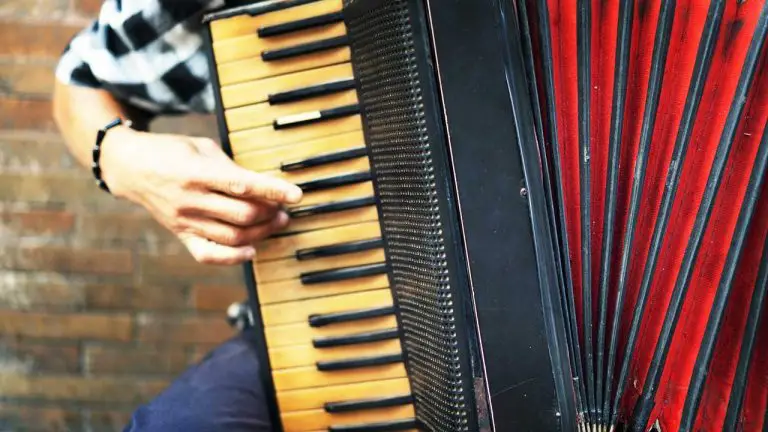
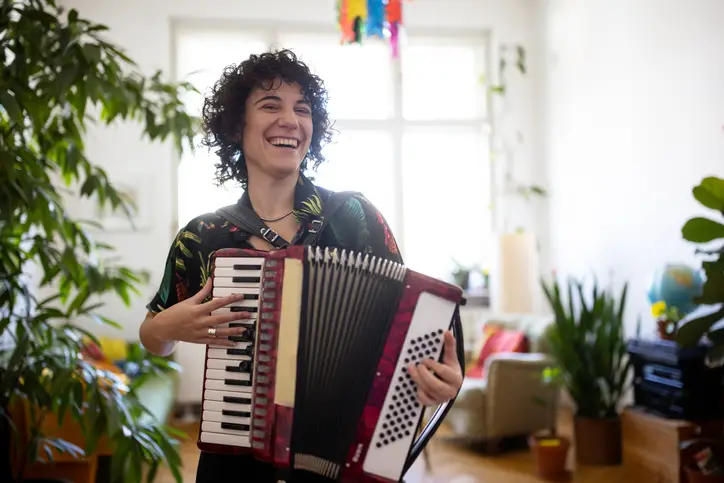
Piano accordions use a standard piano keyboard for the right hand — familiar to anyone who’s played piano, and intuitive for reading sheet music. They’re the most common type in classical and variety contexts. Button accordions use a grid of buttons instead, which initially feels less intuitive but allows a more compact instrument and — for diatonic models — a specific musical character that suits folk styles.
Diatonic and Chromatic Accordions
A diatonic accordion is tuned to a specific set of keys (like G/C/F on the Panther) and plays different notes on the push and pull of the bellows. It’s simpler to start with, suits folk and traditional music, but is limited to those keys. A chromatic accordion plays all 12 semitones and works in any key — more versatile, but more complex to learn. Most beginners starting with folk music are better served by a diatonic instrument first.
Accessories and Maintenance
A gig bag or hard case is essential — accordions don’t tolerate humidity, dust, or physical impacts well, and the bellows are particularly vulnerable. Most Hohner Panther bundles come with a gig bag; if yours doesn’t, budget for one separately. A shoulder strap setup matters more than it seems — a cheap strap that digs in makes long playing sessions miserable. Replace the stock straps if they’re not comfortable.
Basic maintenance: store the accordion in a stable temperature environment, never in direct sunlight or in a car. If a reed goes out of tune or a key sticks, take it to an accordion technician rather than attempting to fix it yourself — accordion internals are precise and easy to make worse with amateur intervention.
Learning to Play the Accordion
The biggest beginner mistake is treating accordion technique as just “push the buttons and move the bellows.” Bellows control — the evenness and pressure of the air flow — is actually the most important physical skill to develop and the one most instructors spend the most time on. Uneven bellows pressure causes notes to waver or cut out entirely. Before worrying about chord patterns or scales, spend your first few weeks just practising even bellows movement with one sustained chord.
For resources: Pietro Deiro’s method books remain standard references for piano accordion. For diatonic, look for instructors specific to the style you want to play — Irish trad, Cajun, and norteño all have distinct technique traditions and you’ll learn faster with a teacher who knows the style you’re aiming for.
Frequently Asked Questions
Is accordion hard to learn?
Moderately difficult. The coordination required — right hand melody, left hand bass buttons, and bellows control simultaneously — takes time to develop. Most beginners can play simple tunes within a few months. Playing with genuine musicality takes years, as with most instruments. The diatonic accordion has a faster initial learning curve for folk styles; the piano accordion takes longer to start sounding good but has a more transferable skill set.
What’s the difference between accordion and melodeon?
A melodeon is a type of diatonic button accordion, typically with one or two rows of buttons. The term “accordion” usually refers to either a larger diatonic instrument (three or more rows) or a piano accordion. In practice, melodeons are associated with English and European folk styles; the term “accordion” in a folk context often means the larger diatonic instruments used in Irish, Cajun, or norteño music. We cover this in detail in our melodeon vs accordion guide.
How much should I spend on a beginner accordion?
Honestly, more than you want to. A playable, repairable accordion starts at around $400–500 for a basic diatonic, and $600–800 for something that’ll serve you well for several years. The instruments under $200 you’ll find on Amazon or eBay aren’t worth buying. If budget is genuinely tight, a quality secondhand instrument from a reputable brand is a better option than a new cheap one — check eBay, Reverb, and local music shops for used Hohner instruments.
Author Profile

- Daniel Johnstone — Dániel to his friends back in Miskolc — is a Hungarian folk musician and writer who has been playing stringed instruments for over twenty years. Growing up in northeastern Hungary with a family steeped in folk music, he developed an early obsession with Celtic and Appalachian styles that eventually brought him to the UK. He worked his way through tenor banjo, 5-string banjo, autoharp, mountain dulcimer, mandolin, ukulele, harp and kalimba — most of them acquired through trial, error and more money than he'd like to admit. He founded Folkstrings.com to cut through the noise: practical, experience-based guides to instruments, strings, gear and accessories for folk players at every level.
Latest entries
 BanjoJuly 14, 2026Is Banjo Hard to Learn? Here’s What Nobody Tells You
 MandolinJuly 14, 2026Online Mandolin Lessons — What YouTube Can’t Teach You (And What Can)
 Useful ToolsJuly 13, 2026Recorder Fingering Chart — Complete Guide for Soprano Recorder (Baroque and German)
 UkuleleJuly 12, 2026Gifts For Ukulele Players: 10 Best Picks